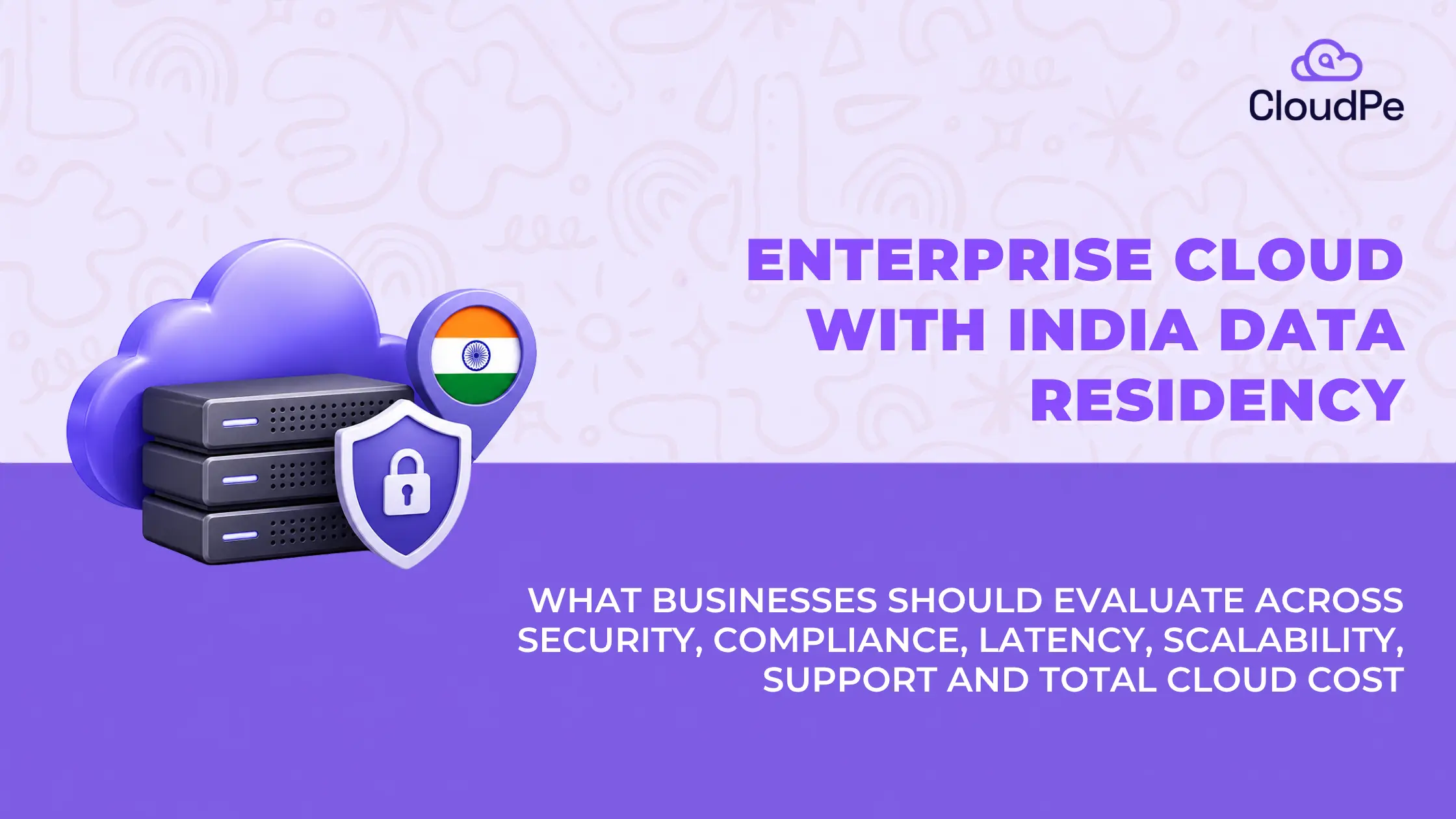
For enterprises operating in India, choosing a cloud provider is no longer only about compute capacity, storage, or price. Data residency, security, compliance, network performance, availability, migration support, and predictable cloud costs are increasingly important parts of the decision.
Cloud hosting has become a backbone for modern businesses, providing on-demand access to computing resources while allowing organisations to scale infrastructure according to their workloads.
Indian cloud providers and global hyperscalers both offer infrastructure in India. However, the right choice for an enterprise depends on more than whether a provider has an Indian data centre.
The more important question is: which cloud provider can deliver the right combination of India data residency, enterprise security, performance, support, and total cost of ownership?
This blog compares the key factors enterprises should evaluate when selecting a cloud provider for India data residency.
What is India data residency in cloud computing?
India data residency refers to the location where an organisation’s data is stored and processed. For enterprises with requirements around keeping workloads within India, choosing infrastructure hosted in Indian data centres can provide greater visibility and control over where data resides.
Data residency should not be confused with data sovereignty. Residency focuses primarily on the physical location of data, while sovereignty is broader and can involve the laws, regulations, and jurisdiction governing that data.
For enterprise workloads, evaluating residency therefore requires looking beyond the primary database or virtual machine. Backups, replicated copies, storage systems, disaster-recovery environments, and data transfers can also form part of the overall data-residency strategy.
Why India data residency matters for enterprises
Below are the pointers highlighting why India data residency matters:
Regulatory and compliance considerations
Indian organisations operate within a growing framework of data protection, cybersecurity, sector-specific regulation, and information-security requirements.
Data residency can simplify governance when workloads and associated infrastructure are hosted within India, although the exact storage or processing requirements depend on the organisation, industry, data type, and applicable regulation.
Greater control over data location
Keeping workloads within India gives enterprises clearer visibility into the physical location of their infrastructure and can make internal data-governance policies easier to implement.
Security and risk management
Enterprise cloud decisions should also consider security controls, access management, encryption, network protection, monitoring, backup architecture, and incident response—not simply the geographical location of a data centre.
Lower latency for India-based users
The performance of a cloud server can be influenced by the distance between the data centre and the end user. Shorter network paths can help improve responsiveness for applications serving users in India, particularly for real-time and latency-sensitive workloads.
Predictable data-transfer costs
Data residency and data movement are also connected to cloud economics. Enterprises moving large datasets between environments can incur significant transfer costs with providers that charge for outbound data.
This makes egress pricing an important consideration when evaluating the long-term total cost of ownership of an enterprise cloud environment.
Build your cloud enterprise with an India residency provider
Get started with CloudPeWhat should enterprises look for in a cloud provider?
India data residency is only one part of enterprise cloud selection. A provider should be evaluated across the complete infrastructure and commercial model, such as:
1. India-hosted infrastructure
The provider should clearly state where infrastructure is located and whether the required compute, storage, backup, and disaster-recovery environments can remain within India.
2. Security and certifications
Security certifications can provide evidence that defined information-security and service-management processes are in place. Enterprises should examine the scope and applicability of each certification rather than treating certification alone as a guarantee of security.
3. Availability and SLA
Mission-critical applications require predictable availability. Enterprises should review platform and service-level commitments, redundancy, failure domains, and disaster-recovery capabilities.
4. Infrastructure performance
Compute processors, storage technology, network capacity, and data-replication architecture directly influence application performance and resilience.
5. Pricing and egress
The headline VM price does not represent the complete cost of running an enterprise workload. Storage, snapshots, backups, networking, support, licensing, and egress can all affect total cloud expenditure.
6. Enterprise support
Local support can be particularly valuable for organisations operating production infrastructure in India, especially during migrations, incidents, capacity planning, and architecture changes.
7. Migration capability
For enterprises already operating workloads on VMware, another cloud provider, or on-premises infrastructure, migration support can be as important as the destination infrastructure itself.
8. Workload and GPU availability
Modern enterprises increasingly run AI, analytics, rendering, media, and high-performance workloads alongside traditional applications. GPU availability and the ability to scale these resources should therefore form part of the evaluation.
Local cloud provider with India data residency vs hyperscalers
There is no single cloud provider that is ideal for every enterprise. Global hyperscalers offer extensive service portfolios and worldwide infrastructure, while India-focused cloud providers can offer specialised local infrastructure, India-based support, and pricing models designed for the Indian market.
The comparison below looks at each provider across key enterprise considerations, including India infrastructure, workload capabilities, pricing, data residency, and suitability for different enterprise requirements.
There is no single cloud provider that is ideal for every enterprise. Global hyperscalers offer extensive service portfolios and worldwide infrastructure, while India-focused cloud providers can offer specialised local infrastructure, India-based support, and pricing models designed for the Indian market.
The comparison below looks at each provider across key enterprise considerations, including India infrastructure, workload capabilities, pricing, data residency, and suitability for different enterprise requirements.
CloudPe
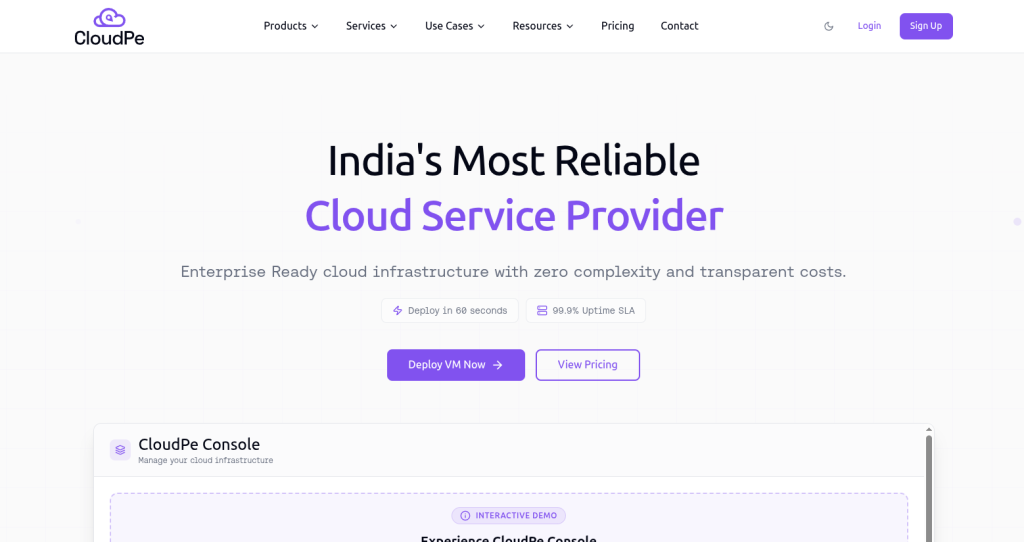
CloudPe provides a sovereign cloud environment with data hosted in India.
CloudPe operates infrastructure across Mumbai, Pune, Delhi, and Bengaluru, with Tier 3 and Tier 4 data centre infrastructure. Its infrastructure includes AMD EPYC processors, NVMe storage, 200+ Gbps internal networking, and 3× data replication.
For enterprises concerned about data movement and cloud costs, CloudPe offers 0 egress. This can make the cost model more predictable for workloads that frequently transfer large volumes of data.
CloudPe supports cloud compute, block and object storage, managed Kubernetes, networking and security, GPU infrastructure, and CloudJiffy PaaS capabilities.
CloudPe also provides GPU instances including NVIDIA L4, RTX PRO 6000, and H200 for AI, machine learning, rendering, and other GPU-intensive workloads.
AWS
Amazon Web Services provides a broad portfolio of cloud services spanning compute, storage, databases, analytics, machine learning, networking, and more.
AWS has infrastructure in India and can support organisations that require a broad range of cloud services alongside global deployment capabilities.
AWS can be particularly suitable for enterprises that already have significant workloads or integrations within the AWS ecosystem, require a large global infrastructure footprint, or depend on its extensive portfolio of managed services.
For India-resident workloads, enterprises should evaluate the specific services being used, data flows, backup locations, disaster-recovery architecture, and applicable data-transfer charges.
Microsoft Azure

Microsoft Azure provides enterprise cloud capabilities across compute, storage, databases, analytics, AI, security, and hybrid-cloud environments.
Azure can be particularly relevant for organisations already invested in Microsoft’s enterprise ecosystem, including Windows Server, Microsoft 365, Active Directory, and other Microsoft technologies.
Enterprises evaluating Azure for India data residency should assess the specific services required, where associated data is stored and processed, and how backup, disaster recovery, and data-transfer requirements are configured.
Google Cloud
Google Cloud provides cloud infrastructure across compute, storage, databases, analytics, AI, and machine learning.
Google Cloud can be a strong option for organisations with data-intensive analytics, AI/ML, and cloud-native workloads, particularly where Google’s broader data and AI ecosystem aligns with existing technology requirements.
For India-resident workloads, enterprises should evaluate the specific regions and services being used, along with data flows, backups, disaster-recovery requirements, and transfer costs.
The key difference is not simply whether a provider has infrastructure in India. Enterprises should consider the combination of data residency, service breadth, global infrastructure, pricing model, egress costs, local support, and workload requirements.
| Evaluation factor | CloudPe | AWS | Microsoft Azure | Google Cloud |
| India-hosted infrastructure | ✓ | ✓ | ✓ | ✓ |
| Enterprise compute | ✓ | ✓ | ✓ | ✓ |
| GPU infrastructure | ✓ | ✓ | ✓ | ✓ |
| Managed Kubernetes | ✓ | ✓ | ✓ | ✓ |
| Enterprise security capabilities | ✓ | ✓ | ✓ | ✓ |
| India-focused infrastructure | ✓ | Regional | Regional | Regional |
| 0 egress | ✓ | Pricing applies | Pricing applies | Pricing applies |
| Local India support | ✓ | Global/local options | Global/local options | Global/local options |
| Global infrastructure footprint | Growing | ✓ | ✓ | ✓ |
This comparison is intended as a high-level evaluation rather than a ranking. The most suitable provider depends on workload requirements, existing technology investments, geographic footprint, compliance obligations, support requirements, and total cost of ownership.
Which cloud provider is best for enterprise data residency in India?
The answer depends on what the enterprise values most.
Global hyperscalers such as AWS, Microsoft Azure, and Google Cloud can be strong choices for organisations that require very large global footprints, extensive managed services, or deep integration with an existing hyperscaler ecosystem.
An India-focused provider such as CloudPe can be particularly relevant when an organisation prioritises India-hosted infrastructure, data residency, local support, predictable pricing, 0 egress, and enterprise cloud infrastructure in India.
For enterprises evaluating providers, the strongest decision framework is to compare data residency, security, performance, availability, support, migration requirements, pricing, and egress together rather than selecting a provider based on a single feature.
Host your compute, storage, and databases locally with full regulatory compliance
Get started with CloudPeFrequently Asked Questions
What is India data residency in cloud computing?
India data residency means that data is hosted within India’s geographical boundaries. Enterprises should also evaluate where backups, replicas, disaster-recovery environments, and related data processing occur.
Does CloudPe host data in India?
Yes. CloudPe provides a sovereign cloud environment with data hosted in India. CloudPe has infrastructure locations in Mumbai, Pune, Delhi, and Bengaluru.
Does CloudPe charge egress fees?
CloudPe offers 0 egress, making it particularly relevant for workloads that regularly transfer large volumes of data.
Can enterprises migrate existing workloads to CloudPe?
Yes. CloudPe supports enterprise migration scenarios and has migrated more than 100 VMs from VMware to Virtuozzo-based infrastructure. Applicable migration projects have been completed in under eight days with zero reported business disruption.
What should enterprises consider when choosing a cloud provider for India data residency?
Enterprises should evaluate data location, security and certifications, availability, infrastructure performance, backup and disaster recovery, data-transfer costs, support, migration capabilities, scalability, and total cost of ownership alongside the provider’s India infrastructure.