Gartner has forecasted in one of their research that data storage costs can take up 14.3% of an IT budget. This makes storage choices critical for business leaders. Selecting between block storage and object storage directly influences database speed, application responsiveness, and overall cloud expenditure.
This article breaks down how both options work. It compares key performance metrics to help Indian organisations pick the right fit for their workloads.
What is block storage?
Cloud block storage splits data into small, equal pieces called blocks. Each block gets its own address code. This lets operating systems read and write data directly with very low delay.
CloudPe builds cloud block storage to act like a fast hard drive attached to a virtual server. This setup helps core databases like MySQL update single data blocks fast without rewriting whole files.
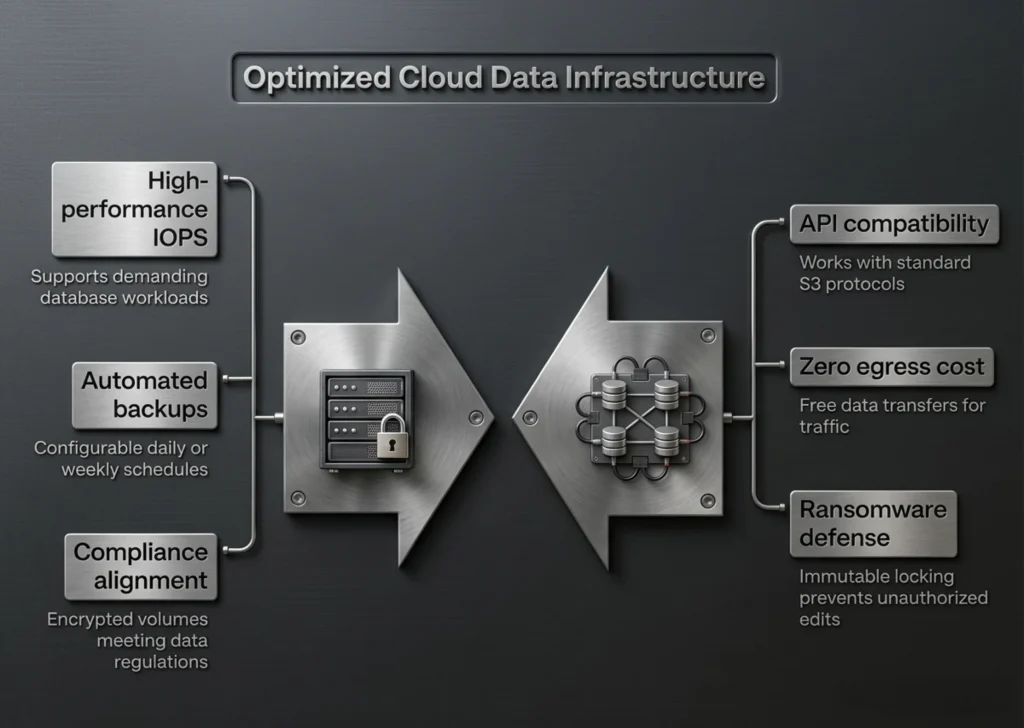
- High-performance IOPS: Delivers up to 100,000 IOPS for demanding database workloads. Perfect for PostgreSQL, MongoDB, Cassandra, and MySQL.
- Automated backups: Runs daily, weekly, or on custom schedules. Features fully configurable retention windows
- Compliance alignment: Offers encrypted volumes that meet RBI, SEBI, and DPDP data rules inside Indian data centres.
What is object storage?
Object storage stores files as single units called objects inside one flat space. Each object holds the raw file, descriptive labels, and an ID number.
CloudPe builds cloud object storage as a scalable target for unstructured files and massive data backups. This design helps applications stream media, retain log data, and reduce overall storage costs without complex directory structures.
- API compatibility: Works with standard AWS S3 REST APIs. This enables applications to store and read files directly over HTTPS.
- Zero egress cost: Delivers free data transfers for India-based traffic to keep monthly bandwidth bills predictable.
- Ransomware defense: Provides immutable bucket locking (Write Once, Ready Many) to protect backups against unauthorized edits or deletions.
Difference between block storage and object storage
Choosing between block storage vs object storage comes down to their features. Check out the table below on the difference between block storage and object storage:
| Feature | Block Storage | Object Storage |
| Data Structure | Equal fixed blocks with direct address keys | Single flat space with custom metadata |
| Performance Benchmark | Fast speed for heavy work | Variable speed built for bulk file transfers |
| Access Method | Direct access through the core operating system | Standard web links over basic HTTP protocols |
| Ideal Workload | Heavy databases, ERP systems, and server boot drives | Video archives, app logs, backups, and reports |
| Price Ratio | Higher cost per GB for guaranteed speed | Lower cost per GB for long-term file storage |
Compare both and pick what fits your workload.
Explore Storage SolutionWhich storage architecture is better for Indian enterprises?
The right pick depends on what an organisation needs to run. Heavy database tasks need high speed. Simple file archives need scale and lower costs.
When cloud storage providers design their setups, they usually run both storage types side by side to balance performance and cost.
Organisations should choose block storage when:
- They run core databases like PostgreSQL, SAP HANA, or SQL Server.
- Applications need fast, continuous updates to small parts of a file.
- Virtual servers need main boot disks and raw drive space.
Organisations should choose object storage when:
- Systems store large piles of static files like PDF bills or video recordings.
- Indian laws require keeping company records for many years.
- Developers build web apps that send files over simple web links.
Conclusion
Finding the right storage setup means balancing speed, local laws, and monthly bills. Most teams save money by running main databases on high-speed block storage while moving old records to object storage.
CloudPe provides both block and object storage from Tier IV Indian data centres. If an enterprise team wants help picking the right option, they can talk to our cloud experts at CloudPe today.
Compare both and pick what fits your workload.
Explore Storage SolutionFrequently Asked Questions
1. What is the primary difference between block storage and object storage?
Block storage cuts files into fixed chunks for fast operating system access. Object storage bundles files with descriptive tags into a flat space accessed through web links.
2. Can block storage and object storage be used together?
Yes, most teams run both at the same time. Apps use block storage for live database work and push old backups or log files into object storage to cut costs.
3. How does block storage support DPDP and RBI compliance in India?
Block storage volumes hosted in Indian data centres keep business data inside country borders. Built-in encryption helps teams meet RBI data rules and DPDP privacy laws.
4. Is block storage faster than object storage?
Yes, block storage delivers faster speeds and higher IOPS. Applications write straight to raw storage without web link lag or extra file tag processing.
5. Why is object storage cheaper than block storage for long-term backups?
Object storage uses standard drives and flat file indexing. It avoids the high cost of dedicated fast networks and pre-set speed limits that block storage needs.