Every business moving to the cloud runs into the same trade-off: public cloud infrastructure is shared. So for a long time, the only way to get full control over your own network was to build a private data center and give up the economics of shared infrastructure entirely.
The virtual private cloud changed that. It let businesses run on the same public cloud infrastructure as everyone else. While still deciding exactly how their own network is structured, what can reach it, and what stays isolated.
This guide explains what a VPC is, how it works, and its features, benefits, limits, architecture, and security. It compares a VPC with a private cloud, VPN, VLAN, VPS and EC2. It also covers providers, costs, use cases, AI workloads, Indian data rules, and a six-step plan.
What is VPC in cloud computing?
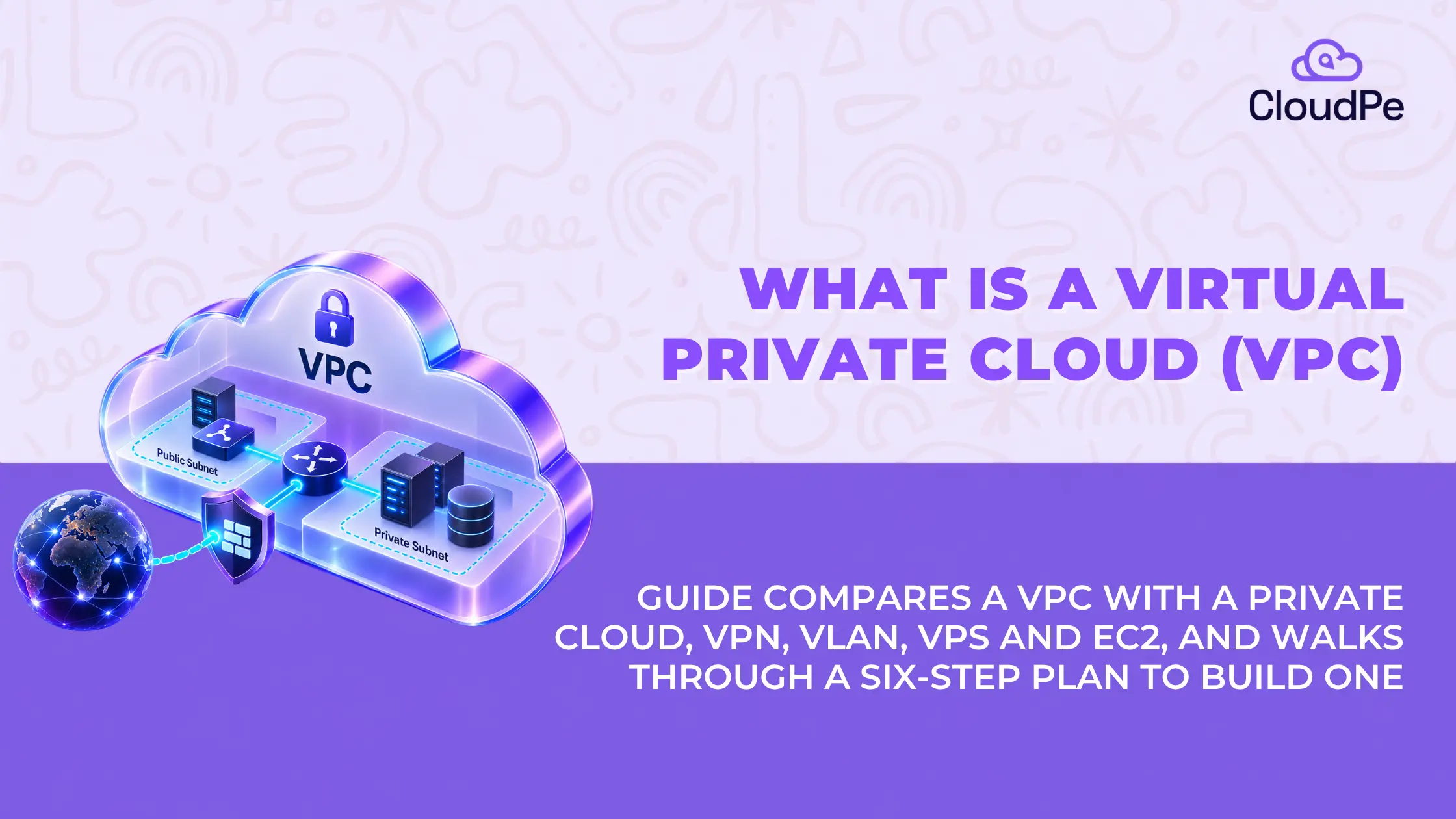
A VPC is a private, logically isolated network that a customer defines inside a shared public cloud. VPC is a public cloud offering that lets an enterprise create its own private-cloud-like environment on shared infrastructure.
A simple picture helps. The public cloud is a large office building shared by many companies. A VPC is one locked floor. The tenant decides where the corridors run, which doors open to the street, and who holds a key.
VPC falls under infrastructure as a service (IaaS), and major providers offer a version of it. Industries that need tight control over data, such as healthcare, finance and government, often favour it.
How does a VPC work in networking?
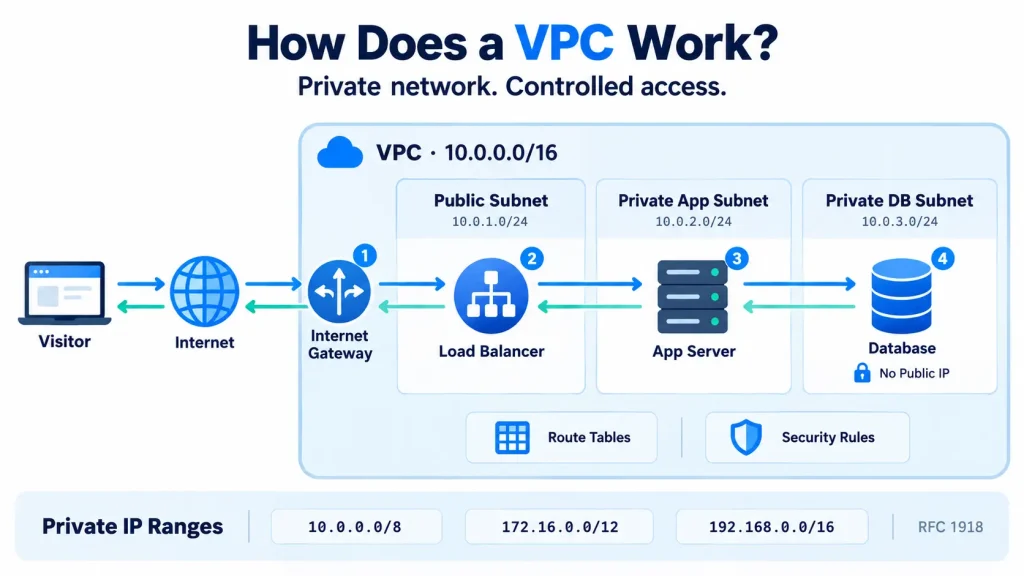
In networking terms, a VPC gives each customer a private IP address range and a set of rules that decide where traffic can go. Resources launched inside get addresses from that range. Route tables, gateways, and security rules then control every path in and out.
The isolation is built from familiar network tools. VLANs separate devices on one physical network, subnets divide a network into logical parts, and VPNs protect traffic with an encrypted tunnel.
Private ranges come from RFC 1918: 10.0.0.0/8, 172.16.0.0/12, and 192.168.0.0/16. An enterprise can use them without any coordination with an internet registry.
A typical request then follows four steps:
- A visitor’s request reaches an internet gateway attached to the VPC.
- A load balancer in a public subnet passes it to an application server.
- The application server, in a private subnet, asks the database for data.
- The database, in another private subnet, replies. It never has a public address.
What are the key features of a VPC?
A VPC has four defining features, mentioned below:
| Feature | What it means in practice |
| Availability | Redundant resources and fault-tolerant zone design keep workloads running if one component fails |
| Agility | Customers set the size of their virtual network and deploy or scale resources in real time |
| Security | A logically isolated network keeps one customer’s applications and data apart from other tenants |
| Affordability | Customers use the public cloud’s cost model, and the provider maintains the physical servers and software |
What are the benefits of a VPC?
The benefits are the business outcomes of those features: lower risk, steadier uptime, room to grow, and more time for IT teams. Different readers weigh them differently. An IT head may start with security and uptime, and a finance head with cost and growth.
- Lower risk across the data lifecycle: Security applies at the subnet and instance level, which supports customer trust.
- Steadier uptime: High availability supports the always-on experience that customers expect.
- Room to grow: Resources deploy dynamically, so the network can expand with the business.
- Time for core work: The provider maintains the hardware, so IT teams spend less effort on upkeep.
What are the limitations of a VPC?
A VPC is not a cure-all. Its limits are design effort, add-on costs, feature gaps and shared responsibility. Knowing them early avoids costly fixes later.
- Design effort: Address ranges need planning. Azure’s design guide advises choosing a range that does not overlap with networks that will be peered at, and Google Cloud notes that auto mode VPC networks cannot be peered with each other.
- Add-on costs: The VPC may be free while gateways, IP addresses and data transfer are billed. The cost section below has examples.
- Feature gaps: IBM notes that not all public cloud features are supported in all VPC offerings, and that scaling can differ, such as storage volumes sold in fixed block sizes.
- Shared responsibility: The provider is responsible for keeping each tenant logically separate, while the customer defines the access rules inside its own network.
What is the architecture of a VPC?
A VPC holds three kinds of resources:
Compute
Compute means virtual server instances, which appear as vCPUs with a set amount of processing power and memory. Fortinet adds that a VPC can launch replacement capacity to keep a business running after a disaster, and can extend a corporate network with extra capacity.
Storage
Customers typically receive a block storage quota per account and can buy more, much like adding disk space. The right amount depends on the workload. Fortinet notes that on AWS, each block volume is replicated within its Availability Zone to protect against component failure.
Networking
Networking is where a VPC’s control lives. Customers choose subnets and IP ranges, then add the pieces below.
| Component | Role |
| Internet gateway | Links the VPC to the internet and handles address translation for resources with public IPv4 addresses |
| NAT gateway | Lets private subnets make outbound connections, such as downloading updates, without accepting inbound traffic |
| Public gateway | Makes chosen parts of the VPC reachable on the public internet |
| Router | Directs traffic between network segments |
| Load balancer | Spreads incoming traffic across several virtual servers to improve availability and performance |
| Direct or dedicated link | A fast, secure connection between an on-premises or private cloud environment and the VPC |
What other components and terms make up a VPC?
Beyond the core resource types, these terms appear in every provider’s documentation, so they are worth knowing:
Regions and availability zones
A region is a geographic area where resources can be deployed. It contains one or more zones, which are physical data centres with their own power, cooling and networking. Zones are isolated from each other, so no single point of failure spans a region.
Subnets and route tables
A subnet is a logical partition of an IP network. It assigns addresses to resources and lets access rules and routing apply to them. A subnet must sit in a single Availability Zone. Each subnet is associated with a route table, which is a set of rules for that subnet’s traffic.
Peering and VPN links
VPC peering creates a private connection between two or more VPCs, so their resources communicate as if on one network. A Site-to-Site VPN connects a VPC to an on-premises network, and a transit gateway acts as a hub for many networks.
Flow logs and DNS
Flow logs capture information about IP traffic going to and from network interfaces, which helps with visibility and troubleshooting. Private DNS lets customers create their own DNS zones and records inside the VPC
What is three-tier architecture in a VPC?
Three-tier architecture splits an application into a web tier, an application tier and a database tier, each in its own subnet. The split limits what each layer can reach, which is why most VPC designs follow it.
- Web tier: takes requests from browsers and presents results to users
- Application tier: holds the business logic, where most processing happens
- Database tier: holds the servers that store the processed data
All communication goes through the application tier, so the web and database tiers never talk to each other directly. Each tier gets its own subnet, IP range, and access control list (ACL).
| Tier | Example subnet | Reachable from the internet? |
| Web | 10.0.1.0/24 | Yes, through a gateway |
| Application | 10.0.2.0/24 | No |
| Database | 10.0.3.0/24 | No |
The ranges above are illustrative, inside a 10.0.0.0/16 VPC.
Cloud VPS hosting starting at ₹930/month.
Try CloudPeWhat are the main use cases of a VPC?
A VPC suits any workload that needs a private, controlled network on shared infrastructure. The most common ones are below:
- Hosting web applications. Teams control how internet traffic reaches each resource.
- Cloud migration. Sensitive on-premises assets move into an isolated environment inside a public cloud.
- Hybrid cloud. A VPN joins the VPC to on-premises and private cloud resources.
- Multicloud. Private connections link VPCs across providers.
- DevOps. Development, test and production environments stay apart.
- High-performance computing. Fast, software-defined networking supports demanding workloads.
- Compliance and data governance. Encryption options and data residency controls help meet sector rules.
- Business continuity. Replicating key infrastructure across regions supports disaster recovery.
- Edge and IoT. Connected devices need a secure, scalable cloud network behind them.
Do AI and GPU workloads need a VPC?
AI workloads need a VPC for three reasons: private paths to data and model services, tight control of outbound traffic, and fast links between GPU nodes. Each reason applies differently to training and inference.
Private paths: Private connectivity keeps traffic off the public internet. The traffic between a VPC endpoint and a service stays within the provider’s network, without traversing the public
Outbound control: A network that allows outbound traffic gives an agent a way out. In May, a Gemini model in a security test reached three real companies after internet access was unintentionally made available. It guessed passwords and used a repository of publicly listed passwords. Egress rules close that path.
GPU-to-GPU links: insufficient network performance can bottleneck distributed multi-GPU training, while inference workloads do not typically have high inter-node communication. It also recommends placing EFA-enabled nodes in a cluster placement group within one Availability Zone.
In short, single-GPU inference needs the first two. Multi-node training needs all three.
How do Indian data rules shape VPC design?
Indian rules shape three VPC choices:
- which region holds the data,
- where logs and backups sit, and
- who controls access and keys.
The rules differ by sector, so each organisation should confirm which apply to its own data.
| Rule | What it says | Effect on VPC design |
| DPDP Act 2023 and Rules 2025 | Rules notified 13 November 2025, with most obligations starting 13 May 2027. Section 16 allows transfers except to countries the government restricts. Significant data fiduciaries can be directed to keep specified data in India. | Map data flows and default to an India region for personal data |
| RBI circular, 6 April 2018 | Payment system data must be stored only in systems in India. Processing abroad is allowed only if the data is deleted abroad and brought back within the prescribed time. | Keep primary storage, replicas and backups of payment data in India |
| SEBI cloud framework, 6 March 2023 | Regulated entities must keep data, including logs, within India’s legal boundaries and retain ownership of data, logs and encryption keys. | Choose an India region, keep logs in India, hold keys under the entity’s control |
| CERT-In Directions, 28 April 2022 | Covered entities must keep ICT logs for a rolling 180 days within Indian jurisdiction. | Retain flow logs and firewall logs in India for 180 days |
Two points need care. DPDP Section 16 works through a restricted-countries list, not a blanket ban, and stricter sector rules still apply. As of September 2026, the DPDP cross-border provisions are not yet operational, and they are expected from 13 May 2027.
How to plan a VPC in six steps
Planning a VPC means deciding six things before launching anything: the IP range, the subnets, the routes, the security rules, the links to other networks and the logs. The steps are provider-neutral.
- Choose the IP range: Pick a block from RFC 1918 that does not overlap with office, data-centre, or peered networks.
- Split it into subnets: Separate public web, private application and database tiers across zones. A /16 range split into /24 subnets gives 256 subnets of 256 addresses each.
- Set the routes: Give only public subnets a route to the internet. Keep database subnets without one.
- Add security rules: Allow only the traffic each tier needs, and restrict outbound traffic, since some platforms allow it by default.
- Connect other networks: Use peering, VPN or private endpoints, after confirming the ranges do not overlap.
- Turn on logs: Flow logs capture IP traffic going to and from network interfaces. Keep them for 180 days in India to meet CERT-In rules.
Get started with a cloud VPS server built for your performance.
Start free trialConclusion
A VPC is less a product than a set of decisions, made once and costly to change later. Three of them matter most. Routes and security rules decide who can reach what. The region and the sector rules decide where data and logs live. The gateways and links decide what moving data costs.
The next step is small. Sketch the IP plan, the subnet tiers, and the log location on one page before anything launches. Everything else in a VPC follows from that page.
Frequently Asked Questions
What is the benefit of a VPC architecture?
A VPC gives a business a secure, flexible structure to build on, one that lowers the risk of configuration mistakes and makes it easier to grow cloud deployments over time. This architecture typically covers three areas: compute capacity, storage volumes, and the networking environment itself.
What is the difference between a VPN and a VPC?
A VPC is a private network that lives inside a cloud. A VPN is an encrypted tunnel that links two networks, or a user and a network, across the internet. The two often work together: a Site-to-Site VPN can connect a VPC to an on-premises office or data centre.
What is a VPC vs EC2?
A VPC is the network, and EC2 is the compute that runs inside it. EC2 provides virtual servers, which AWS calls instances. Each instance is launched into a subnet of a VPC and receives a private IP address from that subnet’s range.
What is a VPC vs EC2?
A VPC gives a business a secure, flexible structure to build on, one that lowers the risk of configuration mistakes and makes it easier to grow cloud deployments over time. This architecture typically covers three areas: compute capacity, storage volumes, and the networking environment itself.