Amazon Web Services (AWS) is no doubt one of the top cloud computing providers in the world and has been serving businesses for years. But for businesses in India, the calculation is changing. Rising AWS costs, complex billing, and limited local support are pushing companies toward alternatives that offer rupee-based pricing, GST-compliant invoicing, and data centers inside India.
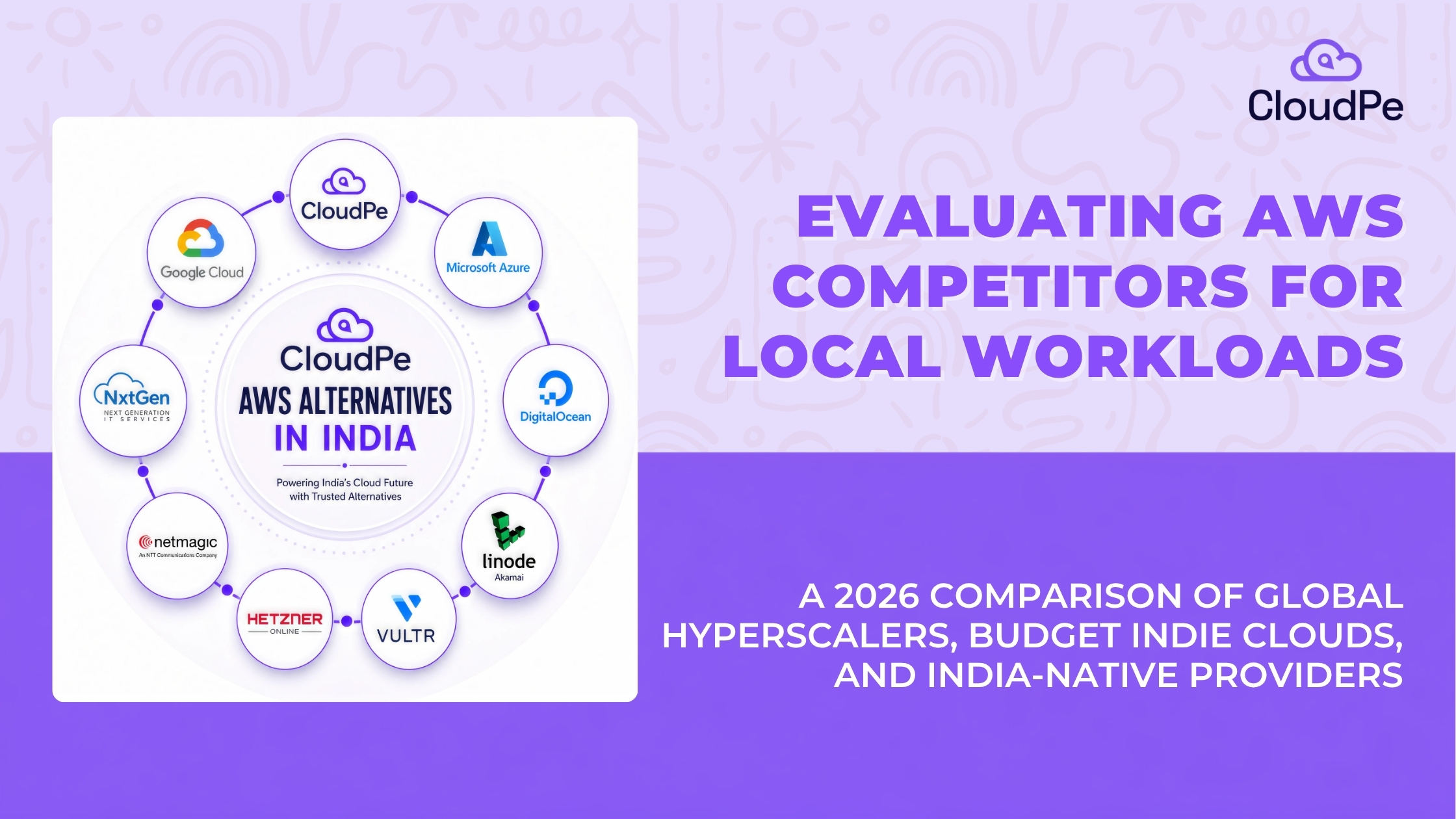
This guide compares 10 real AWS alternatives available to Indian businesses in 2026 — global hyperscalers, budget-focused indie clouds, and India-first providers, so you can pick the right one for your workload, budget, and compliance needs.
Quick Answer: Which AWS Alternative Should You Choose?
- Cheapest overall for Indian businesses: CloudPe — rupee pricing, GST invoicing, up to 30% savings vs. hyperscalers
- Best if you’re already on Microsoft tools: Microsoft Azure
- Best for AI/ML and data-heavy workloads: Google Cloud Platform (GCP)
- Best for developer-friendly simplicity: DigitalOcean
- Best raw compute-per-rupee (self-managed): Hetzner
- Best global reach with India presence: Vultr (Mumbai region) and CloudPe (Mumbai, Pune, Delhi, Bangalore, US, Europe)
- Best for enterprise compliance and hybrid cloud: IBM Cloud or Oracle Cloud
- Best predictable, no-surprise billing: Linode (Akamai Cloud) and CloudPe
- Best for very large-scale, China/APAC-linked operations: Alibaba Cloud
The Growing Indian Cloud Market
The cloud computing market in India is growing rapidly due to aggressive digital transformation, rising data consumption, and broad internet adoption.
AWS, Microsoft Azure, and Google Cloud built the foundation of this market. But it’s diversifying fast. As businesses mature their cloud strategy, they rely less on a single provider and more on multi-cloud and hybrid setups. This gives their spreading workloads to control cost, avoid lock-in, and meet local compliance requirements.
When evaluating an AWS alternative, Indian businesses are typically looking for:
- Rupee-denominated, GST-compliant pricing — no surprise conversions or foreign transaction charges
- Data residency in India — for RBI, SEBI, or other regulatory compliance
- Local support hours — not a ticket queue in a different time zone
- Predictable billing — without the line-item sprawl of hyperscaler invoices
AWS Global Alternatives: Azure and GCP
The two strongest global competitors to AWS are Microsoft Azure and Google Cloud Platform (GCP). Both offer enterprise-grade services with a fast-growing presence in India, including multiple in-country data centers (Mumbai, Pune, Hyderabad, Delhi NCR, depending on provider).
1. Microsoft Azure
If your organization is already invested in the Microsoft ecosystem, Azure is the natural choice. It integrates seamlessly with Windows Server, Office 365, and Active Directory, which simplifies migration and day-to-day management.
Azure’s hybrid cloud tools are a particular strength — extending on-premises environments to the cloud is faster here than with most competitors. The platform spans everything from basic IaaS to advanced analytics, AI, and IoT services.
- Pros: Deep Microsoft product integration, strong hybrid cloud support, robust security and compliance features suited to regulated industries like finance and government.
- Cons: Steep learning curve, complex pricing that can produce unexpected costs, and notable vendor lock-in for Microsoft-centric organizations.
2. Google Cloud Platform (GCP)
GCP has a significant and growing footprint in the Indian cloud market, driven largely by its strength in data analytics, AI, and machine learning. It runs on the same infrastructure that powers Google Search and YouTube, and is especially popular with startups and developers building data-intensive products.
GCP’s managed Kubernetes Engine (GKE) is widely regarded as one of the best managed Kubernetes offerings available, and its pay-as-you-go pricing with sustained-use discounts appeals to cost-conscious teams.
- Pros: Best-in-class integration for big data, AI, and ML workloads; low-latency global network.
- Cons: Steeper learning curve for basic IaaS than AWS; smaller market share means a smaller pool of third-party integrations and community resources.
Budget & Developer-Focused Alternatives
These providers are a better alternative to AWS in terms of simpler pricing, faster deployment, and often significantly lower cost for standard compute workloads.
3. CloudPe
CloudPe is built specifically for the Indian market, with a simple philosophy: “Cloud without Complexity.”
Why CloudPe
1. Transparent, GST-Compliant, Rupee Pricing
Cost is the top concern for Indian customers, and CloudPe addresses it directly with transparent pay-as-you-go pricing — billed in rupees, with GST-compliant invoicing built in, available monthly or hourly.
With CloudPe businesses can save up to 60% compared to hyperscalers.
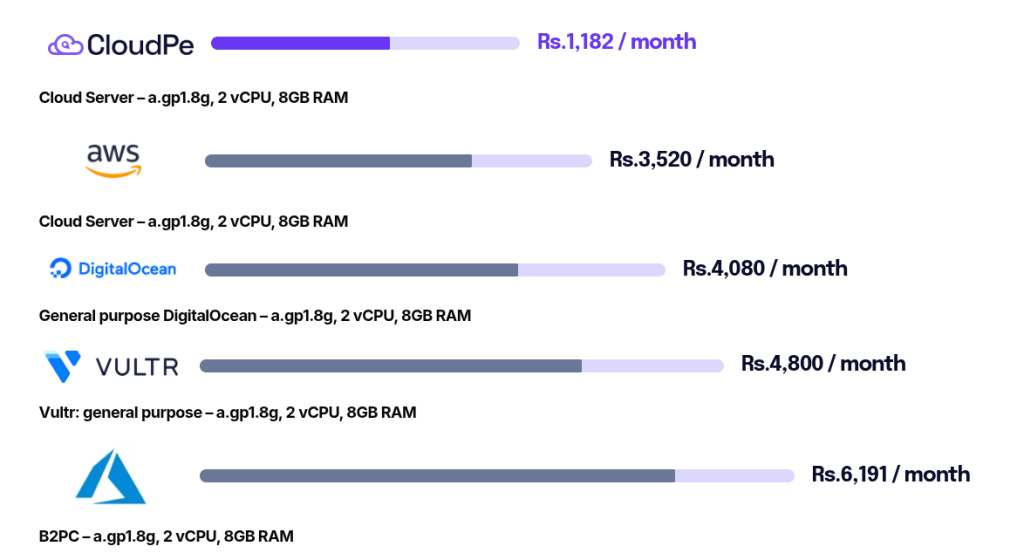
Pricing Comparison — General Purpose (2 vCPUs, 8 GB RAM)
| Provider | Equivalent Plan | Approximate Monthly Price |
| CloudPe | a.gp1.8g | ₹1,182.00 ($14.20) |
| AWS | t4g.medium | ₹3,520.00 ($39.90) |
| Azure | B2ms | ₹6,191.00 ($70.18) |
**Note:* *Prices are estimated based on public pricing calculators for the India region (Mumbai/Central India). They do not include additional costs like data transfer, storage, or managed services.
2. Ease of Use and Instant Deployment
CloudPe makes cloud management easier. It has pre-configured templates that let businesses deploy services rapidly, helping teams without a dedicated IT function who need things running quickly.
3. 24/7 Local Support
CloudPe offers round-the-clock local support. Customer support is a common frustration most Indian businesses report with global providers: slow, time-zone-mismatched ticket queues. CloudPe team’s first response time is within 15 minutes and average resolution time is 2 hours.
4. Data Residency and Compliance
CloudPe’s infrastructure is hosted in Indian data centers. This is the most important factor for businesses subject to RBI, SEBI, or other data-localization requirements.
5. Full Range of Services
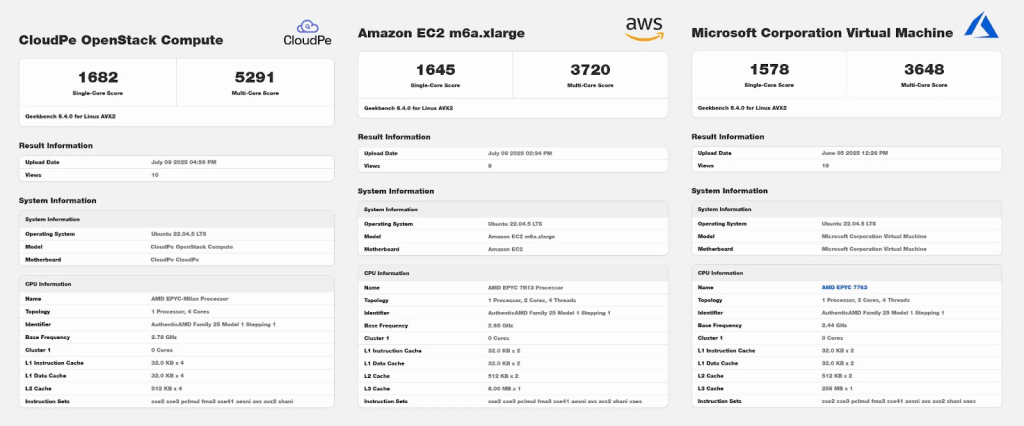
CloudPe offers well-rounded services including high-performance Virtual Machines and fully managed Kubernetes clusters supporting modern application architectures, plus S3-compatible scalable storage, load balancers, and firewalls for traffic management and security.
4. DigitalOcean
DigitalOcean remains a favorite among developers and startups for its simple, predictable pricing and clean UI — especially its “Droplets” (virtual private servers). It’s less complex than the hyperscalers, trading enterprise breadth for a fast, frustration-free developer experience.
- Pros: Very developer-friendly interface, predictable pricing, large and active community with extensive documentation.
- Cons: Lacks the depth of advanced enterprise services found on AWS, Azure, or GCP; not ideal for large, compliance-heavy enterprise workloads.
5. Hetzner
Hetzner is the price-per-computer leader for teams comfortable managing more of their own stack. Its cloud servers (from roughly €4.50–8.50/month depending on spec) consistently undercut US-headquartered providers by 3–5x for equivalent compute, running on strong AMD EPYC and ARM-based hardware.
The trade-off is self-management: Hetzner is infrastructure-first, with fewer managed services and a data center footprint centered on Germany, Finland, the US, and Singapore — no dedicated India region, so latency to Indian users is a real consideration for latency-sensitive apps.
- Pros: Best raw price-per-compute in this list; strong hardware performance for the price.
- Cons: No India data center; more DevOps overhead since you self-manage most of the stack; fewer managed services than DigitalOcean or CloudPe.
6. Vultr
Vultr offers the broadest global footprint of any indie cloud here — 32 data center regions, including Mumbai — plus High Frequency compute instances (3GHz+) that edge out competitors on single-thread performance, and on-demand GPU access for AI/ML workloads.
Support is largely ticket-based rather than white-glove, so it suits technically self-sufficient teams more than businesses wanting hands-on help.
- Pros: Large global footprint with an India (Mumbai) region; strong performance-per-dollar; GPU instances available on demand.
- Cons: Primarily self-service support; billing can include add-on charges (backups, snapshots, bandwidth overages) that inflate the sticker price.
7. Linode (Akamai Cloud)
Linode, now part of Akamai, is built around one core promise: pricing you can predict. No hidden egress charges, no per-API-call fees — its billing transparency is consistently rated its strongest asset. Since the Akamai acquisition, it’s also gained access to Akamai’s global edge network.
- Pros: Most predictable, surprise-free billing in this list; fast support response times; clean admin UI.
- Cons: Roughly 10% pricier than Hetzner for equivalent specs; smaller service catalog than the hyperscalers.
Enterprise & Compliance-Focused Alternatives
8. IBM Cloud
IBM brings decades of enterprise IT experience, with hybrid and multi-cloud solutions built for regulated industries. Its foundation on Red Hat OpenShift and enterprise security tooling from the Watson suite make it a strong fit for compliance-heavy, analytics-driven organizations.
- Pros: Deep hybrid/multi-cloud tooling, strong enterprise-grade security and compliance, solid analytics capabilities.
- Cons: Costly and complex relative to other providers; smaller market presence and a steeper learning curve.
9. Oracle Cloud Infrastructure (OCI)
Oracle Cloud has a genuine India presence, including a Hyderabad region, and is one of the few providers whose Always Free tier is generous enough to matter for real prototyping — Arm-based Ampere A1 compute with several GB of memory, no time limit. Beyond the free tier, OCI is built for enterprises running Oracle databases, SAP, or other large regulated workloads, with consistent pricing across all its public cloud regions.
- Pros: India data center (Hyderabad); strong free tier; excellent fit for Oracle-based or SAP workloads; consistent global pricing.
- Cons: Smaller ecosystem and community than AWS/Azure/GCP; best suited to specific enterprise workloads rather than general-purpose hosting.
10. Alibaba Cloud
Alibaba Cloud is a strong option for businesses with operations spanning China and the broader APAC region, offering hyperscaler-grade infrastructure and a wide service catalog. For India-only workloads it’s a less common choice, but it’s worth considering for companies with cross-border APAC/China requirements.
- Pros: Strong APAC and China connectivity; broad service catalog comparable to other hyperscalers.
- Cons: Limited India-specific presence and support compared to other options on this list; less common choice for India-only deployments.
Conclusion
Finding the right alternative to AWS for your India-based business takes some evaluation — factor in your workload, budget, compliance needs, and long-term plans. The era of relying on a single cloud provider is ending.
The future of cloud computing is multi-cloud. Businesses increasingly combine providers, using each one’s strengths to build a more optimized, resilient IT setup.
For most Indian businesses today, the real decision comes down to balancing cost, performance, and simplicity. Global players like Azure and GCP offer vast ecosystems and reach. Focused, India-first providers like CloudPe — and budget-friendly indie clouds like DigitalOcean, Hetzner, and Vultr — offer specialized, cost-effective alternatives built around what Indian teams actually need.