If you’re evaluating sovereign cloud providers in India for an AI workload, you’ve probably noticed the field looks crowded. It is actually not if you check who qualifies. Global GPU clouds show up in every comparison list, but most don’t have an India data center at all, and the ones that do aren’t necessarily sovereign in the full legal sense.
In this I have covered both: what sovereign cloud actually means, and a fact-checked comparison of who genuinely offers it in India today, global names included, verdict and all.
What is a sovereign cloud
A sovereign cloud keeps data, operations, and legal accountability inside one country’s jurisdiction. A standard public cloud can put your data on infrastructure a foreign government can legally demand access to. A sovereign cloud is built so that can’t happen.
That protection comes from four separate things. A provider needs all four to genuinely qualify, not just one:
| Dimension | What it means |
| Data sovereignty | Data and metadata stay physically and legally inside the country |
| Operational sovereignty | System admin and support are handled by vetted local personnel |
| Technical sovereignty | You keep control of your software and infrastructure, no foreign vendor lock-in |
| Legal sovereignty | The provider’s ownership sits outside foreign legal reach, including laws like the US CLOUD Act |
A data center physically located in India doesn’t automatically mean the provider is immune from foreign legal reach. If the parent company is headquartered elsewhere, that jurisdiction’s laws can still apply. Keep this in mind through the comparison below: it’s the difference between “has a data center in India” and “is actually sovereign in India.”
Why sovereign AI cloud matters for India
Before we get into the whole comparison of top cloud providers, is sovereign cloud even necessary? It is in various aspects.
Here are a few pointers:
1. DPDP Act: where enforcement actually stands
| Phase | Effective date | What it covers |
| Notified | November 2025 | DPDP Rules published, some provisions active |
| Phase 2 | November 2026 | Consent manager framework takes effect |
| Phase 3 | May 2027 | Full substantive compliance required |
As of today, most businesses are in the preparation window, not yet under full enforcement. But the direction is clear: data localization is becoming a real compliance requirement, not a nice-to-have.
2. The IndiaAI Mission (₹10,000 Cr)
A government initiative built around:
- Building AI compute infrastructure inside India
- Making GPU access more affordable for domestic startups
- Growing homegrown AI datasets and models
This directly benefits India-based providers, since the mission favors data centers physically located in the country over foreign infrastructure.
3. Strategic independence
Relying entirely on foreign cloud providers for AI compute creates a dependency risk beyond compliance. Sovereign providers let Indian organizations:
- Build AI capability without depending on infrastructure decisions made abroad
- Keep sensitive data assets under domestic control
- Reduce exposure to geopolitical disruptions affecting foreign-hosted infrastructure
Who actually needs this
Sovereign AI cloud isn’t a requirement for every workload. It matters most for:
- BFSI: banking and financial data typically falls under RBI localization expectations
- Healthcare: patient records and genomic data carry strict residency requirements
- Defense and government: national security workloads generally need full legal and operational sovereignty, not just data residency
- Any regulated sector where a foreign subpoena reaching your data is a real business risk, not a theoretical one
Do global GPU clouds actually offer sovereign options in India
Here’s the honest state of play as of today:
- CoreWeave operates 49+ data centers worldwide, mostly in North America and Europe. Its first Asia-Pacific move is Indonesia, three facilities due online in 2028.
- Lambda runs research-grade GPU clusters out of US colocation facilities, bills in USD only, no announced India expansion.
- Hyperstack (NexGen Cloud) operates only in Canada, Norway, and the US.
- Nscale is UK-headquartered with data centers across the UK, Europe, and the US. It gained roughly 200 India-based employees through its 2026 Anyscale acquisition, but that’s a software team, not infrastructure.
Compare that to CloudPe:
- Fully India-incorporated
- INR billing with no hidden conversion cost, and
- Built specifically for AI and GPU workloads from the start rather than retrofitted for India after launching elsewhere.
Have real India data centers, but aren’t India legal entities:
- Vultr runs three India data centers (Mumbai, Bangalore, Delhi NCR) via an Airtel infrastructure partnership. Real data residency, but Vultr is US-headquartered and bills exclusively in USD.
- DigitalOcean has one India region, in Bangalore. Same pattern: real local infrastructure, US-headquartered parent, USD-only billing.
- OVHcloud has run a Mumbai data center since 2023, built for Indian compliance needs. OVHcloud is France-headquartered, so it’s a serious data residency option, but still sits under EU legal frameworks.
- Gcore also runs a Mumbai data center. Gcore is Luxembourg-headquartered, the same pattern applies.
The pattern: several global names solve data residency (Vultr, DigitalOcean, OVHcloud, Gcore). None are India-headquartered legal entities, so full legal and operational sovereignty still points toward India-native providers.
Sovereign AI cloud providers actually built for India
India-headquartered, India-regulated, built specifically around Indian data sovereignty.
1. ESDS Software Solution
ESDS operates out of Nashik, compliance-first and government-centric.
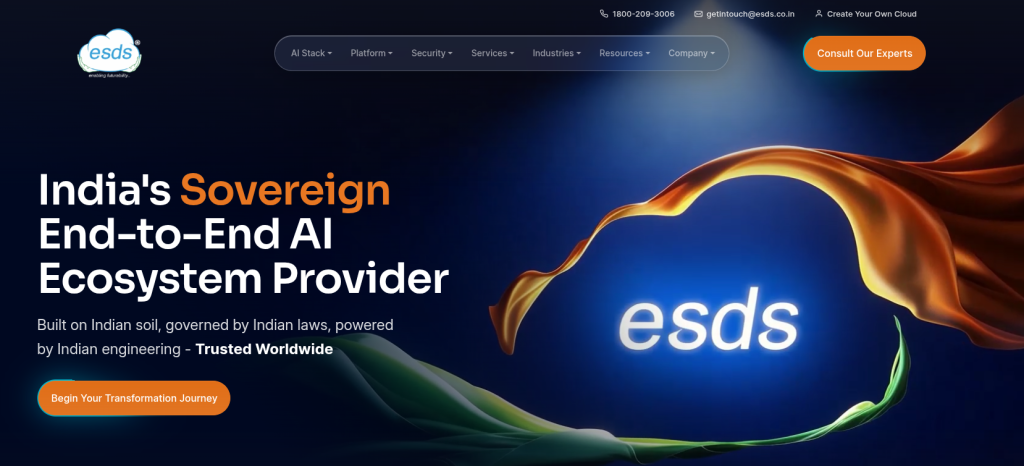
- Some of the highest compliance certifications in the Indian cloud market
- Common choice where audit trails matter as much as raw performance
- Energy-efficient infrastructure positioning
2. CloudPe
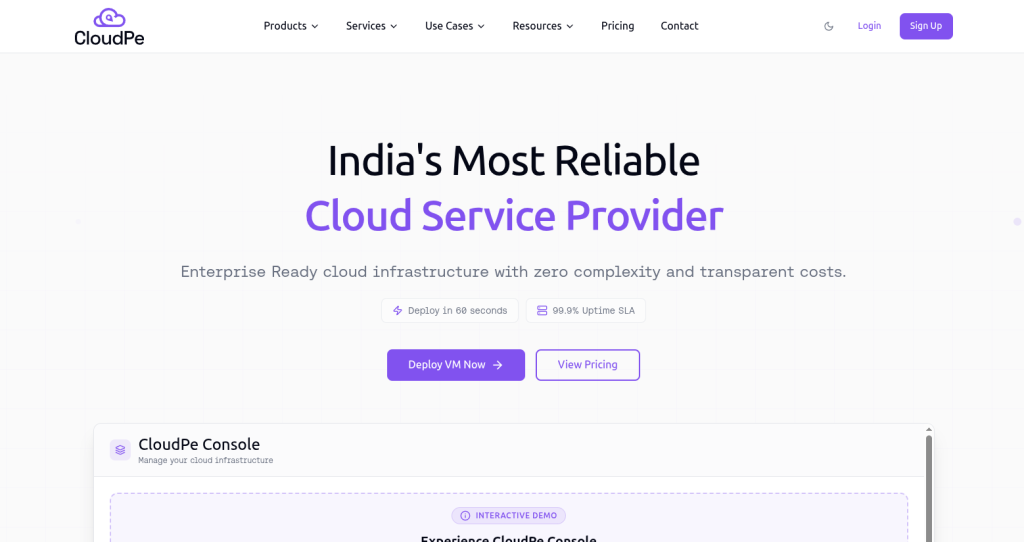
CloudPe is a developer-friendly, India-based AI cloud platform for startups and growth-stage companies.
- On-demand GPU compute with INR billing, no hidden conversion costs
- Workload optimization tuned for AI, ML, and HPC
- Fast provisioning, minimal procurement overhead versus enterprise-first providers
3. E2E Networks
E2E Network’s infrastructure is entirely inside India, nodes across Delhi NCR, Mumbai, and Bengaluru.
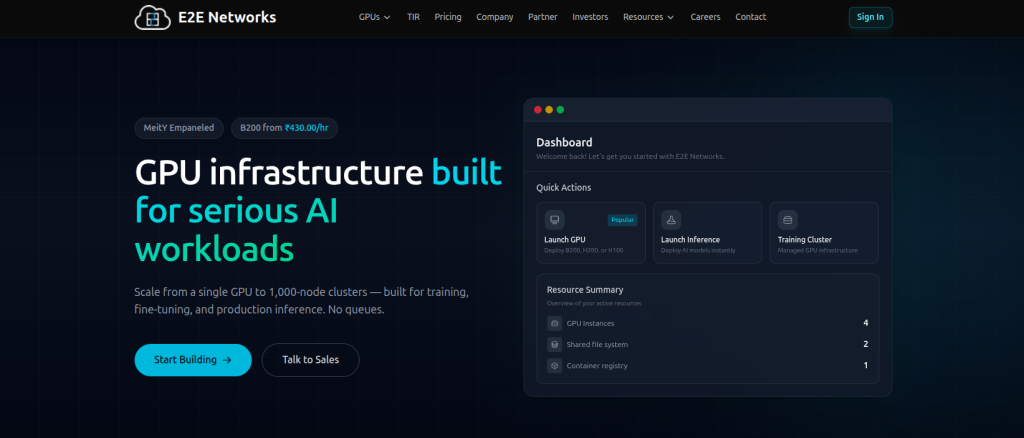
Based in India, E2E Networks is a leading GPU cloud provider and one of the best due to its scalable infrastructure specifically designed for AI workloads.
- Longstanding GPU cloud provider, years of production usage
- Large clusters purpose-built for AI/ML instance types
- INR billing throughout
4. L&T Cloud
Built by Larsen & Toubro, focused on enterprise-grade sovereign infrastructure.
- Deep existing relationships across government and large enterprise accounts
- Heavier compliance and governance layer from day one
- Best fit for organizations, not fast-moving startups
5. Yotta Infrastructure
Yotta is a tier IV-plus data center campus in Navi Mumbai, one of India’s largest hyperscale facilities.
- Built for large GPU clusters at serious scale
- Serves enterprise and government customers
- High end of the market on both infrastructure size and pricing
6. NeevCloud
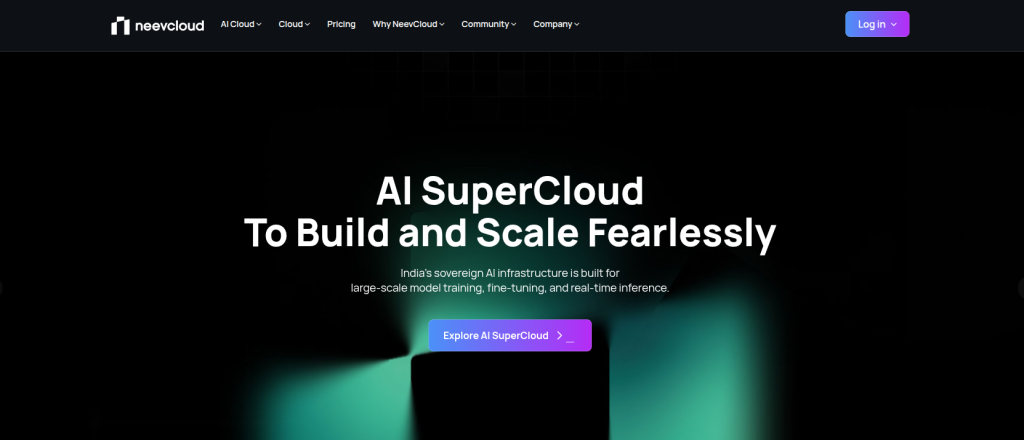
NeevCloud is part of the RackBank group, branded as India’s sovereign AI supercloud.
- AI-native infrastructure, not general-purpose cloud retrofitted for AI
- Terrestrial data centers in Indore and Raipur, GPU provisioning in minutes
- Actively building sovereign multi-cloud architecture
7. Tata Communications Vayu Cloud

Vayu Cloud, formerly IZO Cloud, built around MeitY, RBI, SEBI, and IRDAI compliance.
- Runs on NVIDIA H100, H200, and L40S GPUs
- India-only branded services; no data, metering, or telemetry leaves the country
- Backed by Tata Communications’ telecom-scale infrastructure
Comparison Table
| Provider | India legal entity | GPU availability | Billing | DPDP-ready | SLA |
|---|---|---|---|---|---|
| ESDS | Yes | Medium | INR | Yes | 99.9% |
| CloudPe | Yes | High | INR | Yes | 99.9%+ |
| E2E Networks | Yes | High | INR | Yes | 99.9% |
| L&T Cloud | Yes | Medium | INR | Yes | 99.95% |
| Yotta | Yes | Very high | INR | Yes | 99.95% |
| NeevCloud | Yes | High | INR | Yes | 99.9% |
| Tata Communications Vayu Cloud | Yes | High | INR | Yes | 99.9%+ |
| Vultr | No (data residency only) | Medium | USD | Partial | 99.9% |
| DigitalOcean | No (data residency only) | Medium | USD | Partial | 99.95% |
| OVHcloud | No (data residency only) | Medium | USD/EUR | Partial | 99.9% |
| Gcore | No (data residency only) | Medium | USD | Partial | 99.9% |
“Partial” DPDP-ready reflects that foreign-headquartered providers can host data in India but don’t operate as India legal entities, which affects the operational and legal sovereignty dimensions above.
👉 CloudPe vs top cloud providers in India
What to actually look for in a provider
| Check | Why it matters |
| Data residency and compliance | DPDP alignment, plus RBI/SEBI/IRDAI if sector-relevant. Residency alone isn’t full compliance. |
| GPU compute availability | Confirm actual models (H100, H200, L40S), not a generic “GPU compute” claim. |
| Pricing transparency | INR billing avoids currency risk. Watch for hidden egress fees at real data volumes. |
| SLA and reliability | 99.9%+ is the baseline for production AI workloads. |
| Legal and operational sovereignty | Ask directly: India-incorporated entity, or foreign company’s India data center? |
Choosing between the two categories
| If your situation is… | Consider… |
| No regulatory requirement forcing India-only data handling, already using a global provider elsewhere | Vultr, DigitalOcean, OVHcloud, or Gcore. Trade-off: USD billing, no full legal sovereignty guarantee. |
| Regulated sector, government contracts, or want foreign jurisdiction risk removed entirely | An India-native provider. Only this category closes the full sovereignty gap. |
| AI-first, fast-provisioning startup workload | CloudPe or NeevCloud |
| Large enterprise or government-scale deployment | Yotta or L&T Cloud |
| Deep compliance certification is the primary requirement | Tata Communications Vayu Cloud or ESDS |
Future of sovereign AI in India
Demand for India-native infrastructure is accelerating alongside DPDP enforcement and the IndiaAI Mission’s funding push. Expect two trends to continue:
- More India-native providers building AI-specific infrastructure, following NeevCloud’s move into terrestrial and even orbital edge compute
- More global GPU clouds adding India data centers to capture demand, without necessarily becoming India-legal entities
That gap between “has a data center here” and “is sovereign here” isn’t closing on its own. Worth checking every time, not just taking a provider’s sovereignty claim at face value. As DPDP enforcement tightens through 2027, expect the bar for what counts as genuinely “sovereign” to get stricter, not looser.
Frequently Asked Questions
What is a sovereign cloud?
A sovereign cloud keeps data, operations, and legal accountability inside one country’s jurisdiction, across four dimensions: data, operational, technical, and legal sovereignty. A provider needs all four to fully qualify.
How is sovereign AI different from regular cloud AI?
Regular cloud AI can run on infrastructure anywhere in the world, often subject to foreign laws. Sovereign AI specifically keeps data, model training, and operations within one country’s legal jurisdiction.
Does CoreWeave offer sovereign cloud in India?
No. CoreWeave has no India data centers. Its first Asia-Pacific expansion is in Indonesia, expected online in 2028.
Does Vultr or DigitalOcean qualify as sovereign cloud in India?
They offer real India data residency (Vultr in Mumbai, Bangalore, and Delhi NCR; DigitalOcean in Bangalore), but both are US-headquartered and bill in USD. That covers data sovereignty, not full legal and operational sovereignty.
Is VMware a sovereign cloud provider in India?
Not directly. VMware and Broadcom license infrastructure software to local partners, who then operate sovereign cloud services on top of it.
Which India-native providers actually offer sovereign AI cloud?
E2E Networks, CloudPe, L&T Cloud, ESDS, Yotta, NeevCloud, and Tata Communications Vayu Cloud, all India-headquartered and built around Indian data sovereignty requirements.
What are the best sovereign AI cloud providers for startups?
CloudPe and E2E Networks, for INR pricing and on-demand GPU access without enterprise procurement overhead. NeevCloud also fits fast-provisioning AI-specific workloads.
Is the DPDP Act fully enforced yet?
Not entirely. Rules were notified in November 2025, with phased implementation through May 2027. Most organizations are currently in the preparation phase.