What is a data server?
A data server is a computer or platform designed to store, manage, and deliver data to other systems over a network. It acts as a central point that other computers, called clients, can request data from, whether that’s a website pulling product details, an app checking account information, or a system retrieving stored files.
How a data server works
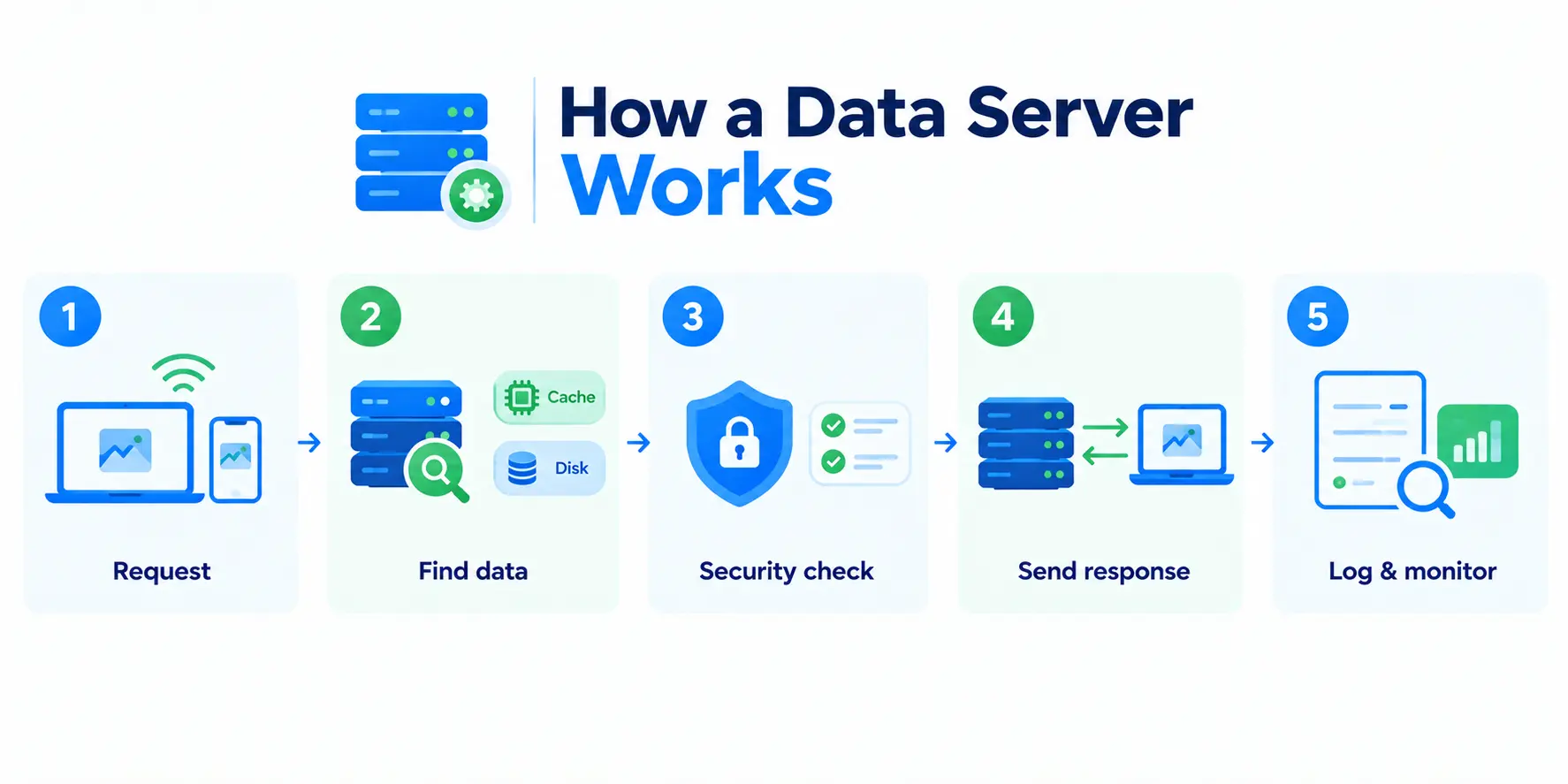
The following is the process of a data server:
- A client, like an app or a website, sends a request for specific data over the network.
- The data server locates the requested data, whether it’s cached in memory or stored on disk.
- The server runs security checks to confirm the request is allowed before handing anything over.
- The requested data is sent back to the client over the network or internet.
- The server logs the activity and is typically monitored to make sure it keeps running smoothly.
Where the data server came from
Below is the roadmap of the data server:
- 1964: IBM’s OS/360 system is one of the earliest examples of a setup that supported remote requests, an early ancestor of the client-server idea, well before the modern internet existed.
- 1969: Computer scientists at Xerox and Xerox PARC coined the terms “server-host” and “user-host” while formulating the client-server model, around the same time the US Department of Defense established ARPANET, the network that eventually grew into the internet.
- 1970s: Minicomputers and timesharing made computing power more accessible than the mainframe era before it, though data and processing were still centralized on individual machines.
- 1980s: Personal computers spread information and processing across many small, disconnected machines, which created a new problem: no central place to reliably store and access shared data. Dedicated data servers were part of the answer to that problem.
| Trivia: The term “server” comes from a simple analogy. A server-host would “serve” data back to a requesting user-host, the same way a waiter serves a customer. That everyday comparison is why the language stuck, and it’s still why we talk about a server “serving” a request or “serving” content today. |
Data server vs related terms
Here are the related terms of data server:
| What it does | |
| Data server | The machine or platform that stores data and handles requests to access it. |
| Database | The organized collection of data itself, not the machine hosting it. |
| Application server | Handles the business logic and application processes, often talking to a data server to retrieve or store data. |
| Cloud server | A virtualized server, hosted by a cloud provider, that can be configured to work as a data server, application server, or both. |
Common types of data servers
The following are the types of data servers:
- Database server: stores and manages structured data, and handles queries from applications.
- File server: stores and shares files across a network, letting multiple users access the same set of files.
- Web/application server: processes requests from websites and apps, often working alongside a data server behind the scenes.
- Cloud-hosted data server: a data server running on cloud infrastructure instead of on-premises hardware, managed by a cloud provider.
Common use cases
Below are the common use cases of data servers:
- E-commerce: storing and serving product catalogs, customer accounts, and transaction history.
- Banking: securely managing account information and transaction records.
- Healthcare: storing and managing patient records, test results, and treatment histories.
- Email: delivering messages between users through providers like Gmail or Outlook.