What is decode?
In storage and networking, decode means reconstructing the original data from whatever fragments are still available, after some of it has been lost or corrupted. This is different from the everyday meaning of “decode,” like unzipping a file or reversing Base64. Here, decode isn’t reversing a known transformation; it’s solving for missing pieces using the data that’s left.
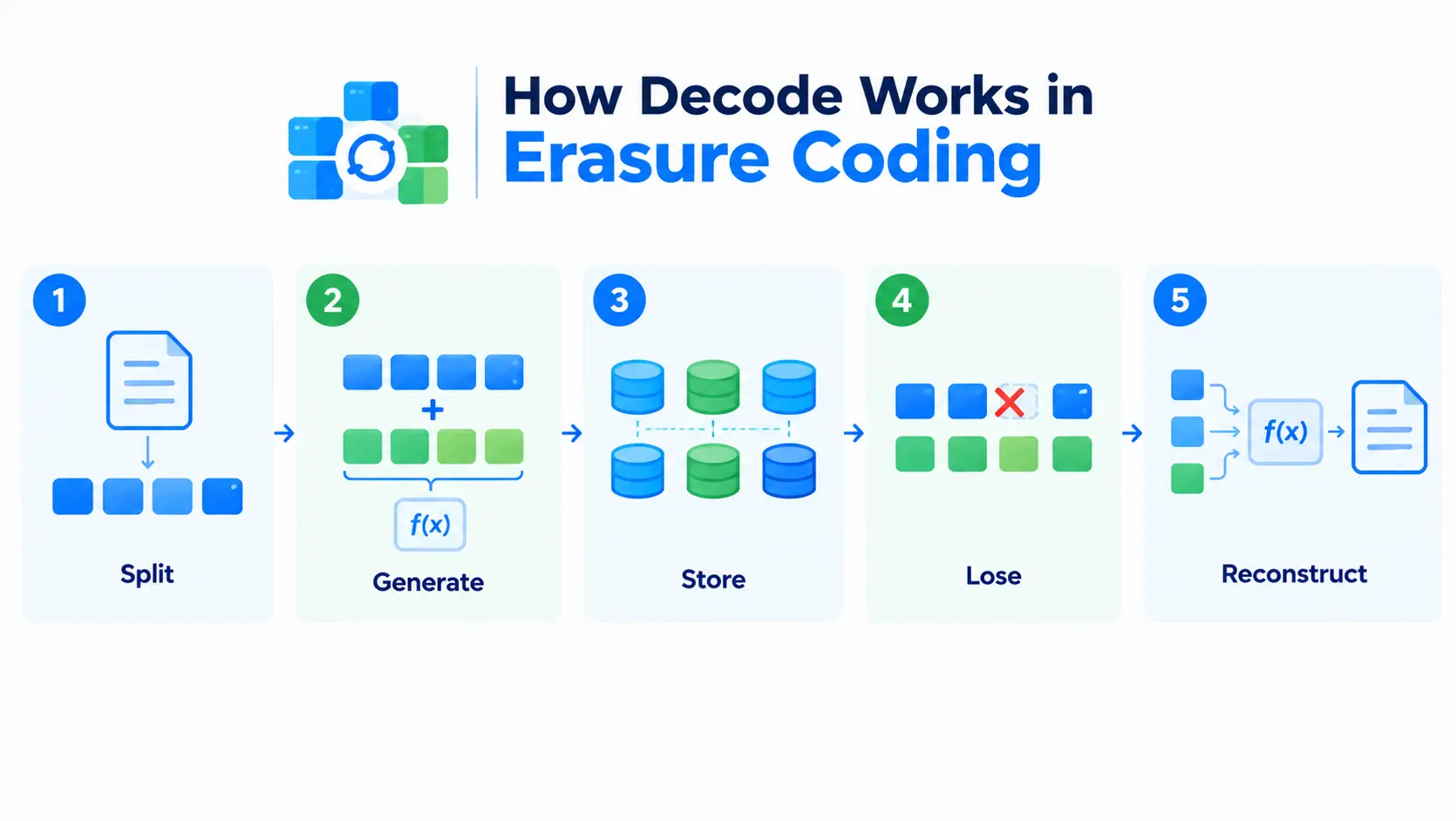
How decode works in erasure coding
The following pointers explain how decoding works:
- Original data is split into smaller pieces, called data fragments.
- Extra fragments, called parity fragments, are generated from the data using a mathematical formula.
- All fragments, data and parity, are stored across different disks, nodes, or locations.
- If some fragments are lost or become unreadable (a drive fails, a node goes offline), the system doesn’t need every original piece back.
- The decode step takes the surviving fragments and runs them through the same formula in reverse, reconstructing exactly what’s missing.
Where this idea came from
Let’s learn the origin of decoding
- 1960: Reed-Solomon codes, the math behind most modern decode operations, were developed for communications, not storage. The goal was fixing corrupted data on noisy transmission lines.
- Decades later: The same math ended up in CDs, DVDs, QR codes, and deep-space satellite transmissions, all needing to recover clean data from damaged or incomplete signals.
- RAID era: Storage systems adopted a version of this with RAID 5 and RAID 6, rebuilding a failed drive using the data and parity on the remaining drives.
- Distributed storage era: As storage moved from single arrays to systems spread across many nodes, RAID’s rebuild approach didn’t scale well. Erasure coding was built specifically to bring this same decode principle to large, distributed systems.
Interesting fact: Decoding here doesn’t require getting back every original fragment. It only needs enough of the surviving data and parity fragments to solve for what’s missing, the same way you can solve for an unknown number in an equation without needing the original two numbers that produced it.
Decode vs encode
Let’s look at what Decode vs encode is below:
- Encode: takes the original data and generates the extra parity fragments needed for protection.
- Decode: takes the surviving fragments, whatever combination of data and parity is left, and reconstructs the original data.
Encode happens once, when data is first written. Decode only happens when something is missing.
Decode vs RAID rebuild
Let’s look at what Decode vs RAID is below:
- RAID rebuild: works within a single array; rebuild time grows as drive sizes grow, since it typically has to read every remaining drive in the array.
- Erasure coding decode: designed for distributed systems, where fragments are spread across many nodes. It can reconstruct data using only a subset of fragments, without depending on any single array staying intact.
RAID rebuild is a narrower, older version of the same underlying decode principle.
Why decode speed matters
The following explains why decode speed matters:
- Rebuild time: the longer decode takes, the longer data sits with reduced redundancy, and the higher the risk if another failure happens before reconstruction finishes.
- Performance impact: decode uses compute resources, which can slow down other read and write operations happening on the same system while reconstruction runs.
- Hardware acceleration: some storage systems offload decode to dedicated hardware, like a DPU, specifically to avoid tying up general CPU resources and to keep reconstruction fast.