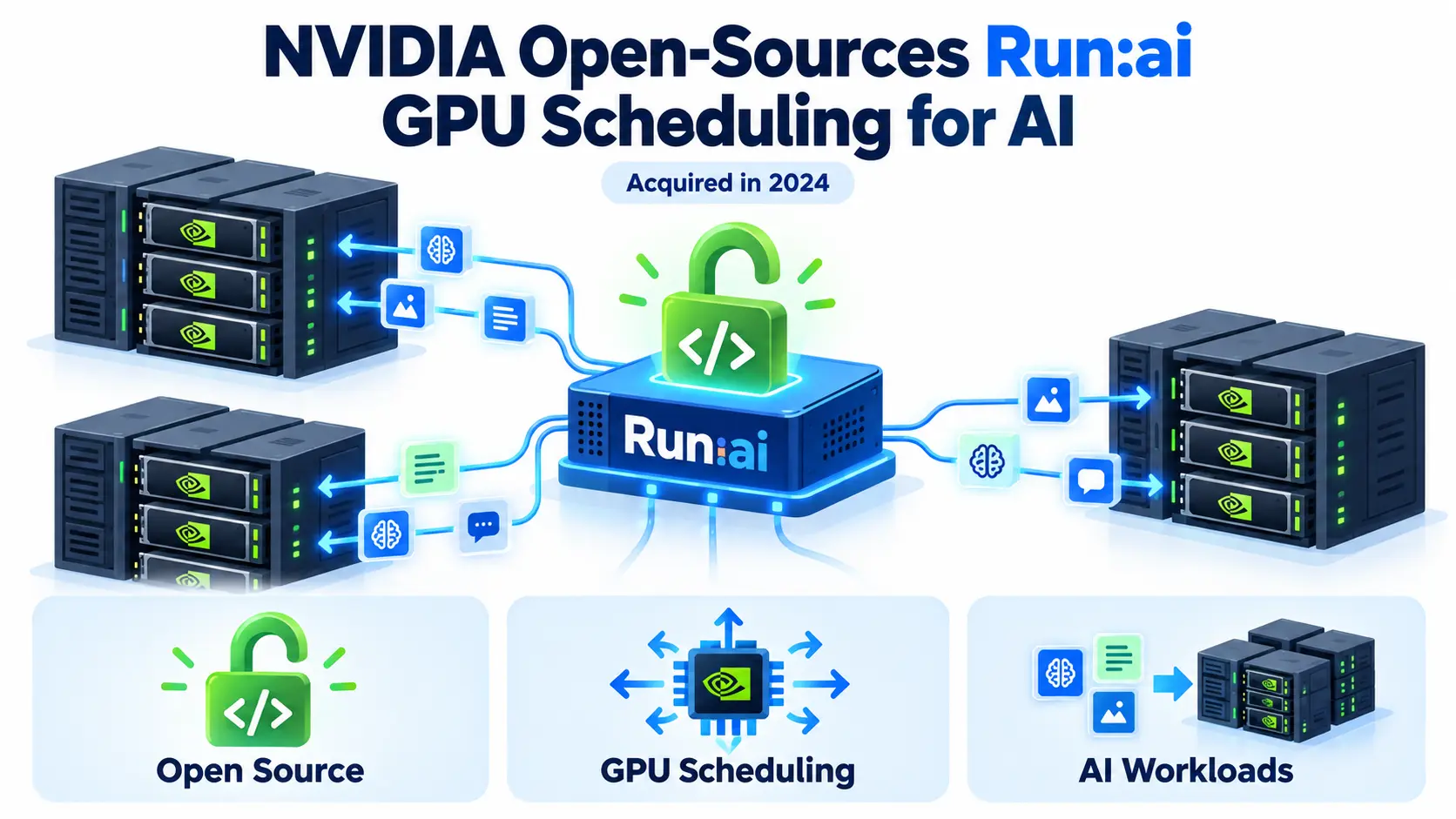
On 13 October, NVIDIA released the full Run:ai platform as open source software, including the GPU sharing and scheduling tools that cloud providers use to run shared GPU clusters. NVIDIA completed its Run:ai acquisition in December 2024, and Calcalist reports the price at $800 million. Nebius and Crusoe announced support the same day, and Lambda said it is working with NVIDIA to offer it on its Kubernetes service.
The release arrives while GPUs are scarce and costly. Cloud GPU rental prices are up 13% over 12 months, so how much work each GPU does now matters as much as how many a company owns.
What did NVIDIA release?
NVIDIA published the complete Run:ai source code and four parts that can be adopted on their own. Here is what the release includes:
- The platform: the full Run:ai source, in the NVIDIA DSX AI Factory GitHub organization
- KAI Scheduler: the Kubernetes scheduler at Run:ai’s core, open source since April 2025 under Apache 2.0 and now a CNCF Sandbox project
- GPU Fractioning Operator: shares one GPU across workloads using CUDA 13.4’s native fractioning, where the driver enforces a hard memory limit per workload. It replaces Run:ai’s earlier proprietary version.
- KAI Resource Management: projects, departments, quotas and node pools
- Workload Map: a contract that treats jobs such as PyTorchJobs and RayClusters as first-class workloads
The community product needs no paid subscription or NVIDIA support entitlement, but enterprise support is not included. The source is governed by its applicable open source licenses, and the NGC Community Product requires acceptance of NVIDIA’s software license terms.
What does Run:ai do?
Run:ai adds two things to standard Kubernetes scheduling:
- GPU sharing
- Quota-based scheduling.
Sharing lets several workloads run on one GPU. Quotas give each team a guaranteed allocation, and let teams borrow idle capacity from one another.
The problem it targets is idle capacity. Lambda describes the pattern: small jobs receive whole GPUs, researchers wait, and reserved capacity sits unused. Gang scheduling adds a second rule, that a multi-pod job is either fully scheduled or fully pending.
Who adopted it first?
NVIDIA names eight DSX partners integrating the open source platform: Crusoe, Mirantis, Nebius, OpenNebula Systems, Rafay, Saturn Cloud, Spectro Cloud and vCluster. Amongst them, the following three have published their plans:
- Nebius: a launch partner, with open source Run:ai available in Nebius AI Cloud Applications on its managed Kubernetes service
- Crusoe: welcomed the release and keeps its existing integration, in which Crusoe Managed Kubernetes is a partner-compatible distribution
- Lambda: has supported Run:ai since 2022 and is working with NVIDIA to make it a first-class option on Lambda Kubernetes Service, as part of a planned library of managed schedulers
Why did NVIDIA open source Run:ai?
NVIDIA is following through on a commitment made when it bought the company. Calcalist reports that Run:ai’s founders said at the time they planned to open source the software. NVIDIA’s stated aim is to let partners and AI clouds raise throughput and improve GPU utilization.
One detail shapes the picture. The scheduler is open, but the fractioning relies on a CUDA 13.4 driver feature, which is NVIDIA’s own technology. That is an observation, not a claim from the announcement, and it means the sharing works on NVIDIA GPUs.
What should teams check before adopting it?
Kubernetes version compatibility is the first check. NVIDIA’s Run:ai documentation lists support for Kubernetes 1.34 to 1.36 in the latest release. Oracle announced Kubernetes 1.37 on its managed service on 9 October.
That release adds HorizontalPodAutoscaler scale to zero (Beta) and stable Dynamic Resource Allocation for GPUs. Teams planning to move to 1.37 should confirm Run:ai support first.
What this means going forward
With the scheduler free, providers will compete on how well they run it, not on owning it. The open questions are which providers ship managed offerings, on what support terms, and how quickly the software keeps pace with new Kubernetes releases.
Kubernetes itself is moving the same way, toward letting idle GPU workloads scale down and share hardware. In a market where GPU prices are climbing again, utilization is becoming a main cost lever.