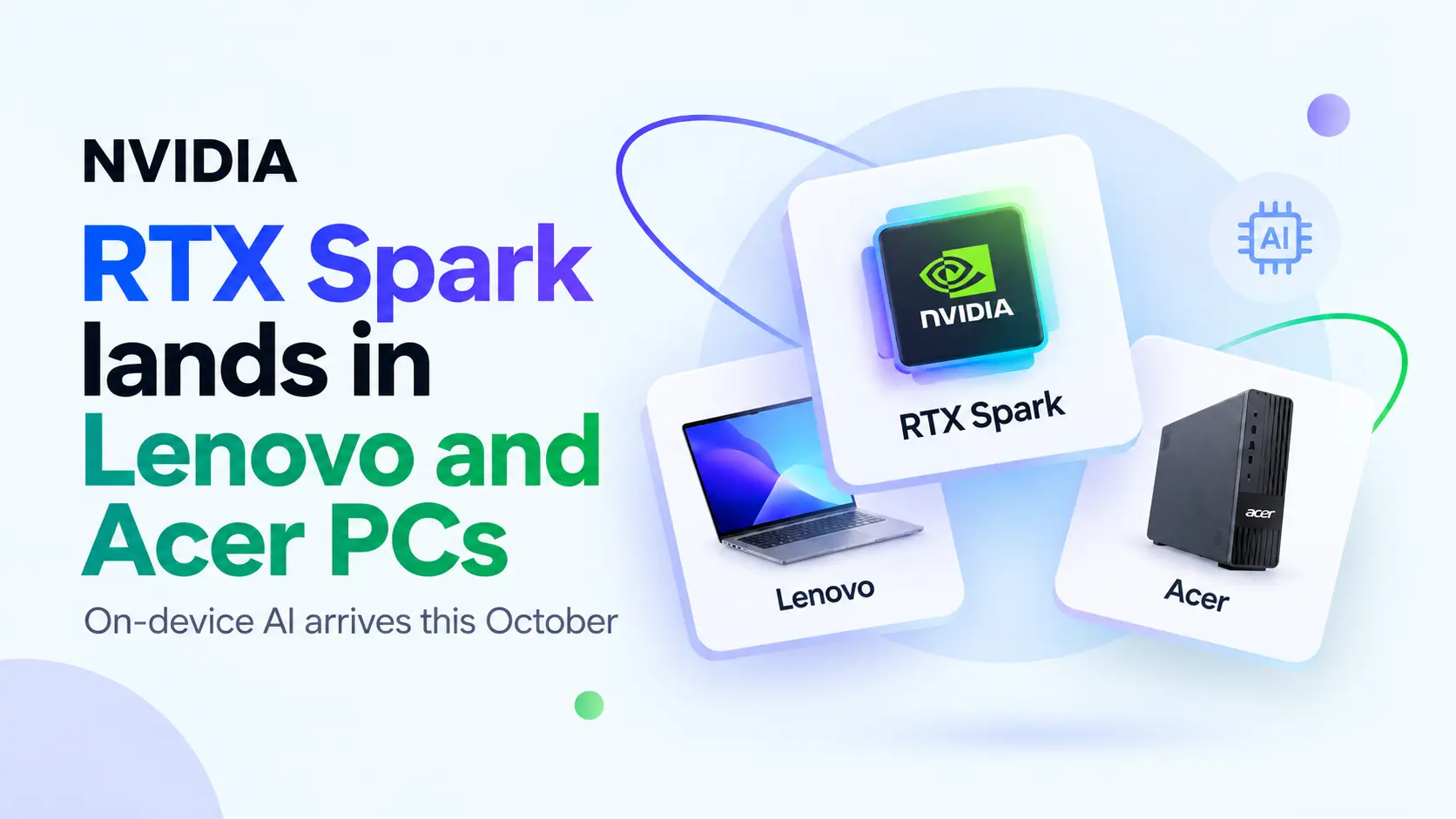
Nvidia first showed off its RTX Spark superchip on June 1, 2026. Now, at IFA 2026 in Berlin, CEO Jensen Huang confirmed that the first Windows PCs built on it including Lenovo’s Yoga Pro 9n and a compact desktop from Acer will start shipping in October. The chip was built in collaboration with Microsoft and MediaTek.
Most of the buzz so far has been about gaming and creative work. But for enterprise IT teams, the real story is bigger as this chip changes where AI workloads can run.
What Lenovo and Acer are shipping
Lenovo’s entry is the Yoga Pro 9n, positioned as a creator-and-power-user laptop that pairs RTX Spark with Lenovo’s existing Yoga design language. Meant to handle local AI work alongside everyday productivity and content creation tasks.
Acer’s take is a compact desktop, built for people who want workstation-level local AI compute without a full tower a fit for developers, small studios, or edge deployments where desk space is limited.
Both are among the first devices to put RTX Spark’s full unified compute and memory architecture in a consumer-accessible form factor, rather than a data-center card.
What makes RTX Spark different
Most “AI laptops” today use a low-power NPU. Good enough for things like blurring your background on a video call, but not much more.
RTX Spark is built for heavier work:
- More compute, unified: up to 20 Grace CPU cores and 6,144 Blackwell GPU CUDA cores working together
- More memory, faster: up to 128 GB of unified memory, linked by high-speed NVLink-C2C
- Real throughput: up to 1 petaflop of FP4 performance, in a laptop or small desktop
That’s enough memory and power to run large, multi-billion-parameter language models. And even continuous AI agents directly on the device, with no cloud connection needed.
Why this matters for enterprise budgets
Running AI workloads entirely in the cloud comes with recurring costs: bandwidth, API tokens, and network latency that adds up over time.
Moving routine work such as inference, code generation, and local agent tasks onto local hardware like RTX Spark changes that math:
- Faster response times: no network round-trip means real-time performance for agents and local search
- Predictable costs: repetitive, high-frequency inference shifts from variable cloud bills to a fixed hardware cost
- Better data control: sensitive files, code, and customer data stay on-device instead of leaving the network
Does This Mean Cloud Computing Is Going Away?
None of this replaces the cloud. Training large foundation models, running big batch jobs, and managing large-scale databases still need serious cloud infrastructure.
What’s changing is the split. Enterprises are moving toward a hybrid setup:
- Cloud: model training, heavy batch processing, long-term storage, global coordination
- Local silicon (like RTX Spark): real-time inference, sensitive data processing, fast day-to-day developer tasks
What this means going forward
RTX Spark’s October launch is a signal that serious AI workloads no longer need to live entirely in the cloud. For teams building AI infrastructure, now’s a good time to start planning hybrid pipelines that use the cloud for scale and local silicon for speed and privacy.