Whenever the term “BFSI” is coined, the first few things that come to mind are security, compliance, fraud protection and so on. Every country has the same situation and India is no different. One of the most important factors here is data protection which directly depends on the infrastructure of the website, portal and dashboard of the app. AI is emerging these days but if not handled properly it is also a very vulnerable technology which can be a huge concern in BFSI if anything goes south. Well you one where this is getting it, AI is directly related to GPU and when talking about INR GPU cloud there are a lot of factors to consider before making a decision on which providers are best for this.
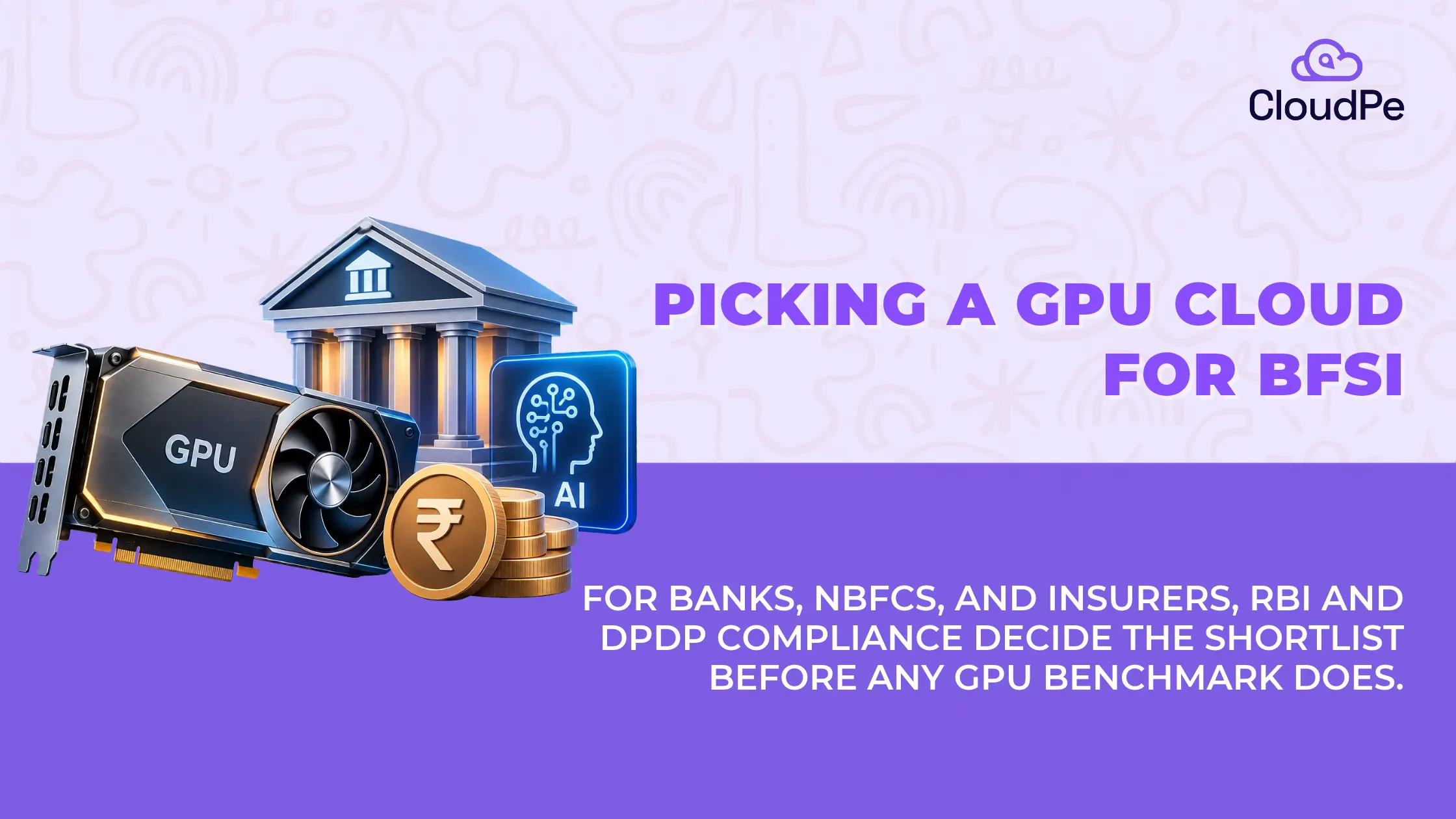
What matters more than any single GPU benchmark is this: for banks, NBFCs, and insurers, the provider has to clear RBI and DPDP data residency requirements before GPU price or performance even enters the conversation. CloudPe, E2E Networks, Yotta, and a handful of others meet that bar with INR billing and India-based data centres. Which one fits depends on your workload and your compliance posture, both covered below.
Why BFSI needs GPUs: AI training vs AI inferencing
BFSI’s GPU needs split into two different jobs, and conflating them leads to the wrong purchase.
AI training and fine-tuning is building or adapting a model before it goes into production. A bank training a fraud model on years of transaction history, a lender building a credit risk model, or an insurer fine-tuning an Indic-language LLM for customer service all fall here. This work is compute-heavy, runs in bursts rather than constantly, and benefits from multi-GPU clusters.
AI inferencing is running an already-trained model against live data. Real-time fraud scoring on an incoming transaction, a KYC document being read and classified, a voice AI system handling a customer call, all of this is inferencing. It needs to run continuously, respond fast, and stay available, since it sits in the path of a live customer interaction.
The distinction matters for procurement. Training workloads can often tolerate burst or scheduled capacity. Inferencing workloads cannot: they need dedicated, always-on, auditable infrastructure, because they are touching live customer and transaction data every time they run.
What “GPU requirements” actually means for AI workloads
“We need a GPU” is not a complete requirement. Three things decide which GPU and how many:
- VRAM (GPU memory). Smaller models and inference workloads can run on 24GB. Larger models, or multiple models served from one GPU, need 48GB or 80GB or more.
- Single GPU vs multi-GPU clusters. Training a large model usually needs multiple GPUs connected with NVLink or InfiniBand, so they can share work efficiently. Inference for most BFSI use cases runs fine on a single GPU.
- Sustained load vs burst load. Training jobs run hard for hours or days, then stop. Inference workloads for BFSI need to be available continuously, since fraud scoring and chat support do not pause outside business hours.
Getting this wrong in either direction costs money. Overprovisioning VRAM for a small inference workload wastes spend. Underprovisioning for a training run means the job fails or runs too slowly to be useful.
Why BFSI needs a different checklist
Most “top GPU cloud” articles are written for AI startups. They rank providers on price per GPU-hour and move on. That checklist does not work for a bank or insurer.
A fraud detection model running on a shared, multi-tenant GPU cluster without audit logs is a compliance problem before it is a performance problem. RBI’s data localisation rules and the Digital Personal Data Protection (DPDP) Act do not care how fast your inference is if the data path cannot be audited.
So the first filter for a BFSI buyer is not “which GPU is fastest.” It is “which provider can prove where the data sits, who touched it, and how fast they recover it if something breaks.”
The BFSI GPU cloud compliance checklist
Run every provider through this before you look at a single price sheet.
| Requirement | Why it matters for BFSI |
| India data residency | Required under RBI data localisation guidelines and DPDP |
| ISO 27001 / SOC 2 | Baseline security certification most BFSI audits ask for |
| Dedicated GPU tenancy | Shared or spot GPU capacity is hard to audit cleanly |
| Private networking (VPC) | Keeps AI workloads isolated from public internet paths |
| Backup and disaster recovery | Core banking and trading systems cannot tolerate data loss |
| SIEM integration | Needed for security monitoring and incident response |
| IAM controls | Role-based access for audit trails |
| Customer audit support | Your compliance team needs to be able to inspect the provider, not just trust it |
| SLA commitment | Downtime on a live trading or payments system is a reportable event |
A provider that is cheap but fails three or four of these is not actually an option for a regulated workload, no matter what the GPU-hour rate looks like.
Compliance requirements by BFSI use case
The general checklist above is the floor. Each use case adds its own specific requirement on top of it.
| Use case | Workload type | Specific compliance requirement |
| Fraud detection (real-time scoring) | Inferencing | Continuous audit logging on every scoring decision, IAM controls on who can query or retrain the model |
| KYC and document intelligence | Inferencing | India-resident storage for scanned ID and financial documents, encryption at rest, retention aligned to RBI record-keeping norms |
| Voice AI and call centre analytics | Inferencing | Consent and retention rules for recorded calls, India-located storage for voice data |
| Credit and risk modelling | Training | Isolated training environment, dataset access controls, IP protection for the resulting model |
| Private LLM or internal copilot | Both | VPC isolation from public internet, SIEM integration, full audit trail on every query that touches customer data |
If a provider cannot speak to the specific row your use case falls under, the general compliance checklist is not enough on its own.
Which GPUs are best for BFSI: training vs inference
Best GPUs for AI training in BFSI
| Use case | Recommended GPU tier | Why |
| Fraud or risk model training on historical data | A100 (multi-GPU) | Enough VRAM and multi-GPU scaling for structured data training |
| Fine-tuning an Indic-language LLM for customer service | H100 (multi-GPU cluster) | Higher VRAM and throughput needed for language model fine-tuning |
| Large-scale model training or full fine-tuning | H100 or H200 | Needed for larger parameter counts and faster training cycles |
Best GPUs for AI inferencing in BFSI
| Use case | Recommended GPU tier | Why |
| Proof of concept, model evaluation | L4 or A100 | Lower cost, enough VRAM to test before committing budget |
| Production inference (fraud scoring, document AI, chatbots, RAG) | A100 or RTX Pro 6000 class | Balances throughput and cost for always-on inference |
| Voice AI, real-time analytics | A100 or H100 | Lower latency matters more than raw throughput here |
CloudPe’s GPU lineup covers this full range: L4, A100, RTX Pro 6000, H100, and H200, all billed in INR, all running out of Indian data centres. GPU instances start at Rs. 14,500 per month, which puts the proof-of-concept tier within reach without a procurement cycle.
Match the GPU tier to the BFSI use case
| Use case | Recommended GPU tier | Why |
| Proof of concept, model evaluation | L4 or A100 | Lower cost, enough VRAM to test before committing budget |
| Production inference (fraud detection, document AI, chatbots, RAG) | A100 or RTX Pro 6000 class | Balances throughput and cost for always-on inference |
| Voice AI, real-time analytics | A100 or H100 | Lower latency matters more than raw throughput here |
| Large LLM fine-tuning or training | H100 or H200 | Needed for multi-GPU training runs and larger parameter counts |
CloudPe’s GPU lineup covers this full range: L4, A100, RTX Pro 6000, H100, and H200, all billed in INR, all running out of Indian data centres.
INR GPU clouds for BFSI, compared
| Provider | India data centres | Compliance positioning | GPU range | Best fit |
| CloudPe | Mumbai, Pune, Delhi, Hyderabad | DPDP and RBI-aligned, DRaaS and VPC available on the same platform | L4, A100, RTX Pro 6000, H200, H200 | Teams that want GPU, private networking, and disaster recovery under one vendor instead of stitching three together |
| E2E Networks | Delhi NCR, Mumbai, Bengaluru | NSE-listed, MeitY empanelled, GST-compliant invoicing | A100, H100, H200, B200 | Startups and enterprises that want the widest current-generation GPU catalogue in INR |
| Yotta Data Services | Navi Mumbai (Tier IV+) | Enterprise contracts, DPDP-compliant by design | H100, A100 (enterprise agreements only) | Large BFSI or government deployments with a procurement team and no need for self-serve |
| Cyfuture | Multiple Tier III data centres | India-hosted, positions itself for regulated sectors | A100, H100, L4-class | Teams prioritising lower published hourly rates over bundled compliance tooling |
| NxtGen | Five data centres across India | Markets a dedicated DPDPA/RBI/SEBI compliance suite for BFSI | H100, A100 (enterprise) | Teams that want compliance framing spelled out explicitly, with less self-serve flexibility |
None of these is universally “best.” Yotta and NxtGen lean toward large enterprise contracts with longer procurement cycles. E2E and Cyfuture lean toward self-serve and published pricing. CloudPe sits in between: self-serve GPU provisioning, but with VPC and DRaaS available on the same account, which matters if your BFSI workload needs disaster recovery as much as it needs inference capacity.
Reference architecture for a compliant BFSI AI deployment
A production AI system for a bank or insurer typically looks like this:
| Users |API Gateway + WAF |Application layer |RAG / AI service |GPU cloud (A100 / H100 / RTX Pro 6000) |Private database + vector database |Monitoring + SIEM |
The GPU layer is one piece. The private networking around it, and the monitoring behind it, matter just as much for passing an audit.
GPU cloud built for BFSI
CloudPe runs its GPU cloud from the same India data centres as its VPC and DRaaS products, Mumbai, Pune, Delhi, and Bengaluru. That matters for BFSI specifically: you are not stitching together a GPU vendor, a networking vendor, and a backup vendor to satisfy one audit.
Backing numbers: 99.9% uptime SLA, support issues resolved in under 2 hours, and a parent company (Leapswitch) running infrastructure for 22,000+ customers across 20+ years. None of that replaces a named case study, but it is what a compliance team can actually verify before signing.
GPU on rent vs buying, for a compliance-bound team
Buying GPU hardware outright means owning the compliance burden for the hardware too, including physical security, firmware updates, and disposal. Most BFSI teams do not want that liability sitting in their own data centre.
Renting GPU capacity shifts that burden to the provider, but only if the rental is on dedicated, auditable infrastructure. Spot or shared capacity from a global marketplace can be cheaper per hour, but it is harder to prove isolation during an audit. For BFSI, renting on a dedicated India-hosted GPU cloud is usually the right trade: no hardware ownership, but still a clean audit trail.
Talk to CloudPe about BFSI AI infrastructure
If you are evaluating GPU cloud options for a regulated AI workload, CloudPe’s team can walk through which GPU tier and compliance setup fits your specific use case.
Frequently Asked Questions
Can a bank or NBFC use AWS or Azure for AI workloads in India?
Yes, both operate India regions. The complication is cost (AWS and Azure typically run higher than domestic INR GPU clouds) and the extra compliance documentation needed to satisfy RBI and DPDP reviewers when working with a global hyperscaler.
What GPU is best for fraud detection models?
An A100 or RTX Pro 6000-class GPU is typically enough for production fraud detection inference. You do not need H100 or H200-class hardware unless you are also running large-model training on the same infrastructure.
Is CloudPe compliant with DPDP and RBI requirements?
CloudPe runs GPU Cloud, VPC, and DRaaS from India-based data centres in Mumbai, Pune, Delhi, and Bengaluru, aligned with DPDP and RBI data residency expectations. For a specific compliance certification list, confirm directly with CloudPe’s team before including in a procurement document.
Does BFSI AI always need H100 or H200 GPUs?
No. Most BFSI inference workloads, like fraud scoring or document processing, run well on A100 or RTX Pro 6000-class GPUs. H100 and H200 are for fine-tuning or training larger models, not for serving an already-trained model.
Is renting GPU capacity safe for regulated workloads?
Yes, as long as it is dedicated tenancy on an India-hosted provider with audit support, not shared or spot capacity on a global marketplace. The checklist earlier in this article covers what to confirm before signing.