You have built your application and now it’s time to deploy it. One of the best options out there to deploy and host your application is public cloud. It’s quick, scalable and solves the purpose. There are a few decisions you need to make for this. The most default choice people make is to go with AWS, but if you are planning this as a long term business and not a temporary project, there are certain things you need to look at before committing to any public cloud platform like choosing, right virtual machine, storage capacity, and computing resources. One more important thing is the pricing. And based on your Target audience the region of your cloud this directly affects your monthly cloud bill as well as latency.
In this blog we are talking purely about public cloud pricing in India and the USA.
A virtual machine hosted in Mumbai and an identical virtual machine hosted in Northern Virginia may have different prices, even when both are offered by the same cloud provider.
This happens because public cloud pricing is not necessarily uniform across geographical regions. Infrastructure costs, demand, service availability, networking, and regional operating expenses can all influence what providers charge.
For Indian businesses, this creates an interesting question. Should they host their applications in an Indian cloud region, closer to their customers, or choose a US region that may offer lower compute prices?
To understand the actual difference, we need to examine how public cloud pricing works and which costs change when workloads move between India and the USA.
What is a public cloud?
A public cloud is a cloud computing model in which a third-party provider makes computing resources such as virtual machines, storage, networking, and databases available to customers over the internet.
Instead of purchasing physical servers, businesses can rent infrastructure according to their requirements.
The underlying hardware is managed by the provider, while customers provision and control their allocated resources. Public cloud infrastructure is typically multi-tenant, meaning multiple customers share the provider’s physical infrastructure while their workloads remain logically isolated.
Popular public cloud providers include Amazon Web Services, Microsoft Azure, and Google Cloud.
One of the primary advantages of this model is flexible pricing. Businesses can provision resources for a few hours, several months, or longer, depending on the service and billing arrangement.
However, the price of those resources can change depending on where they are deployed.
Why does public cloud pricing vary between India and the USA?
Cloud providers operate data centres in different geographical regions. Each region has its own infrastructure, operating requirements, and available services.
For example, AWS operates regions in Mumbai (ap-south-1) and Northern Virginia (us-east-1). Google Cloud also operates regions in India and the United States.
While the services may be similar, their operating conditions are not necessarily identical.
Several factors contribute to regional pricing differences.
1. Infrastructure and operating costs
Building and operating a data centre involves purchasing hardware, establishing network connectivity, maintaining cooling systems, and supplying electricity.
These expenses vary across geographical locations.
Land costs, energy pricing, equipment procurement, infrastructure investments, and local operating conditions may influence the cost of delivering cloud services.
Providers account for these factors when establishing their regional prices, although the exact pricing methodology is generally not disclosed.
2. Demand and infrastructure capacity
Cloud regions do not have identical levels of demand or available infrastructure.
A mature region with a large installed infrastructure base may have different economics from a region with newer deployments or more limited capacity.
US regions have historically been important locations for large-scale cloud infrastructure. However, this does not mean every US service is cheaper than its Indian equivalent.
Pricing differences must be checked for each service and instance configuration.
3. Service and hardware availability
Not every public cloud region offers the same virtual machine families, GPU accelerators, or managed services.
A newer instance generation might be available in one region but not another.
For example, AWS maintains a region-specific list of supported EC2 instance families. Google Cloud also documents regional availability for machine types and accelerators.
This matters because businesses may need to select different configurations depending on the region.
Even when the advertised hardware appears comparable, performance and cost may not be identical.
India vs USA: Which public cloud region is cheaper?
There is no single answer that applies to every provider or service.
US regions, particularly Northern Virginia, are frequently used as reference regions when comparing cloud prices. Some services may be cheaper there than in Indian regions, but others may have smaller differences or different pricing structures.
The correct comparison involves checking identical configurations within the same cloud provider.
Consider the following example.
Illustrative monthly VM pricing
Assume identical VM specifications, Linux operating system, 730 running hours per month, and hypothetical hourly prices.
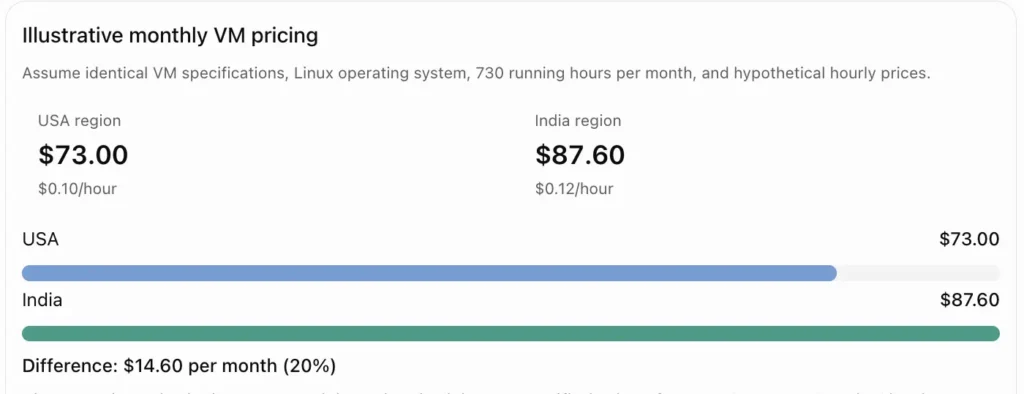
These are hypothetical rates to explain regional pricing, not verified prices from AWS, Azure, Google Cloud, or CloudPe. Storage, bandwidth, IPs, taxes, and additional services are excluded.
In this example, the Indian region costs 20% more for the same compute configuration.
But this does not automatically make the US deployment more economical.
If the application serves Indian customers, network performance and data transfer costs may change the overall calculation.
The most accurate approach is to compare complete monthly costs using the provider’s current regional pricing calculator.
| ⭐Recomended Read: AWS alternatives in India |
How individual public cloud services affect regional pricing
Compute costs are only one part of a public cloud bill. A typical production application also uses storage, networking, backups, and possibly managed databases.
Each component must be considered separately.
| Cost component | What changes by region? |
| Virtual machines | Hourly rates and available instance families |
| Block storage | Capacity pricing, performance tiers, provisioned IOPS |
| Object storage | Storage rates, requests, retrieval and transfer charges |
| Managed databases | Instance pricing, storage, backups and high availability |
| Data transfer | Internet egress and cross-region traffic rates |
| GPU instances | Accelerator availability, configuration and hourly pricing |
| Backups and DR | Storage location, replication and recovery costs |
Google Cloud explicitly notes that compute resource pricing differs across regions and that data synchronization between regions can introduce additional transfer charges.
This is why comparing only the advertised price of a cloud VM can produce a misleading result.
How data transfer costs change the comparison
Imagine an Indian SaaS company hosting its application in a US cloud region.
The application might be cheaper to run at the compute level. However, most of its customers are in India.
Every user request must travel between India and the US hosting region. Depending on the application, this can affect response times.
Internet data transfer charges also need attention.
Many public cloud platforms charge for outbound traffic, although free allowances, bundled transfer, and pricing tiers vary by provider.
For example, AWS documents internet data transfer allowances and outbound transfer pricing separately from EC2 compute charges.
Cross-region traffic can introduce another expense.
If the application runs in India but frequently retrieves data from a database hosted in the USA, the architecture may incur inter-region transfer charges while also increasing application latency.
For applications with frequent database queries, API calls, or large data transfers, these costs can become significant.
The important question is not simply where the server is cheaper, but where the entire application operates most efficiently.
Does an Indian public cloud region provide better performance?
For applications primarily serving Indian users, hosting closer to those users can reduce network round-trip time.
Consider an online shopping platform whose customers are predominantly located in Mumbai, Pune, Bengaluru, and Delhi.
Hosting the application in an Indian region may help reduce latency compared with serving every request from a distant US region.
This can be especially useful for interactive applications such as payment systems, enterprise software, gaming backends, and real-time collaboration platforms.
However, physical distance is not the only factor affecting latency.
Internet routing, network peering, application architecture, CDN usage, database performance, and server utilization also influence response times.
A poorly optimized application hosted in India can still perform worse than a well-designed application hosted overseas.
Google Cloud recommends considering latency, regional pricing, service availability, and workload dependencies together when selecting a deployment region.
How do data residency requirements affect region selection?
For some businesses, hosting location is not simply a performance or pricing decision.
Organizations handling regulated information may need to comply with specific data storage, processing, or retention requirements.
Certain Indian regulatory frameworks impose requirements on particular categories of data or regulated entities.
However, there is no universal rule requiring every Indian business to host all its cloud workloads within India.
Businesses should identify which regulations and contractual obligations apply to their particular workloads before selecting a region.
It is also important to verify where backups, logs, disaster recovery copies, and replicated data are stored.
Choosing an Indian region for the primary server does not necessarily mean every associated service stores its data in India.
USD vs INR: Does billing currency affect cloud costs?
Another important consideration for Indian businesses is the billing currency.
Some cloud providers publish or calculate service prices in US dollars, while local billing arrangements may support Indian rupees.
For instance, Google Cloud documents INR billing for applicable Indian billing accounts, regardless of the region in which resources are deployed.
When expenses are denominated in foreign currency, exchange-rate changes can make monthly budgeting less predictable.
Businesses should also account for applicable taxes and payment-related charges.
However, INR billing does not automatically mean that the underlying infrastructure is cheaper.
Billing currency and resource pricing are separate considerations.
When should you choose an Indian cloud region over a US region?
The decision should depend on the workload rather than a general assumption that one country is cheaper.
An Indian region may be more suitable for an application serving primarily Indian users, particularly when low latency and local data location are important.
A US region may be attractive when a business serves mostly North American customers, depends on services available there, or finds a meaningful overall cost advantage.
For multinational companies, a multi-region architecture may make sense, with applications deployed closer to the users they serve.
However, running across multiple regions can introduce additional infrastructure, replication, operational, and networking expenses.
The following questions help narrow the choice:
- Where are most application users located?
- What are the current prices for the exact compute and storage configurations?
- How much outbound and cross-region data transfer is expected?
- Are required services and GPU configurations available?
- What are the application’s latency and uptime requirements?
- Are there specific data residency or contractual requirements?
- How do taxes, billing currency, and support charges affect the final cost?
Answering these questions helps businesses compare the full operating cost rather than focusing on one hourly price.
Cheapest region is not always the best
A public cloud region with lower compute prices may look attractive at first.
But the total cost of running an application depends on several interconnected factors.
An Indian business might save money on a US-hosted VM while accepting higher latency for local users. Another business might benefit from hosting in India because its customers, databases, and application services are concentrated there.
The right decision comes from evaluating compute, storage, networking, performance, availability, and regulatory requirements together.
Cloud region selection should be based on total cost of ownership and workload performance, not simply the lowest advertised VM price.
For Indian organizations exploring cloud infrastructure, comparing global public cloud providers alongside domestic cloud platforms can help identify an environment that meets both technical requirements and budget expectations.
Frequently Asked Questions
1. Is public cloud cheaper in India or the USA?
It depends on the cloud provider, region, and service. Some US regions may have lower compute prices, but storage, networking, and other service charges can change the total comparison.
2. Is AWS a public cloud?
Yes. AWS is a major public cloud provider offering virtual machines, storage, databases, networking, and a broad range of other cloud services.
3. What is the difference between public cloud and private cloud?
Public cloud infrastructure is operated by a third-party provider and generally shared among multiple customers through logical isolation. Private cloud infrastructure is dedicated to a single organization, whether hosted on-premises or by an external provider.
4. Does hosting a website in India reduce latency?
It can reduce latency for users located in India, but actual performance also depends on network routing, application optimization, CDN configuration, and infrastructure quality.
5. Can an Indian business host its application in a US cloud region?
Generally, yes, subject to applicable laws, industry-specific requirements, contractual obligations, and data processing restrictions.
6. What should businesses compare before selecting a public cloud provider?
They should evaluate compute and storage pricing, data transfer charges, available regions, reliability, security, scalability, support, and overall application performance.