As a SaaS product grows, so does its infrastructure complexity. More services, more containers, more engineers shipping code at the same time. Managing all of that manually slows down the team. A Kubernetes cluster is how most engineering teams solve this problem. It automates the deployment, scaling, and management of containerised applications across a group of machines.
In this blog we have explained what a Kubernetes cluster is, how it is built, and how SaaS teams actually use it to manage complex infrastructure smoothly.
What is a Kubernetes cluster?
A Kubernetes cluster is a group of machines, called nodes, that work together to run containerised applications. Instead of managing each server individually, the cluster manages them as a single unit.
You tell Kubernetes what you want: run three instances of this application, restart it if it crashes, scale up when traffic spikes. The cluster handles the rest. It decides which machine runs which workload, monitors the health of every container, and responds automatically when something goes wrong.
Every Kubernetes cluster has two types of components: a control plane and worker nodes. The control plane makes the decisions. The worker nodes do the actual work. Together, they give your applications a self-managing infrastructure layer.
Kubernetes is open-source and was originally built by Google. It is now maintained by the Cloud Native Computing Foundation (CNCF) and is the standard for container orchestration at scale.
Kubernetes cluster architecture
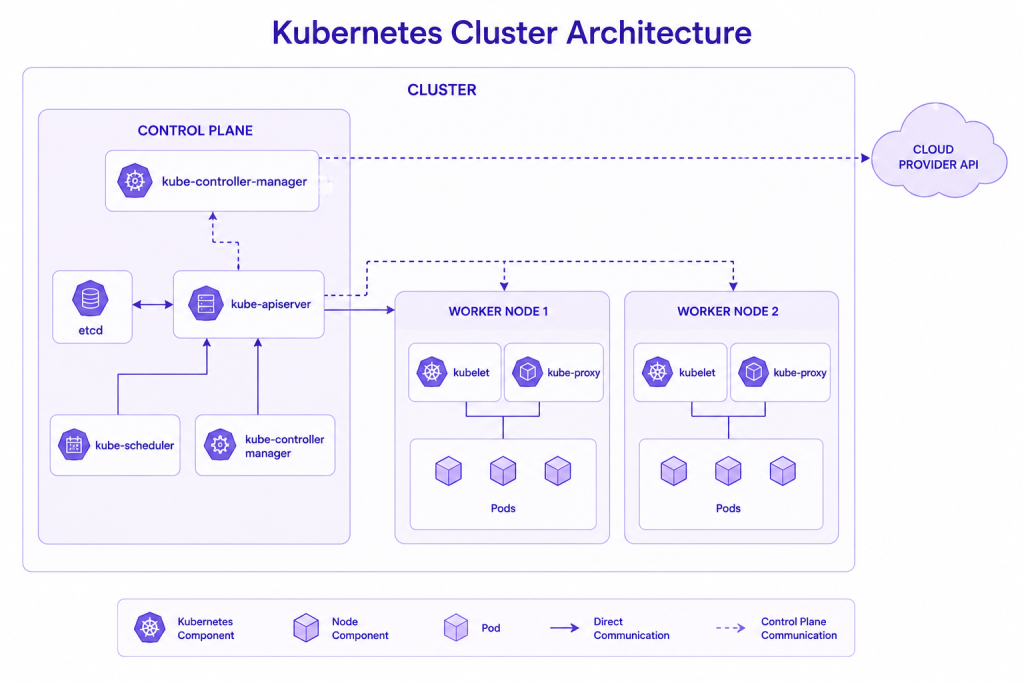
A Kubernetes cluster is divided into two layers: the control plane and the worker nodes. Understanding what each component does helps you make better decisions about how you deploy and manage your cluster.
Control plane
The control plane is the brain of the cluster. It manages state, makes scheduling decisions, and responds to events across the cluster. It does not run your application workloads. It runs the logic that keeps everything else working.
The key components are:
- kube-apiserver: The entry point for all communication with the cluster. Every instruction you give Kubernetes passes through here first.
- etcd: A distributed key-value store that holds the cluster’s data. Think of it as the cluster’s memory. The current state of every resource in the cluster is stored here.
- kube-scheduler: Watches for new pods that have not been assigned to a node. Picks the right node based on available resources, constraints, and rules you have defined.
- kube-controller-manager: Runs a set of controllers that keep the cluster in its desired state. If a pod crashes, the controller detects it and triggers a replacement.
Worker nodes
Worker nodes are the machines where your applications actually run. Each node contains three core components:
- kubelet: An agent running on every node. It communicates with the control plane and ensures the containers described in pod specifications are running and healthy.
- kube-proxy: Manages network rules on each node. It handles routing so traffic reaches the right pods from inside and outside the cluster.
- Container runtime: The software that actually runs containers. containerd is the most widely used runtime in production clusters today.
How they work together
Here is a simple example.
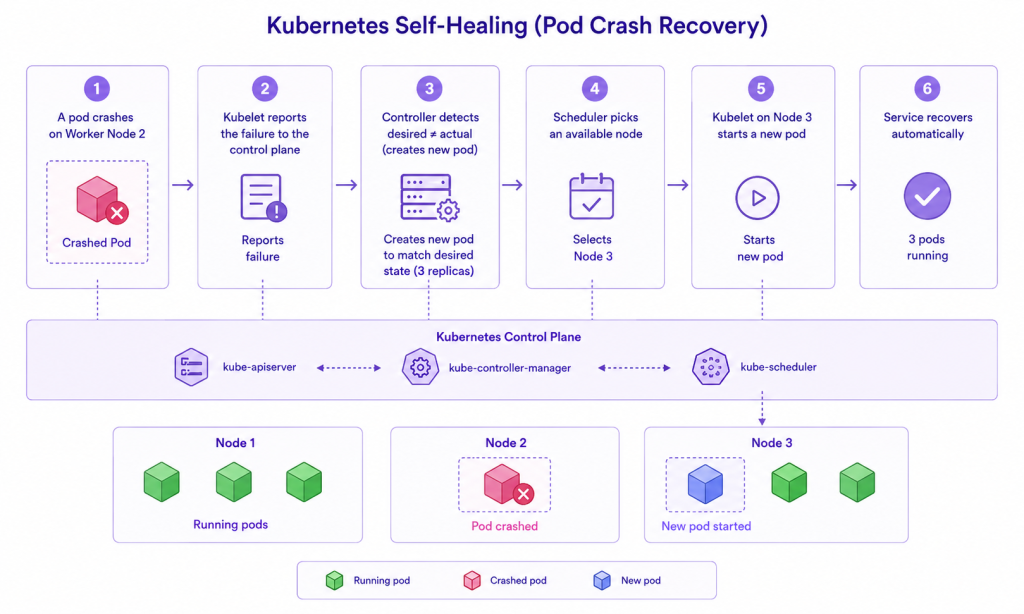
A pod running your payment service crashes on worker node 2. The kubelet on that node reports the failure to the control plane. The kube-controller-manager detects that the desired state (three running replicas) no longer matches the actual state (two running replicas). The kube-scheduler picks an available node. The kubelet on that node starts a new pod. Your service recovers without anyone on your team touching a server.
Is Kubernetes cluster and VM the same?
No. A Kubernetes cluster is not a virtual machine.
A VM is a machine, physical or virtual, that runs an operating system. A Kubernetes cluster is a management system that runs across one or more machines and controls how containerised applications are deployed and operated on those machines.
Worker nodes inside a cluster can be VMs. In most cloud environments, they are. But the cluster itself is the orchestration layer sitting above the machines, not a machine itself.
Three distinct layers: a pod is the smallest deployable unit, a node is the machine a pod runs on, and a cluster is the group of nodes managed as a single system.
Types of Kubernetes clusters
Single-node clusters
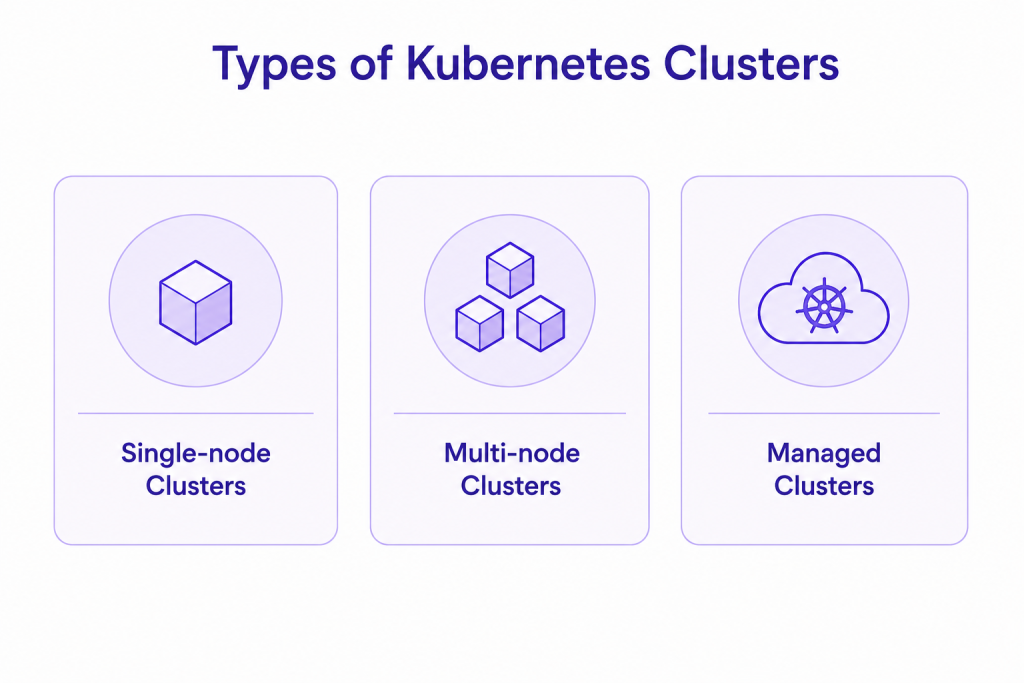
A single-node cluster runs both the control plane and worker processes on one machine. Tools like Minikube and kind (Kubernetes in Docker) are used to set these up locally.
Single-node clusters are for local development and testing only. They give developers a way to build and test Kubernetes-native applications on their laptops without needing a full production environment. They are not suitable for real workloads.
Multi-node clusters
A multi-node cluster separates the control plane from the worker nodes. This is the production standard.
Multiple worker nodes mean workloads are distributed. If one node fails, the cluster moves pods to healthy nodes automatically. You can add or remove worker nodes as demand changes. Most teams running production applications operate multi-node clusters.
Managed clusters
A managed cluster is a multi-node cluster where the cloud provider operates and maintains the control plane on your behalf.
With a managed cluster, you do not patch the control plane, manage etcd backups, or worry about control plane availability. The provider handles all of this. Your team focuses on deploying and running applications.
Examples include Amazon EKS, Google GKE, Azure AKS, and CloudPe Kubernetes as a Service.
Core benefits of a Kubernetes cluster
- Auto-scaling: Kubernetes scales the number of running pods up or down automatically based on real-time demand. Traffic doubles at 9am? The cluster adds pods. Traffic drops overnight? It removes them. No manual intervention needed.
- Self-healing: When a container crashes, Kubernetes restarts it. When a node goes down, Kubernetes reschedules its pods on healthy nodes. When a health check fails, Kubernetes stops sending traffic to that pod until it recovers.
- Load balancing: Kubernetes distributes traffic across all healthy pods running a service. No single pod gets overwhelmed. Performance stays consistent as traffic fluctuates.
- Rolling updates: You can deploy a new version of your application without taking it offline. Kubernetes replaces pods one at a time, health-checking each before removing the old one. A bad deployment can be rolled back with one command.
- Portability: Kubernetes runs on any infrastructure. On-premises servers, any cloud provider, or a mix of both. Your deployment configuration moves with you.
How SaaS teams use Kubernetes clusters
The value of a Kubernetes cluster looks different depending on where your product is in its growth. Here is how it plays out across three stages.
Early stage
At this stage, your product might have a handful of services and low, predictable traffic. A small managed cluster with two or three nodes is enough.
Many early-stage SaaS teams skip Kubernetes and run containers directly on VMs. That works until it does not. Teams that adopt Kubernetes early get a consistent deployment workflow from day one, clean local-to-production environment parity, and an infrastructure foundation that does not need to be rebuilt as traffic grows.
The setup cost is low with a managed cluster. You are not managing the control plane. You are writing deployment files and running your services.
Growth stage
This is where Kubernetes earns its place. Multiple services, unpredictable traffic spikes, several engineers shipping features in parallel.
At the growth stage, auto-scaling prevents traffic spikes from becoming outages. Namespaces let you isolate staging, production, and development environments cleanly. CI/CD pipelines integrate directly with Kubernetes rolling deployments. Your team ships faster because the infrastructure handles the operational load.
Without Kubernetes at this stage, you are either over-provisioning and wasting spend, or scrambling to scale manually during spikes.
Scale stage
At scale, the requirements change. Multi-region deployments for latency. Compliance requirements around where data lives and how infrastructure is isolated. Disaster recovery built into the cluster design.
At this point, self-managed clusters become a real operational burden. Upgrading the control plane, managing etcd, ensuring control plane high availability across regions: this is full-time infrastructure work. Most SaaS companies at scale move to managed Kubernetes and put that engineering time into the product instead.
Managed Kubernetes vs self-managed: what SaaS teams actually choose
| Factor | Self-managed | Managed Kubernetes |
| Control plane management | Your team | Provider handles it |
| Setup time | Days to weeks | Minutes |
| Engineering overhead | High | Low |
| Compliance readiness | Must configure yourself | Pre-configured |
| Upgrade management | Manual | Automated or assisted |
| Cost structure | Lower infra cost, higher ops cost | Predictable, bundled |
| Best for | Large infra teams with deep K8s expertise | Product teams focused on shipping |
For most SaaS teams, the cost of engineering time spent managing a cluster exceeds the price difference between self-managed and managed Kubernetes. For teams under 50 engineers, managed Kubernetes almost always wins on total cost.
Kubernetes cluster vs Docker
Docker and Kubernetes are often mentioned together. They are not the same thing and they are not alternatives to each other.
Docker builds and runs containers on a single machine. It is a container runtime. Kubernetes manages containers across many machines. It is a container orchestrator.
Docker Compose lets you run multiple containers together on one machine. It works well for local development. It does not handle production-scale deployment, auto-scaling, self-healing, or multi-machine management.
The common production pattern: Docker builds your container images. Kubernetes runs and manages them across a cluster of nodes. They work together.
Running Kubernetes in India: what to check
Indian SaaS companies have specific infrastructure requirements that most Kubernetes Service guides do not address.
- Data residency: If your product serves regulated industries like BFSI, healthcare, or government, your data and workloads may need to stay within Indian borders. This applies to the nodes your pods run on, not just where your database sits. Running a Kubernetes cluster on servers physically located in India satisfies this requirement. Running it on a foreign region of a hyperscaler does not.
- DPDP and RBI compliance: The Digital Personal Data Protection Act and RBI guidelines both have implications for where personal data is processed and stored. A Kubernetes cluster running on India-hosted infrastructure removes ambiguity in compliance and audit conversations.
- Support response time: When a node fails at 2am, the difference between a team physically in India with engineers available around the clock and a global ticket queue is the difference between a quick fix and an extended outage.
Ready to run Kubernetes without managing it yourself?
CloudPe offers managed Kubernetes as a Service from Indian data centres. Auto-scaling, 99.9% uptime SLA, and support that resolves issues in under 2 hours.
[Talk to the CloudPe team]
Frequently Asked Questions
What is a Kubernetes cluster?
</summary>
<div role="region" aria-labelledby="e-n-accordion-item-2640" class="elementor-element elementor-element-fe13257 e-con-full e-flex e-con e-child" data-id="fe13257" data-element_type="container" data-e-type="container">
<div role="region" aria-labelledby="e-n-accordion-item-2640" class="elementor-element elementor-element-567c35f e-flex e-con-boxed e-con e-child" data-id="567c35f" data-element_type="container" data-e-type="container">
<div class="e-con-inner">
<div class="elementor-element elementor-element-6771c5b elementor-widget elementor-widget-text-editor" data-id="6771c5b" data-element_type="widget" data-e-type="widget" data-widget_type="text-editor.default">
<div class="elementor-widget-container">
<p><span style="font-weight: 400;">A Kubernetes cluster is a group of machines (nodes) that work together to run, scale, and manage containerised applications automatically. It consists of a control plane that makes decisions and worker nodes that execute workloads.</span></p> </div>
</div>
</div>
</div>
</div>
</details>
<details id="e-n-accordion-item-2641" class="e-n-accordion-item" >
<summary class="e-n-accordion-item-title" data-accordion-index="2" tabindex="-1" aria-expanded="false" aria-controls="e-n-accordion-item-2641" >
<span class='e-n-accordion-item-title-header'><div class="e-n-accordion-item-title-text"> What is the point of a Kubernetes cluster? </div></span>
<span class='e-n-accordion-item-title-icon'>
<span class='e-opened' ><svg aria-hidden="true" class="e-font-icon-svg e-fas-minus" viewBox="0 0 448 512" xmlns="http://www.w3.org/2000/svg"><path d="M416 208H32c-17.67 0-32 14.33-32 32v32c0 17.67 14.33 32 32 32h384c17.67 0 32-14.33 32-32v-32c0-17.67-14.33-32-32-32z"></path></svg></span>
<span class='e-closed'><svg aria-hidden="true" class="e-font-icon-svg e-fas-plus" viewBox="0 0 448 512" xmlns="http://www.w3.org/2000/svg"><path d="M416 208H272V64c0-17.67-14.33-32-32-32h-32c-17.67 0-32 14.33-32 32v144H32c-17.67 0-32 14.33-32 32v32c0 17.67 14.33 32 32 32h144v144c0 17.67 14.33 32 32 32h32c17.67 0 32-14.33 32-32V304h144c17.67 0 32-14.33 32-32v-32c0-17.67-14.33-32-32-32z"></path></svg></span>
</span>
</summary>
<div role="region" aria-labelledby="e-n-accordion-item-2641" class="elementor-element elementor-element-c2cd988 e-con-full e-flex e-con e-child" data-id="c2cd988" data-element_type="container" data-e-type="container">
<div role="region" aria-labelledby="e-n-accordion-item-2641" class="elementor-element elementor-element-0f407ad e-flex e-con-boxed e-con e-child" data-id="0f407ad" data-element_type="container" data-e-type="container">
<div class="e-con-inner">
<div class="elementor-element elementor-element-e000bae elementor-widget elementor-widget-text-editor" data-id="e000bae" data-element_type="widget" data-e-type="widget" data-widget_type="text-editor.default">
<div class="elementor-widget-container">
<p><span style="font-weight: 400;">The point is to automate the operational work of running containerised applications at scale. Auto-scaling, self-healing, rolling updates, and load balancing are all handled by the cluster so your team focuses on the application, not the infrastructure.</span></p> </div>
</div>
</div>
</div>
</div>
</details>
<details id="e-n-accordion-item-2642" class="e-n-accordion-item" >
<summary class="e-n-accordion-item-title" data-accordion-index="3" tabindex="-1" aria-expanded="false" aria-controls="e-n-accordion-item-2642" >
<span class='e-n-accordion-item-title-header'><div class="e-n-accordion-item-title-text"> What is Kubernetes used for? </div></span>
<span class='e-n-accordion-item-title-icon'>
<span class='e-opened' ><svg aria-hidden="true" class="e-font-icon-svg e-fas-minus" viewBox="0 0 448 512" xmlns="http://www.w3.org/2000/svg"><path d="M416 208H32c-17.67 0-32 14.33-32 32v32c0 17.67 14.33 32 32 32h384c17.67 0 32-14.33 32-32v-32c0-17.67-14.33-32-32-32z"></path></svg></span>
<span class='e-closed'><svg aria-hidden="true" class="e-font-icon-svg e-fas-plus" viewBox="0 0 448 512" xmlns="http://www.w3.org/2000/svg"><path d="M416 208H272V64c0-17.67-14.33-32-32-32h-32c-17.67 0-32 14.33-32 32v144H32c-17.67 0-32 14.33-32 32v32c0 17.67 14.33 32 32 32h144v144c0 17.67 14.33 32 32 32h32c17.67 0 32-14.33 32-32V304h144c17.67 0 32-14.33 32-32v-32c0-17.67-14.33-32-32-32z"></path></svg></span>
</span>
</summary>
<div role="region" aria-labelledby="e-n-accordion-item-2642" class="elementor-element elementor-element-a1975b3 e-con-full e-flex e-con e-child" data-id="a1975b3" data-element_type="container" data-e-type="container">
<div role="region" aria-labelledby="e-n-accordion-item-2642" class="elementor-element elementor-element-294beb6 e-flex e-con-boxed e-con e-child" data-id="294beb6" data-element_type="container" data-e-type="container">
<div class="e-con-inner">
<div class="elementor-element elementor-element-02cbca8 elementor-widget elementor-widget-text-editor" data-id="02cbca8" data-element_type="widget" data-e-type="widget" data-widget_type="text-editor.default">
<div class="elementor-widget-container">
<p><span style="font-weight: 400;">Kubernetes is used to deploy, scale, and manage containerised applications across multiple machines. Common use cases include microservices-based SaaS products, CI/CD pipelines, AI and ML workloads, and any application that needs to scale based on demand.</span></p> </div>
</div>
</div>
</div>
</div>
</details>
<details id="e-n-accordion-item-2643" class="e-n-accordion-item" >
<summary class="e-n-accordion-item-title" data-accordion-index="4" tabindex="-1" aria-expanded="false" aria-controls="e-n-accordion-item-2643" >
<span class='e-n-accordion-item-title-header'><div class="e-n-accordion-item-title-text"> Is a Kubernetes cluster a VM? </div></span>
<span class='e-n-accordion-item-title-icon'>
<span class='e-opened' ><svg aria-hidden="true" class="e-font-icon-svg e-fas-minus" viewBox="0 0 448 512" xmlns="http://www.w3.org/2000/svg"><path d="M416 208H32c-17.67 0-32 14.33-32 32v32c0 17.67 14.33 32 32 32h384c17.67 0 32-14.33 32-32v-32c0-17.67-14.33-32-32-32z"></path></svg></span>
<span class='e-closed'><svg aria-hidden="true" class="e-font-icon-svg e-fas-plus" viewBox="0 0 448 512" xmlns="http://www.w3.org/2000/svg"><path d="M416 208H272V64c0-17.67-14.33-32-32-32h-32c-17.67 0-32 14.33-32 32v144H32c-17.67 0-32 14.33-32 32v32c0 17.67 14.33 32 32 32h144v144c0 17.67 14.33 32 32 32h32c17.67 0 32-14.33 32-32V304h144c17.67 0 32-14.33 32-32v-32c0-17.67-14.33-32-32-32z"></path></svg></span>
</span>
</summary>
<div role="region" aria-labelledby="e-n-accordion-item-2643" class="elementor-element elementor-element-6d4dd73 e-flex e-con-boxed e-con e-child" data-id="6d4dd73" data-element_type="container" data-e-type="container">
<div class="e-con-inner">
<div role="region" aria-labelledby="e-n-accordion-item-2643" class="elementor-element elementor-element-5add531 e-con-full e-flex e-con e-child" data-id="5add531" data-element_type="container" data-e-type="container">
<div class="elementor-element elementor-element-6c9f036 elementor-widget elementor-widget-text-editor" data-id="6c9f036" data-element_type="widget" data-e-type="widget" data-widget_type="text-editor.default">
<div class="elementor-widget-container">
<p><span style="font-weight: 400;">No. A VM is a machine. A Kubernetes cluster is a management system that runs across multiple machines (which can be VMs) and orchestrates containerised workloads on them. They are different layers.</span></p> </div>
</div>
</div>
</div>
</div>
</details>
<details id="e-n-accordion-item-2644" class="e-n-accordion-item" >
<summary class="e-n-accordion-item-title" data-accordion-index="5" tabindex="-1" aria-expanded="false" aria-controls="e-n-accordion-item-2644" >
<span class='e-n-accordion-item-title-header'><div class="e-n-accordion-item-title-text"> What is the difference between Kubernetes and Docker? </div></span>
<span class='e-n-accordion-item-title-icon'>
<span class='e-opened' ><svg aria-hidden="true" class="e-font-icon-svg e-fas-minus" viewBox="0 0 448 512" xmlns="http://www.w3.org/2000/svg"><path d="M416 208H32c-17.67 0-32 14.33-32 32v32c0 17.67 14.33 32 32 32h384c17.67 0 32-14.33 32-32v-32c0-17.67-14.33-32-32-32z"></path></svg></span>
<span class='e-closed'><svg aria-hidden="true" class="e-font-icon-svg e-fas-plus" viewBox="0 0 448 512" xmlns="http://www.w3.org/2000/svg"><path d="M416 208H272V64c0-17.67-14.33-32-32-32h-32c-17.67 0-32 14.33-32 32v144H32c-17.67 0-32 14.33-32 32v32c0 17.67 14.33 32 32 32h144v144c0 17.67 14.33 32 32 32h32c17.67 0 32-14.33 32-32V304h144c17.67 0 32-14.33 32-32v-32c0-17.67-14.33-32-32-32z"></path></svg></span>
</span>
</summary>
<div role="region" aria-labelledby="e-n-accordion-item-2644" class="elementor-element elementor-element-d40e7e1 e-flex e-con-boxed e-con e-child" data-id="d40e7e1" data-element_type="container" data-e-type="container">
<div class="e-con-inner">
<div role="region" aria-labelledby="e-n-accordion-item-2644" class="elementor-element elementor-element-5a99da2 e-con-full e-flex e-con e-child" data-id="5a99da2" data-element_type="container" data-e-type="container">
<div class="elementor-element elementor-element-b16ca6b elementor-widget elementor-widget-text-editor" data-id="b16ca6b" data-element_type="widget" data-e-type="widget" data-widget_type="text-editor.default">
<div class="elementor-widget-container">
<p><span style="font-weight: 400;">Docker builds and runs containers on a single machine. Kubernetes manages containers across many machines. In production, they work together: Docker creates the container images, Kubernetes runs and manages them at scale.</span></p> </div>
</div>
</div>
</div>
</div>
</details>
</div>
</div>
</div>
</div>
</div>
</div>
</summary>
<div role="region" aria-labelledby="e-n-accordion-item-2640" class="elementor-element elementor-element-fe13257 e-con-full e-flex e-con e-child" data-id="fe13257" data-element_type="container" data-e-type="container">
<div role="region" aria-labelledby="e-n-accordion-item-2640" class="elementor-element elementor-element-567c35f e-flex e-con-boxed e-con e-child" data-id="567c35f" data-element_type="container" data-e-type="container">
<div class="e-con-inner">
<div class="elementor-element elementor-element-6771c5b elementor-widget elementor-widget-text-editor" data-id="6771c5b" data-element_type="widget" data-e-type="widget" data-widget_type="text-editor.default">
<div class="elementor-widget-container">
<p><span style="font-weight: 400;">A Kubernetes cluster is a group of machines (nodes) that work together to run, scale, and manage containerised applications automatically. It consists of a control plane that makes decisions and worker nodes that execute workloads.</span></p> </div>
</div>
</div>
</div>
</div>
</details>
<details id="e-n-accordion-item-2641" class="e-n-accordion-item" >
<summary class="e-n-accordion-item-title" data-accordion-index="2" tabindex="-1" aria-expanded="false" aria-controls="e-n-accordion-item-2641" >
<span class='e-n-accordion-item-title-header'><div class="e-n-accordion-item-title-text"> What is the point of a Kubernetes cluster? </div></span>
<span class='e-n-accordion-item-title-icon'>
<span class='e-opened' ><svg aria-hidden="true" class="e-font-icon-svg e-fas-minus" viewBox="0 0 448 512" xmlns="http://www.w3.org/2000/svg"><path d="M416 208H32c-17.67 0-32 14.33-32 32v32c0 17.67 14.33 32 32 32h384c17.67 0 32-14.33 32-32v-32c0-17.67-14.33-32-32-32z"></path></svg></span>
<span class='e-closed'><svg aria-hidden="true" class="e-font-icon-svg e-fas-plus" viewBox="0 0 448 512" xmlns="http://www.w3.org/2000/svg"><path d="M416 208H272V64c0-17.67-14.33-32-32-32h-32c-17.67 0-32 14.33-32 32v144H32c-17.67 0-32 14.33-32 32v32c0 17.67 14.33 32 32 32h144v144c0 17.67 14.33 32 32 32h32c17.67 0 32-14.33 32-32V304h144c17.67 0 32-14.33 32-32v-32c0-17.67-14.33-32-32-32z"></path></svg></span>
</span>
</summary>
<div role="region" aria-labelledby="e-n-accordion-item-2641" class="elementor-element elementor-element-c2cd988 e-con-full e-flex e-con e-child" data-id="c2cd988" data-element_type="container" data-e-type="container">
<div role="region" aria-labelledby="e-n-accordion-item-2641" class="elementor-element elementor-element-0f407ad e-flex e-con-boxed e-con e-child" data-id="0f407ad" data-element_type="container" data-e-type="container">
<div class="e-con-inner">
<div class="elementor-element elementor-element-e000bae elementor-widget elementor-widget-text-editor" data-id="e000bae" data-element_type="widget" data-e-type="widget" data-widget_type="text-editor.default">
<div class="elementor-widget-container">
<p><span style="font-weight: 400;">The point is to automate the operational work of running containerised applications at scale. Auto-scaling, self-healing, rolling updates, and load balancing are all handled by the cluster so your team focuses on the application, not the infrastructure.</span></p> </div>
</div>
</div>
</div>
</div>
</details>
<details id="e-n-accordion-item-2642" class="e-n-accordion-item" >
<summary class="e-n-accordion-item-title" data-accordion-index="3" tabindex="-1" aria-expanded="false" aria-controls="e-n-accordion-item-2642" >
<span class='e-n-accordion-item-title-header'><div class="e-n-accordion-item-title-text"> What is Kubernetes used for? </div></span>
<span class='e-n-accordion-item-title-icon'>
<span class='e-opened' ><svg aria-hidden="true" class="e-font-icon-svg e-fas-minus" viewBox="0 0 448 512" xmlns="http://www.w3.org/2000/svg"><path d="M416 208H32c-17.67 0-32 14.33-32 32v32c0 17.67 14.33 32 32 32h384c17.67 0 32-14.33 32-32v-32c0-17.67-14.33-32-32-32z"></path></svg></span>
<span class='e-closed'><svg aria-hidden="true" class="e-font-icon-svg e-fas-plus" viewBox="0 0 448 512" xmlns="http://www.w3.org/2000/svg"><path d="M416 208H272V64c0-17.67-14.33-32-32-32h-32c-17.67 0-32 14.33-32 32v144H32c-17.67 0-32 14.33-32 32v32c0 17.67 14.33 32 32 32h144v144c0 17.67 14.33 32 32 32h32c17.67 0 32-14.33 32-32V304h144c17.67 0 32-14.33 32-32v-32c0-17.67-14.33-32-32-32z"></path></svg></span>
</span>
</summary>
<div role="region" aria-labelledby="e-n-accordion-item-2642" class="elementor-element elementor-element-a1975b3 e-con-full e-flex e-con e-child" data-id="a1975b3" data-element_type="container" data-e-type="container">
<div role="region" aria-labelledby="e-n-accordion-item-2642" class="elementor-element elementor-element-294beb6 e-flex e-con-boxed e-con e-child" data-id="294beb6" data-element_type="container" data-e-type="container">
<div class="e-con-inner">
<div class="elementor-element elementor-element-02cbca8 elementor-widget elementor-widget-text-editor" data-id="02cbca8" data-element_type="widget" data-e-type="widget" data-widget_type="text-editor.default">
<div class="elementor-widget-container">
<p><span style="font-weight: 400;">Kubernetes is used to deploy, scale, and manage containerised applications across multiple machines. Common use cases include microservices-based SaaS products, CI/CD pipelines, AI and ML workloads, and any application that needs to scale based on demand.</span></p> </div>
</div>
</div>
</div>
</div>
</details>
<details id="e-n-accordion-item-2643" class="e-n-accordion-item" >
<summary class="e-n-accordion-item-title" data-accordion-index="4" tabindex="-1" aria-expanded="false" aria-controls="e-n-accordion-item-2643" >
<span class='e-n-accordion-item-title-header'><div class="e-n-accordion-item-title-text"> Is a Kubernetes cluster a VM? </div></span>
<span class='e-n-accordion-item-title-icon'>
<span class='e-opened' ><svg aria-hidden="true" class="e-font-icon-svg e-fas-minus" viewBox="0 0 448 512" xmlns="http://www.w3.org/2000/svg"><path d="M416 208H32c-17.67 0-32 14.33-32 32v32c0 17.67 14.33 32 32 32h384c17.67 0 32-14.33 32-32v-32c0-17.67-14.33-32-32-32z"></path></svg></span>
<span class='e-closed'><svg aria-hidden="true" class="e-font-icon-svg e-fas-plus" viewBox="0 0 448 512" xmlns="http://www.w3.org/2000/svg"><path d="M416 208H272V64c0-17.67-14.33-32-32-32h-32c-17.67 0-32 14.33-32 32v144H32c-17.67 0-32 14.33-32 32v32c0 17.67 14.33 32 32 32h144v144c0 17.67 14.33 32 32 32h32c17.67 0 32-14.33 32-32V304h144c17.67 0 32-14.33 32-32v-32c0-17.67-14.33-32-32-32z"></path></svg></span>
</span>
</summary>
<div role="region" aria-labelledby="e-n-accordion-item-2643" class="elementor-element elementor-element-6d4dd73 e-flex e-con-boxed e-con e-child" data-id="6d4dd73" data-element_type="container" data-e-type="container">
<div class="e-con-inner">
<div role="region" aria-labelledby="e-n-accordion-item-2643" class="elementor-element elementor-element-5add531 e-con-full e-flex e-con e-child" data-id="5add531" data-element_type="container" data-e-type="container">
<div class="elementor-element elementor-element-6c9f036 elementor-widget elementor-widget-text-editor" data-id="6c9f036" data-element_type="widget" data-e-type="widget" data-widget_type="text-editor.default">
<div class="elementor-widget-container">
<p><span style="font-weight: 400;">No. A VM is a machine. A Kubernetes cluster is a management system that runs across multiple machines (which can be VMs) and orchestrates containerised workloads on them. They are different layers.</span></p> </div>
</div>
</div>
</div>
</div>
</details>
<details id="e-n-accordion-item-2644" class="e-n-accordion-item" >
<summary class="e-n-accordion-item-title" data-accordion-index="5" tabindex="-1" aria-expanded="false" aria-controls="e-n-accordion-item-2644" >
<span class='e-n-accordion-item-title-header'><div class="e-n-accordion-item-title-text"> What is the difference between Kubernetes and Docker? </div></span>
<span class='e-n-accordion-item-title-icon'>
<span class='e-opened' ><svg aria-hidden="true" class="e-font-icon-svg e-fas-minus" viewBox="0 0 448 512" xmlns="http://www.w3.org/2000/svg"><path d="M416 208H32c-17.67 0-32 14.33-32 32v32c0 17.67 14.33 32 32 32h384c17.67 0 32-14.33 32-32v-32c0-17.67-14.33-32-32-32z"></path></svg></span>
<span class='e-closed'><svg aria-hidden="true" class="e-font-icon-svg e-fas-plus" viewBox="0 0 448 512" xmlns="http://www.w3.org/2000/svg"><path d="M416 208H272V64c0-17.67-14.33-32-32-32h-32c-17.67 0-32 14.33-32 32v144H32c-17.67 0-32 14.33-32 32v32c0 17.67 14.33 32 32 32h144v144c0 17.67 14.33 32 32 32h32c17.67 0 32-14.33 32-32V304h144c17.67 0 32-14.33 32-32v-32c0-17.67-14.33-32-32-32z"></path></svg></span>
</span>
</summary>
<div role="region" aria-labelledby="e-n-accordion-item-2644" class="elementor-element elementor-element-d40e7e1 e-flex e-con-boxed e-con e-child" data-id="d40e7e1" data-element_type="container" data-e-type="container">
<div class="e-con-inner">
<div role="region" aria-labelledby="e-n-accordion-item-2644" class="elementor-element elementor-element-5a99da2 e-con-full e-flex e-con e-child" data-id="5a99da2" data-element_type="container" data-e-type="container">
<div class="elementor-element elementor-element-b16ca6b elementor-widget elementor-widget-text-editor" data-id="b16ca6b" data-element_type="widget" data-e-type="widget" data-widget_type="text-editor.default">
<div class="elementor-widget-container">
<p><span style="font-weight: 400;">Docker builds and runs containers on a single machine. Kubernetes manages containers across many machines. In production, they work together: Docker creates the container images, Kubernetes runs and manages them at scale.</span></p> </div>
</div>
</div>
</div>
</div>
</details>
</div>
</div>
</div>
</div>
</div>
</div>