What is Machine Learning (ML)
Machine learning (ML) is a way of training software, called a model, to make predictions or generate content from data, instead of following a fixed set of programmed rules. Rather than writing explicit instructions for every scenario, you feed the model lots of data, and it learns the patterns and relationships in that data on its own.
That’s the core difference from traditional programming. Traditional software follows rules you write; ML software learns rules from data.
How ML works
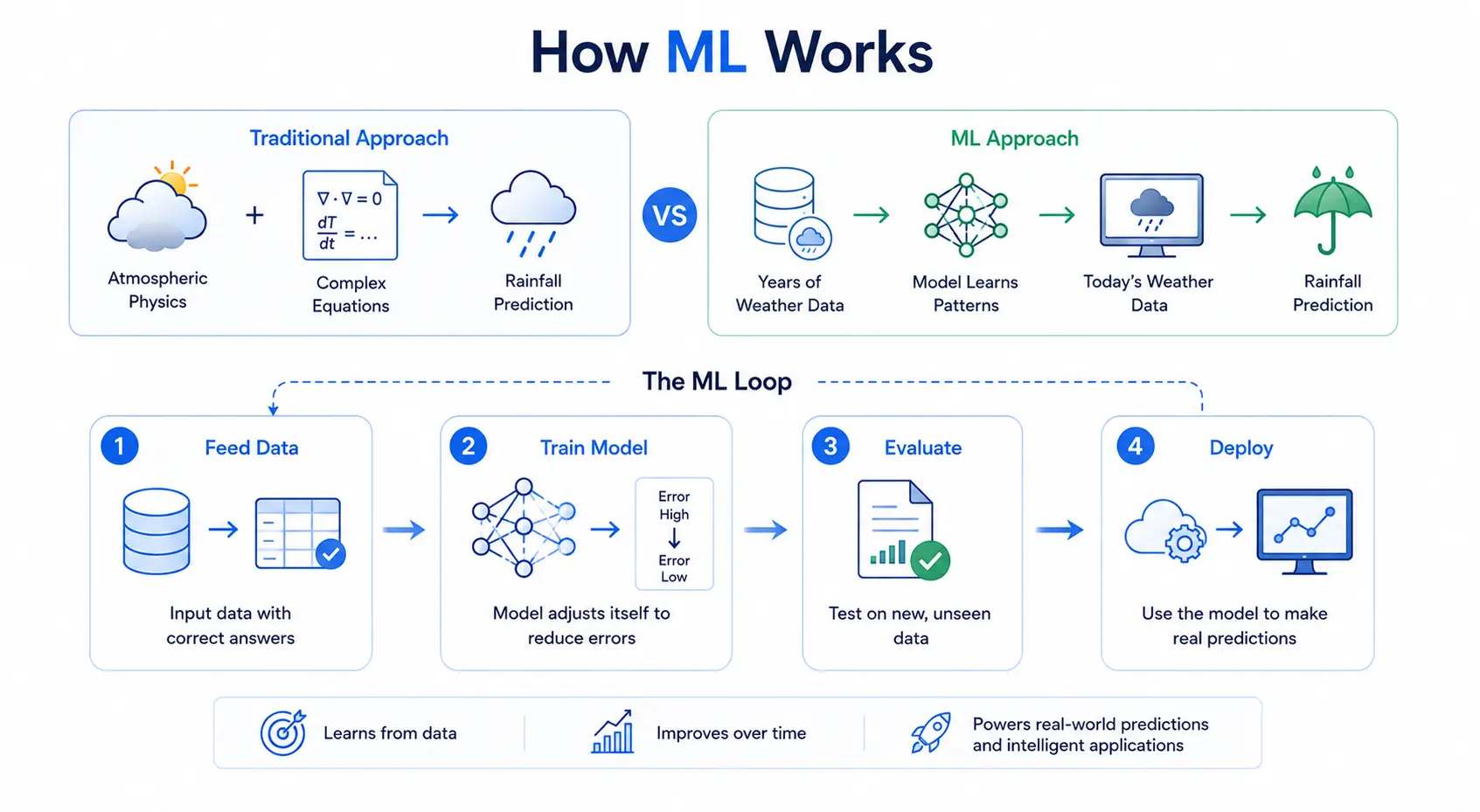
Say you want to predict rainfall. The traditional approach means modeling atmospheric physics with complex equations, extremely difficult to get right. The ML approach is different: you feed a model years of historical weather data until it learns the relationship between weather patterns and rainfall outcomes. Then you give it today’s weather data, and it predicts the rain.
At a high level, ML always follows the same loop:
- Feed data into the model, often with the correct answers included.
- Train the model, adjusting it internally until its predictions get closer to the correct answers.
- Evaluate how well it performs on new data it hasn’t seen before.
- Deploy the trained model to make real predictions or generate real content.
What are the ML types?
ML systems generally fall into one of four categories, based on how they learn:
- Supervised learning: Trained on data that already has the correct answers labeled. It learns the connection between inputs and outputs, then applies that to new data. Used for tasks like predicting house prices (regression) or spam-filtering emails (classification).
- Unsupervised learning: Trained on data with no labeled answers. It finds patterns and groupings on its own, commonly through clustering, like grouping customers by purchase behavior without being told what the groups should be.
- Reinforcement learning: Learns by trial and error, receiving rewards or penalties for actions taken in an environment, and gradually finding the strategy that earns the most reward. This is how systems like AlphaGo learned to play Go, and how many robotics and game-playing systems are trained.
- Generative AI: Learns patterns from existing data well enough to create new, similar content, text, images, audio, or code, rather than just predicting a label or number. This is the category behind tools like ChatGPT and image generators.
Machine learning use cases
The following are the ML use cases:
- Recommendations: Suggesting products, movies, or songs based on past behavior (Netflix, Spotify, e-commerce platforms).
- Fraud detection: Flagging unusual transaction patterns in banking and payments in real time.
- Predictive maintenance: Estimating when equipment is likely to fail, before it actually does, in manufacturing and logistics.
- Image and speech recognition: Powering photo tagging, voice assistants, and medical image analysis.
- Demand forecasting: Predicting inventory needs, ride times, or energy usage based on historical patterns.
- Content generation: Drafting text, summarizing documents, and generating code, via generative AI models.
What are Machine Learning Libraries?
Machine learning libraries are pre-built software toolkits that give developers ready-made functions and structures for building ML models, so they don’t have to implement algorithms like gradient descent or neural network layers from scratch. Examples include TensorFlow, XGBoost, OpenCV, Pandas, etc.