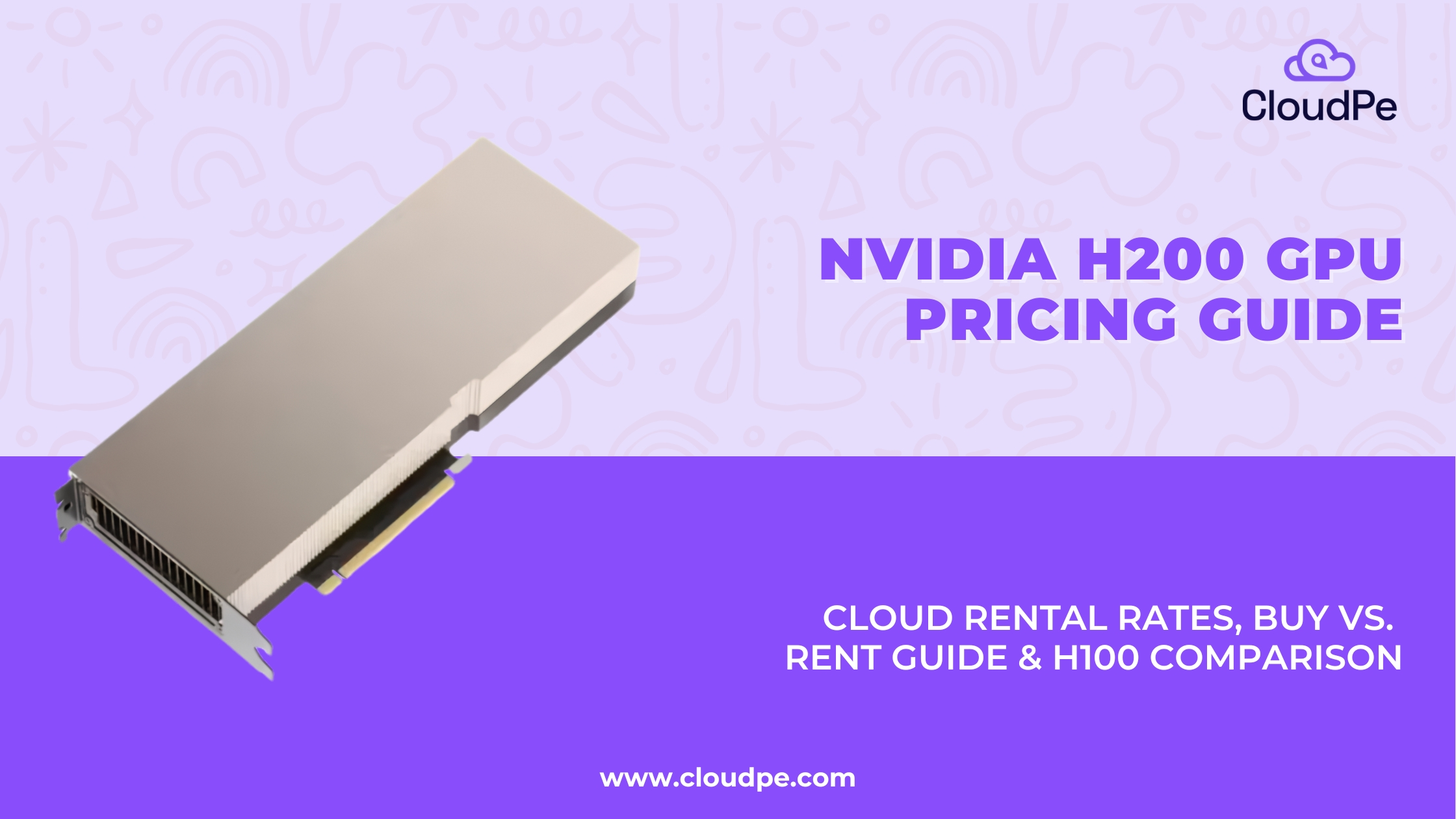
With the rapid growth in the AI industry, the demand for GPUs with higher memory is clearly increasing. Until 2024, with H100, 80 GB of GPU memory was more than enough. But now, the context windows stretched past 32K tokens, models crossed the 70-billion-parameter mark, and teams running inference on H100s started hitting a wall. And we all know this is not the first time, this happened with the model before that and the one before. With this increasing necessity, NVIDIA launched the H200. Same Hopper silicon, same compute, but 76% more memory, and enough extra bandwidth to make sure that memory doesn’t just sit there unused.
The H200 cloud pricing will be more compared to H100. Whether you decide to buy or rent H200 GPU. It’s fair if you are in a dilemma about whether the extra memory is worth paying for or just a bigger number on a spec sheet.
Short answer: depends entirely on what you’re running. A model that fits comfortably in 80 GB won’t see the benefit. One that doesn’t will see it immediately, in fewer GPUs needed and less time spent working around memory limits.
TL;DR
The Nvidia H200 costs $30,000 to $45,000 to buy outright, and $2.43 to $13.78 an hour to rent, depending on the provider. Most specialised H200 cloud pricing is between $2.43 and $4.50/hr. Hyperscalers charge $10.60/hr and up, usually with an 8-GPU minimum. CloudPe offers it on-demand in India at Rs. 300/hour, with 16 vCPUs, 128 GB RAM, and 250 GB NVMe included, in a Mumbai Tier-4 facility, no forex billing, no minimum GPU count
| # | Provider | Instance / Shape | GPUs | Per-GPU Price |
|---|---|---|---|---|
| 1 | CloudPe | H200 GPU (single up to 8×) | 1, 2, 4, 8 | ₹300/hr (~$3.40–3.60) |
| 2 | AWS | p5e.48xlarge / p5en.48xlarge | 8 | p5en ~$7.91/GPU |
| 3 | Azure | Standard_ND96isr_H200_v5 | 8 | ~$13.78/GPU |
| 4 | Google Cloud | a3-ultragpu-8g | 8 | ~$10.85/GPU |
| 5 | Oracle (OCI) | BM.GPU.H200.8 (bare metal) | 8 | $10/GPU |
What is the Nvidia H200?
The H200 GPU is Nvidia’s memory-upgraded version of the H100. Same compute die, same 16,896 CUDA cores, same 700W power draw. The difference is memory: 141 GB of HBM3e instead of the H100’s 80 GB, and 4.8 TB/s of bandwidth instead of 3.35 TB/s.
It launched in November 2024 as a drop-in replacement for existing H100 systems. No new architecture. No re-engineering required. You take an H100 rack and swap in H200s.
Why the memory jump matters
Large language models are increasingly limited by memory, not compute. A 70-billion-parameter model at standard 16-bit precision needs roughly 140 GB just to hold its weights, before adding memory for context and cache. That’s already past what a single H100 can hold. On an H200, it fits on one GPU.
Fewer GPUs needed per model means fewer nodes, less networking overhead between GPUs, and less complexity in how the workload is split up. That’s where the H200’s price premium can pay for itself, if your workload actually needs the memory.
How much does an Nvidia H200 GPU cost to buy?
If you’re buying hardware outright, here’s what to expect.
| Configuration | Price |
|---|---|
| Single H200 GPU | $30,000 to $45,000 |
| 8-GPU H200 server (e.g. DGX-class) | $300,000 to $400,000+ |
| Single H200 GPU, landed in India | Rs. 40 to 50 lakh |
| 8-GPU server, landed in India | Approaching Rs. 1 crore |
The price range of a single GPU depends on the form factor you choose. SXM is usually higher compared to PCIe. Another factor influencing the prices of GPUs is the supply. It has stayed tight since launch, so prices sit toward the higher end more often than not.
A few other things to keep in mind when buying GPUs in India from a price perspective:
- Import duties and logistics. It adds a meaningful premium on top of the global price.
- Power, cooling, and rack infrastructure.
The hard truth:
The cost and the maintenance cost are so high that most buyers, in India and globally, don’t purchase H200s outright unless they’re running near-constant utilisation for years. And honestly, it is a smart decision. The obvious alternative to this is renting.
Nvidia H200 cloud pricing for rental
H200 cloud pricing splits into three tiers, and they’re priced very differently.
| Tier | Typical rate | Trade-off |
| On-demand, specialised AI clouds | $2.43 to $4.50/hr | Balance of price and reliability |
| Hyperscalers (AWS, Azure, GCP) | $10.60/hr and up | Usually requires an 8-GPU minimum commitment |
| Spot / preemptible | As low as $0.31/hr | Your job can be paused or killed with little notice |
Rent NVIDIA H200 GPU
Deploy NowNvidia H200 vs H100: price and performance
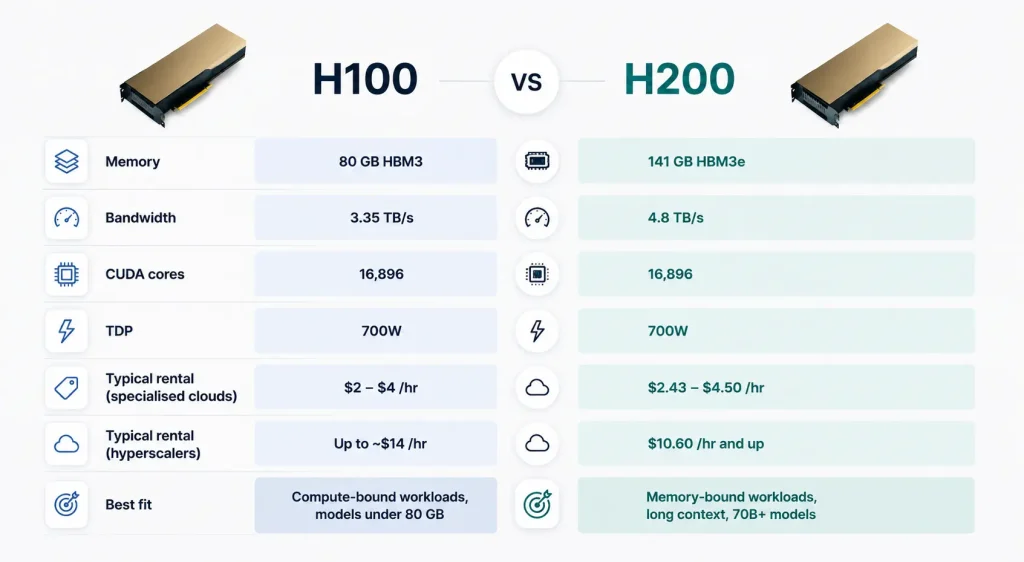
Compute is identical between the two chips. Same CUDA core count, same tensor core throughput, same peak FP16 and FP8 numbers. Every difference below comes from memory.
| H100 | H200 | |
|---|---|---|
| Memory | 80 GB HBM3 | 141 GB HBM3e |
| Bandwidth | 3.35 TB/s | 4.8 TB/s |
| CUDA cores | 16,896 | 16,896 |
| TDP | 700W | 700W |
| Typical rental (specialised clouds) | $2 to $4/hr | $2.43 to $4.50/hr |
| Typical rental (hyperscalers) | Up to ~$14/hr | $10.60/hr and up |
| Best fit | Compute-bound workloads, models under 80 GB | Memory-bound workloads, long context, 70B+ models |
Although the pricing is also compared, it should not be the first metric to compare with. The decision of choosing which GPU should depend on which one costs less for your workload. If your model and context window fit comfortably in 80 GB, the H100 is the better deal outright. If you’re hitting memory limits, you have to increase models of H100 to compensate. This additional H100 costs you in GPUs, in networking, and in engineering time, often more than the H200’s hourly premium.
Is the H200 price worth it?
Depends entirely on the workload. Here’s where the extra memory earns its keep.
Long-context inference
Retrieval-augmented generation pipelines and chatbots handling context windows past 100,000 tokens are exactly what the H200 was built for. The larger memory pool holds longer contexts per GPU without hitting out-of-memory errors or needing workarounds like aggressive context truncation.
LLM fine-tuning
Fine-tuning models in the 70B+ parameter range benefits directly from the extra headroom. Larger batch sizes and longer sequences fit without resorting to gradient checkpointing or model sharding, both of which slow training down and add engineering overhead.
Multi-tenant serving
Running multiple models or multiple customers on shared infrastructure means the H200’s memory lets you pack more tenants per GPU. Fewer GPUs needed for the same served traffic can make the higher hourly rate work out cheaper overall, not more expensive.
If none of these describe your workload, the H100 is very likely the better economic choice. Don’t pay for memory you won’t use.
Should you buy or rent an H200 GPU?
Run the numbers before deciding.
An 8-GPU H200 server costs roughly $300,000 to $400,000 upfront. Renting the same 8 GPUs at the current market median ($3.94/hr per GPU) costs about $31.50 an hour, or roughly $23,000 a month at full-time, 24/7 utilisation.
At that rate, it takes 14 to 16 months of continuous, fully-utilised rental to match the upfront purchase cost, and that’s before counting power, cooling, networking, and the staff needed to run physical infrastructure.
Buy if:
- You’re running near 100% utilisation for 18+ months or more
- You have the facilities and in-house team to operate GPU hardware
- You can absorb the capital outlay upfront without it affecting runway
Rent if:
- Your utilisation is variable or seasonal
- You’re still validating a workload or model
- You need to scale monthly, up or down
- You don’t want to carry depreciation risk as newer GPUs (like the B200) reach the market
For most companies outside a handful of large AI labs, renting wins. The breakeven point assumes a level of sustained, predictable, near-constant utilisation that most teams don’t actually have.
Rent NVIDIA H200 GPU
Deploy NowCloudPe H200 GPU cloud
CloudPe runs NVIDIA H200 GPU cloud instances out of a Tier-4 data centre, billed in INR.
| Detail | |
| On-demand rate | Rs. 300/hour, single H200 |
| Included | 16 vCPUs, 128 GB RAM, 250 GB NVMe storage |
| Reserved / monthly | Available for steady workloads; contact sales for a quote |
| Multi-GPU | 2x, 4x, and 8x H200 configurations, as VMs or dedicated bare-metal |
| Location | India, Tier-4 data centre |
At current exchange rates, Rs. 300/hour works out to roughly $3.60.
Why CloudPe H200 GPU
- The data stays in India, and your monthly bill isn’t exposed to forex swings the way a US or EU-billed invoice is.
- Time to first token on comparable long-context workloads drops from around 48ms to 21ms compared to standard H100 setups.
- 99.9% uptime SLA and a Tier-4 facility.
Have any questions regarding CloudPe H200 GPU?
Contact UsConclusion
The H200 vs H100 will not be the last time this exact debate plays out. Another GPU with more memory will launch, another model will need every bit of it, and the same argument will happen all over again. It always comes down to one question: does your workload actually need what you’re paying extra for, or does it just sound like it should? As far as H200 GPU is concerned, check your own numbers before the spec sheet convinces you either way. Price your actual workload on a couple of providers and let that decide it, not the marketing on either side of the H100 vs H200 debate.
Frequently Asked Questions
How much does an Nvidia H200 GPU cost?
Buying one outright costs $30,000 to $45,000. Renting one costs $2.43 to $13.78 an hour depending on the provider, with most specialised clouds charging $2.43 to $4.50 an hour.
Why is the H200 more expensive than the H100?
The H200 has 76% more memory (141 GB vs 80 GB) and 43% more bandwidth, at the same compute. That extra memory has been in tight supply since launch, which keeps rental and purchase prices higher than the H100.
Is the H200 faster than the H100?
H200 is not faster than H100. The reason is that their compute is identical. The H200’s advantage is memory and bandwidth, which translates to real performance gains on memory-bound work like long-context inference and large-batch fine-tuning. On compute-bound workloads, expect little to no difference.
Should I rent or buy an H200 GPU?
Rent unless you can guarantee near-full utilisation for 18 months or more. At typical rental rates, buying an 8-GPU server only pays off after roughly 14 to 16 months of continuous, full-time use, before counting power, cooling, and staffing.
Will H200 pricing drop as Nvidia’s B200 rolls out?
Not yet. B200 supply remains constrained, with backlogs reported in the millions of units through mid-2026. That’s part of why hyperscalers raised H200 prices in January 2026 instead of lowering them. Expect H200 pricing to ease only once Blackwell supply scales up meaningfully, likely later in 2026.
Does memory alone justify choosing the H200 over the H100?
Only if your workload is memory-bound. Check whether your model, context length, and batch size fit within 80 GB before paying the H200 premium. If they do, the H100 is the cheaper option with no performance cost.