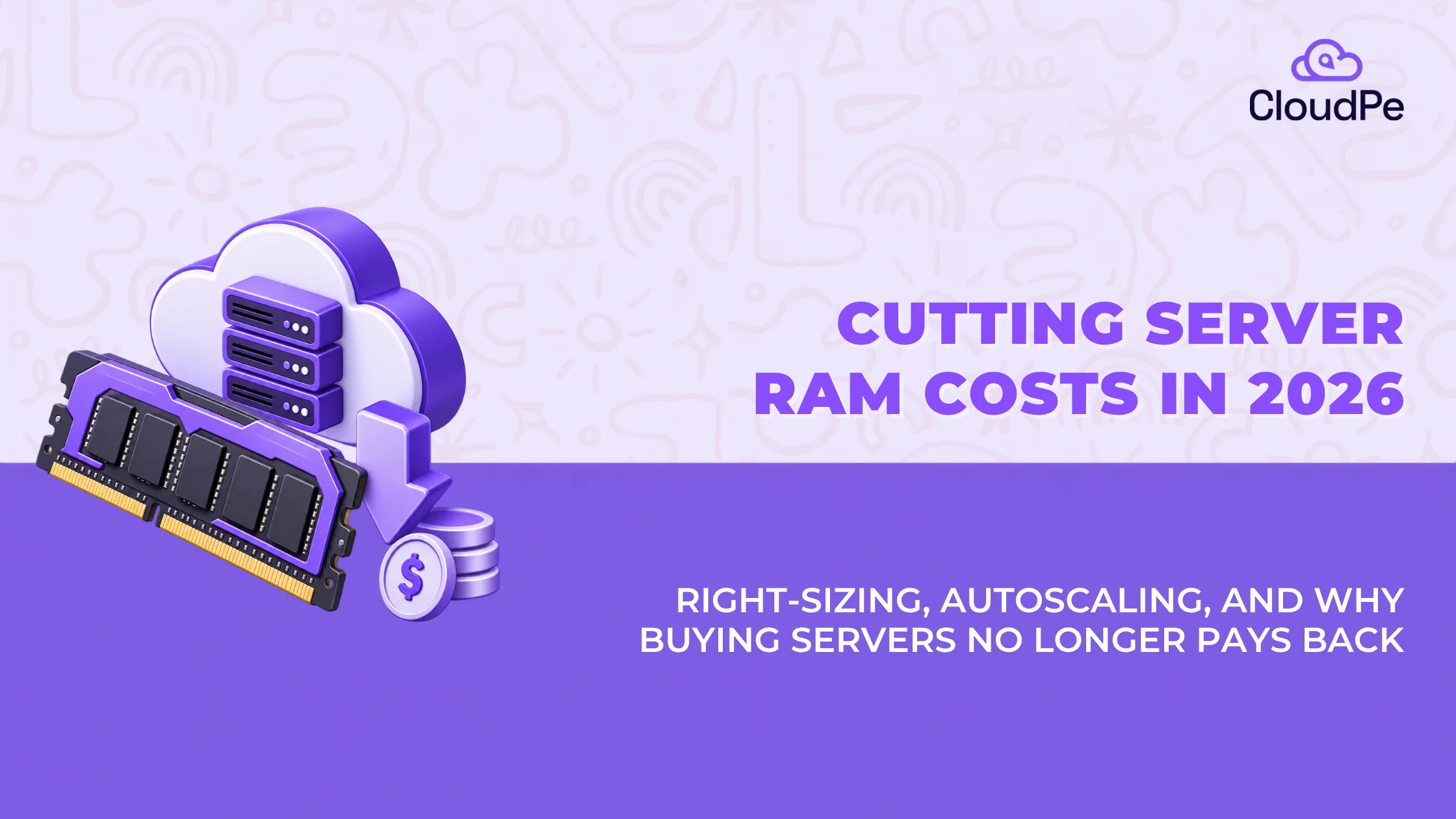
You can reduce server RAM costs using cloud solutions in three ways. Shift memory-heavy workloads off owned hardware onto rented cloud capacity. Right-size memory instead of overprovisioning “just in case.” Use managed in-memory services instead of self-hosted RAM-heavy servers.
This matters more in 2026 than in past years. TrendForce reports that DDR4 prices have climbed 158% and DDR5 prices have surged 307% since September 2025, driven by AI data centers consuming an outsized share of global memory production.
Here’s why prices moved this fast, and what actually works to bring your costs back down.
Why server RAM prices are rising so sharply in 2026
Server RAM prices are rising because AI accelerators need high-bandwidth memory (HBM), and manufacturers have redirected production capacity away from standard server memory to build it. TrendForce estimates HBM wafer input will grow from about 18% of total DRAM wafer capacity at the end of 2025 to roughly 22% by the end of 2026, because it earns manufacturers 3 to 5 times more revenue per wafer than conventional DDR5.
That reallocation shows up directly in pricing. DDR4 prices have climbed 158%, and DDR5 prices have surged 307% since September 2025, per the same TrendForce data. A 64GB DDR5-4800 module that cost around $380 in early 2025 now runs $820 to $890.
Mind you, this isn’t a temporary spike
Analysts aren’t calling this a normal market cycle. SemiAnalysis has described it as a “once-in-four-decades” shortage, and current projections suggest pricing won’t normalize before 2027 or 2028, rather than the usual 12- to 18-month recovery window that memory shortages have followed in the past.
Manufacturers are also prioritizing large, multi-year contracts over smaller individual orders, which means the businesses most exposed to this shortage are often the ones with the least buying power: small and mid-sized companies ordering servers one at a time, rather than hyperscalers locking in supply years in advance.
How much more server memory costs now
Gartner estimates a combined 130% surge in DRAM and SSD pricing by the end of 2026 compared to 2025. Since memory typically makes up 20 to 30% of a server’s total bill of materials, that translates into roughly a 5 to 10% increase on the total cloud bill once it passes through compute, storage, and provider margins, smaller than the raw DRAM shock, but still a real number on every invoice.
Delivery times have stretched too. A server that shipped in two to three weeks in 2024 now often takes six to eight weeks, since manufacturers are prioritizing large, multi-year contracts over individual orders.
Buying or refreshing servers rarely makes sense right now
Buying servers rarely makes financial sense during this shortage. The classic “hardware pays for itself in three years” math was built on 2024 pricing, and current memory costs have changed that math.
A real example clearly shows the gap. A business planning to refresh 15 servers for €180,000 instead migrated to cloud infrastructure at €4,500 per month, saving €18,000 over three years compared to the original purchase plan.
This is because cloud providers buy memory in volume at scale and can spread the cost shock across a much larger customer base than a single business can absorb by refreshing its own hardware alone. A hyperscaler negotiating multi-year supply contracts is playing a fundamentally different game than a business trying to order 15 servers’ worth of DDR5 on the open market this quarter.
There’s also a depreciation risk worth factoring in. Hardware bought today, at inflated prices, doesn’t get cheaper to own once the market eventually corrects. That risk sits entirely with the buyer under a purchase model, and shifts to the provider under a rental one.
If your team is currently weighing a hardware refresh against renting equivalent capacity, it’s worth comparing current cloud pricing against a fresh hardware quote before assuming the old three-year payback math still holds.
Cloud providers are absorbing this shock differently
Not every provider is passing this cost increase in the same way, which makes provider choice matter more than usual right now. OVHcloud has published its pricing changes directly, targeting an average increase of just 9 to 11% for its public cloud and bare-metal services through 2028, explicitly choosing not to pass on the full component-cost spike. Other providers have moved differently, with some reporting cloud server price increases of 30-37% in certain markets.
That’s a meaningful gap for the exact same underlying memory shortage. Comparing how transparently a provider communicates and absorbs this increase is worth as much attention as comparing their advertised rate per GB of RAM.
A provider offering flat, predictable pricing makes this comparison easier, since the increase (or lack thereof) shows up clearly rather than being buried across dozens of line items.
Five ways to cut cloud RAM costs without cutting performance
Beyond choosing the right provider, a few practical habits make a real difference in what you actually pay for memory:
- Right-size memory-optimized instances instead of defaulting to the largest RAM tier “to be safe.” Most workloads use far less peak memory than the instance size suggests.
- Use autoscaling so you’re not paying for idle RAM around the clock on infrastructure sized for rare traffic spikes.
- Move to managed in-memory services like Redis instead of self-hosting memory-heavy databases, letting the provider absorb hardware refresh risk rather than you.
- Tier your data properly, keeping only genuinely hot data in RAM and moving cold or infrequently accessed data to cheaper storage instead of memory.
- Lock in reserved or committed pricing for steady baseline workloads now, before further increases push reserved rates higher too.
Fortunately, none of these require ripping out existing infrastructure to implement. Most teams see the fastest results from right-sizing first, since it’s usually a configuration change rather than a migration project, and it directly targets the gap between provisioned memory and what a workload actually uses.
CloudPe gives you transparent, INR billing with no hidden costs and ₹0 egress fee.
Try now for freeWhich workloads get hit hardest by rising RAM costs
Memory-optimized workloads take the biggest hit, since their entire cost structure depends more heavily on RAM than on compute. That includes memory-optimized cloud instance types such as AWS’s R-series, Azure’s E-series, and Google Cloud’s high-memory tiers, as well as in-memory databases such as Redis and ElastiCache.
If your infrastructure relies on any of these, the techniques above matter more to your bill than to a typical compute-heavy workload that uses memory more lightly. A team running a large in-memory cache layer, for instance, will feel this shortage in a way a team running mostly stateless compute simply won’t, even if both are nominally paying for “cloud infrastructure” on the same invoice.
Conclusion
Server RAM prices in 2026 aren’t following a normal market cycle; they’re being reshaped by AI’s demand for high-bandwidth memory, and that reshaping isn’t reversing anytime soon.
Reducing your exposure means treating memory as a cost to actively manage rather than a fixed line item: right-size what you provision, choose a provider that isn’t passing on the full shock, and shift capital-heavy purchases toward flexible cloud capacity while the underlying shortage plays out.
The businesses that come out of this shortage in the best position won’t be the ones who timed a single perfect purchase. They’ll be the ones who stopped treating memory as a fixed cost and started actively managing it the way they already manage compute and storage.
Frequently Asked Questions
Why is RAM so expensive in 2026?
AI accelerators require high-bandwidth memory, and manufacturers have redirected production capacity toward it, leaving less supply for standard server DDR4 and DDR5, which has pushed prices up 100% to over 300% since late 2025 depending on the memory type.
Will RAM prices go back down soon?
Not according to current projections. Most analysts expect gradual stabilization in the second half of 2026 at the earliest, with a full return to pre-shortage pricing unlikely before 2027 or 2028.
Is cloud actually cheaper than buying servers right now?
For most businesses, yes, since cloud providers buy memory at a scale individual businesses can’t match, and they spread the current cost shock across many customers rather than one buyer absorbing it all at once.
What’s the fastest way to cut cloud memory costs?
Right-sizing memory-optimized instances typically delivers the quickest savings, since most workloads are provisioned with far more RAM than they actually use at peak.
Should I delay a planned server refresh?
It depends on your timeline flexibility. If a refresh isn’t urgent, comparing current cloud pricing to today’s inflated hardware costs is worth doing before committing, since predictable cloud capacity often outperforms the old hardware payback math at current prices.