Virtual private servers (VPS) host websites, business applications, databases, and other online services in an isolated server environment. They offer more control and dedicated resources than shared hosting without the cost of an entire physical server.
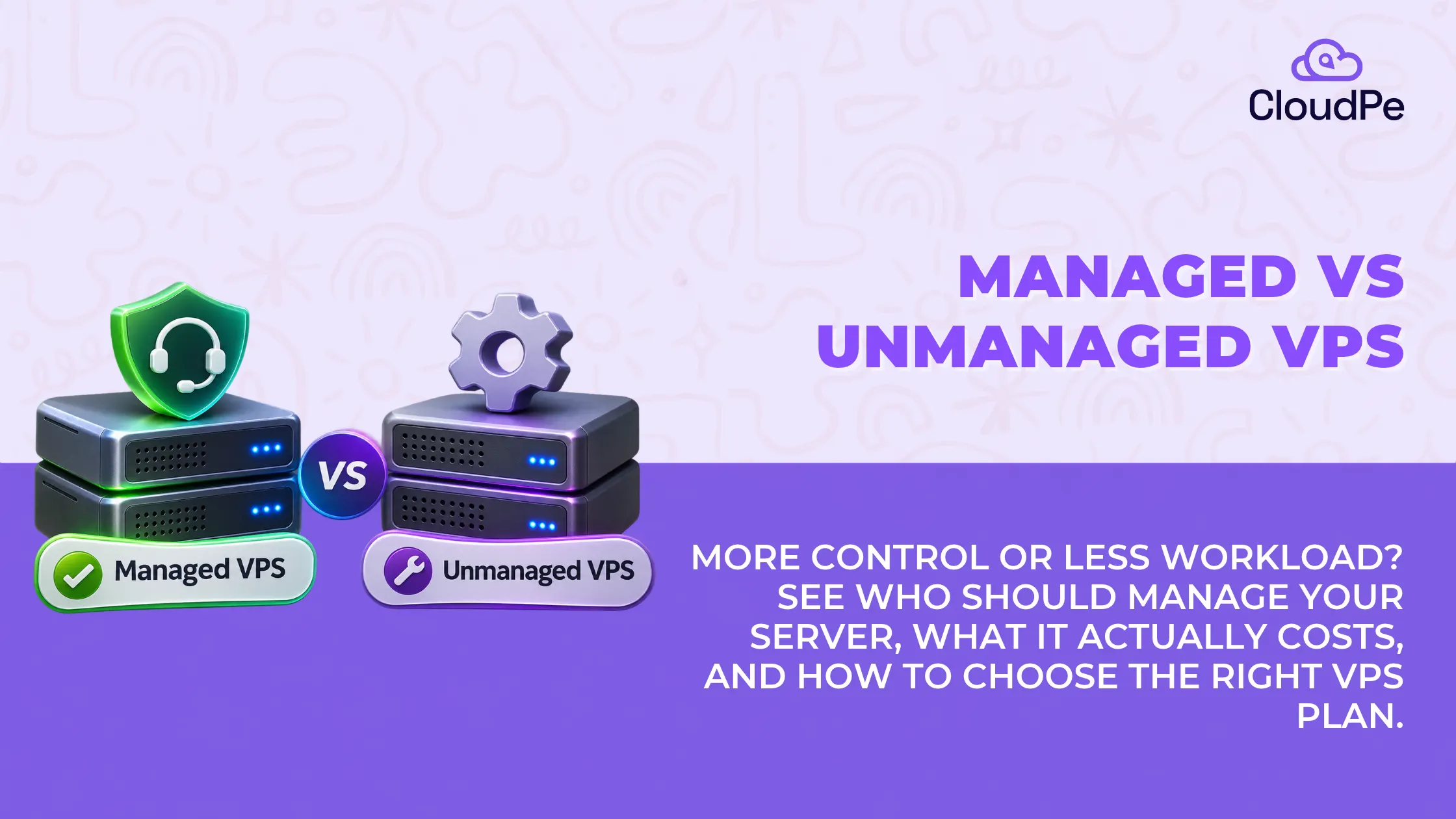
When choosing VPS hosting, businesses must also decide who will manage the server. Managed VPS hosting includes provider support for agreed tasks, such as system updates, monitoring, and security maintenance. Unmanaged VPS hosting requires businesses to handle most of these responsibilities themselves.
For small businesses, this choice affects operating costs, security practices, and the time spent on server maintenance. Understanding the differences helps businesses select a hosting plan that matches their technical expertise, application requirements, and available resources.
This blog compares managed and unmanaged VPS hosting, explains their key differences, and examines the costs, responsibilities, and selection criteria small businesses should consider before choosing a plan.
What is managed and unmanaged VPS hosting?
A virtual private server (VPS) is a virtual machine hosted on a physical server. It provides an independent operating environment with allocated computing resources, including CPU, RAM, and storage. Businesses can use it to host websites, applications, databases, and other services.
The main difference between managed and unmanaged VPS hosting is the responsibility for server administration.
Managed VPS hosting: Server administration handled by the provider
Managed VPS hosting includes server-management services provided by the hosting company. Depending on the plan, these may cover operating system updates, security patching, monitoring, software installation, backups, and technical troubleshooting.
The provider manages the agreed server-level tasks while the business focuses on its website, application, or online services.
This model can suit small businesses that need more control than shared hosting offers but lack the resources to manage server operations internally.
For example, a small e-commerce business may need a VPS to host its online store and database. A managed plan can help the team handle routine server maintenance without assigning every administrative task to an employee.
However, managed hosting does not automatically cover every technical requirement. Application debugging, custom development, database optimisation, backup retention, and incident response may fall outside the plan’s scope.
Businesses should verify which services are included before purchasing a managed VPS plan.
Get managed cloud services with 24/7 AIOps monitoring.
Try CloudPeWhen unmanaged VPS hosting makes more sense
Managed hosting is not automatically the best option for every business. An unmanaged VPS can be a practical choice when the team has the expertise and time to manage the environment.
The business has in-house technical expertise
A business with experienced developers or system administrators may already have processes for server setup, security patching, monitoring, and backups.
In that case, paying for management services may add limited value if the provider’s services duplicate existing capabilities.
The team must still ensure that server responsibilities are clearly assigned and that maintenance continues when key employees are unavailable.
The application requires custom configurations
Some applications need specific software versions, system dependencies, networking rules, or deployment workflows.
An unmanaged VPS can give the technical team more freedom to configure and maintain the environment. This is particularly useful when standard managed plans restrict certain administrative changes.
Businesses should still review the provider’s acceptable-use policies and technical limitations before deploying custom configurations.
The business wants to reduce direct hosting costs
Unmanaged VPS plans often have lower advertised prices because they include fewer server-management services.
This can benefit businesses that already have the people and processes needed to maintain the server.
However, the comparison should include staff time, backup infrastructure, monitoring tools, support requirements, and the cost of resolving incidents. A lower monthly fee does not always mean a lower total operating cost.
Choosing the right VPS hosting for your business
The decision should reflect the team’s capabilities and the importance of the applications running on the server.
| Business situation | Option to consider | Why |
| Small business without dedicated IT staff | Managed VPS | Reduces routine server-administration work |
| Business website or online store with limited technical support | Managed VPS | Provides access to agreed management and support services |
| Development team comfortable managing Linux servers | Unmanaged VPS | Offers greater administrative control |
| Business with specialised software requirements | Unmanaged VPS | Allows the team to configure and maintain its environment |
| Business where server issues can disrupt operations | Managed VPS | May provide monitoring and server-level incident support |
| Business with experienced system administrators | Unmanaged VPS | Can avoid paying for management the team already provides |
Business size alone does not determine the right hosting model. A small company running a revenue-critical application may need more support than a larger company with an experienced technical team.
Before deciding, ask four questions:
- Does the team know how to configure and secure the server?
- Who will monitor the server and respond to incidents?
- Are backups and restoration procedures in place?
- Would the cost of internal administration exceed the price of managed hosting?
If these responsibilities cannot be handled consistently, a managed plan may be the more practical option. If the business already has the expertise and processes, unmanaged hosting may offer better control over its environment.
Managed VPS hosting pricing resources in India
The cost of managed VPS hosting in India depends on server resources, the level of management, software licences, support arrangements, and billing terms.
A lower-priced plan may provide basic server resources with limited support. A higher-priced plan may include proactive monitoring, backups, migration assistance, security maintenance, or a control panel.
The important consideration is what the business receives for the price.
Server resources and configuration
CPU allocation, RAM, storage capacity, storage performance, bandwidth, and operating system choices affect VPS pricing.
A small business hosting a basic website may need fewer resources than an online store with a large product catalogue and a database handling frequent transactions.
Compare plans using equivalent specifications rather than selecting the cheapest option based only on its advertised monthly fee.
Scope of server management
Management services can create a significant difference between two plans with similar hardware specifications.
Check whether the plan includes:
- Operating system and security updates.
- Server monitoring and alerts.
- Backup configuration and restoration.
- Firewall setup and security hardening.
- Software installation and server configuration.
- Migration assistance and technical troubleshooting.
Do not assume that all these services are included. Some providers offer them as add-ons, while others limit support to specific tasks.
Total cost beyond the monthly plan
The VPS hosting server price is only one part of the total cost.
Businesses should also consider staff time, backup storage, control-panel licences, security tools, bandwidth charges, and additional support. For unmanaged hosting, these responsibilities may require internal resources or separate services.
When comparing a VPS server price in India, review renewal rates, applicable taxes, billing commitments, and the resources included in each plan. Introductory discounts may not reflect the long-term cost.
The best-value plan is the one that meets the workload’s requirements while keeping management and operating costs predictable.
| Cloud VPS hosting in India starting at ₹930/month. | Try CloudPe |
Checklist for choosing a managed VPS provider in India
A managed VPS provider should offer a clearly defined service, not just a virtual server with a management label.
Before purchasing managed VPS hosting in India, review the following areas.
Server management and support
Ask which operating system tasks the provider handles and whether support covers server configuration, software installation, troubleshooting, and performance issues.
Check support availability, escalation procedures, and response commitments. A provider’s advertised 24/7 support does not necessarily mean every issue receives immediate resolution.
Backup and recovery
Confirm whether backups are included, how frequently they run, how long they are retained, and whether restoration carries an additional charge.
A backup is useful only if the business can recover the required data within an acceptable timeframe. For critical applications, consider maintaining an independent backup copy and testing restoration procedures.
Security responsibilities
Understand who manages operating system patches, firewall configuration, access controls, and server-level security.
The business remains responsible for application security and data-handling practices unless those services are explicitly included in the agreement.
Performance and upgrade options
Compare CPU, RAM, storage type, bandwidth, and network capacity. Check whether the provider can increase resources as requirements change and whether upgrades require downtime or migration.
A plan with generous specifications may still perform poorly if the application is not configured properly or the storage and network cannot meet its needs.
Infrastructure location and billing terms
For businesses serving Indian customers, the data centre’s location may influence network latency. The appropriate location also depends on where users and connected services operate.
Review the provider’s pricing structure, renewal rates, taxes, service commitments, and cancellation terms. These details help establish the long-term cost of hosting.
| Run whatever your business needs on one VPS server platform. | Try CloudPe |
Conclusion
Choosing between managed and unmanaged VPS hosting comes down to who can take responsibility for the server.
Managed VPS hosting can help small businesses reduce routine administration and access technical support without building a dedicated server-management team. Unmanaged VPS hosting can suit businesses with the expertise to configure, secure, monitor, and maintain their own environments.
Before choosing a plan, evaluate the team’s technical capabilities, the application’s importance, the provider’s management scope, and the total operating cost. The right VPS hosting arrangement should meet current business needs while keeping server responsibilities clear as the business grows.
Frequently Asked Questions
What is managed VPS hosting?
Managed VPS hosting is a virtual private server service where the provider handles agreed server-administration tasks. These may include operating system updates, security patching, monitoring, backups, and technical support. The exact scope depends on the plan.
What is the best managed VPS hosting plan in India?
The best plan depends on the application’s resource requirements and the support the business needs. Compare CPU, RAM, storage, bandwidth, server location, backup policies, management scope, support commitments, and renewal pricing. A plan with more resources is not necessarily better if the application does not need them.
What is VPS hosting used for?
VPS hosting is used to run business websites, e-commerce stores, web applications, databases, development environments, and other services that need an independent virtual server. It provides more control than typical shared hosting while avoiding the need to rent an entire physical server.
How to manage a VPS server?
Managing a VPS involves configuring the operating system, installing required software, securing access, applying updates, monitoring resource usage, maintaining backups, and troubleshooting issues. Businesses can handle these tasks internally with the right technical expertise or choose a managed VPS plan that covers specified responsibilities.
Is managed VPS hosting free?
Fully managed VPS hosting generally involves a recurring fee because server administration and technical support require ongoing work. Some providers may offer free trials, promotional credits, or limited introductory offers. Check whether management services remain included after the promotion ends.
What is the difference between shared VPS hosting and managed VPS hosting?
These terms describe different aspects of hosting. Shared VPS hosting is not a consistently defined industry category, so the provider’s exact meaning should be checked. Managed VPS describes who handles server administration. A VPS can use virtualised hardware shared with other customers while still providing an independently managed server environment.
What is KVM VPS hosting?
KVM VPS hosting uses Kernel-based Virtual Machine (KVM), a virtualisation technology that allows a physical Linux server to host virtual machines. Each virtual machine operates as a separate environment with allocated resources. KVM describes the virtualisation technology, not the level of server management; a KVM VPS can be managed or unmanaged.
How much does a VPS server cost in India?
The VPS server price in India varies with CPU, RAM, storage, bandwidth, virtualisation technology, management services, and billing terms. Unmanaged plans generally have lower entry prices, while managed plans may cost more because they include administration and support. Compare current plans using equivalent specifications and check taxes and renewal rates.
What is the cheapest VPS hosting in India?
The cheapest VPS hosting in India is not necessarily the most economical choice for a business. Compare the resources included, performance, support, backup arrangements, security responsibilities, and renewal price. A low-cost unmanaged plan may be suitable for a technical team, while a business without server-administration expertise may benefit more from a managed plan.