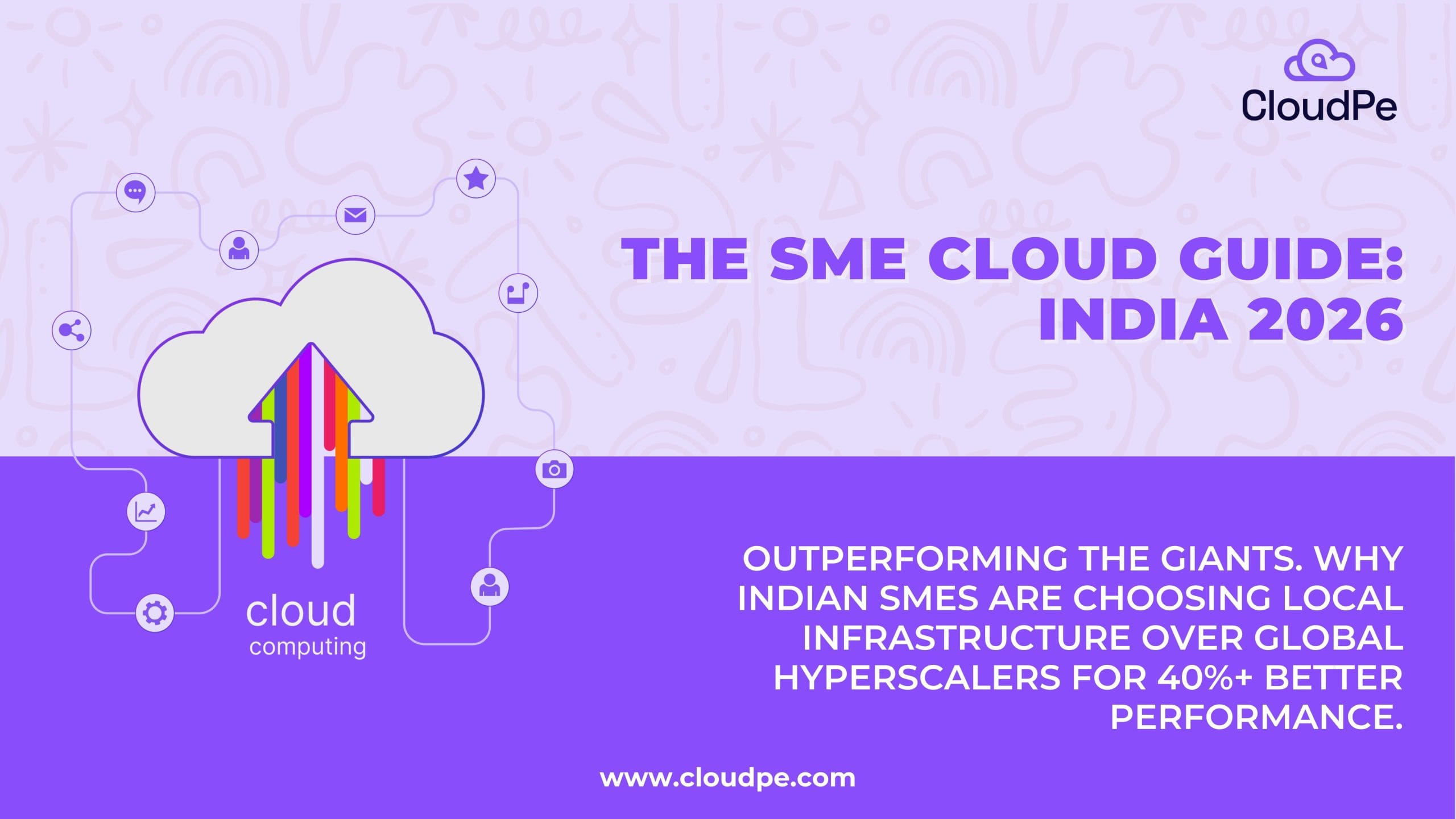
Choosing the right cloud service provider is an important decision for growing small and medium-sized enterprises (SMEs) in India. From hosting business websites and e-commerce platforms to running SaaS applications and managing customer data, businesses need cloud infrastructure that delivers reliable performance without making IT costs difficult to manage.
India’s demand for cloud infrastructure continues to grow. According to Gartner’s November 2026 forecast, infrastructure-as-a-service (IaaS) spending in India is expected to increase by 40.3% in 2027.
For SMEs, however, choosing the best cloud service provider in India is not simply about selecting the biggest company or the lowest-priced virtual machine. Performance, scalability, total cost, technical support, security, and data centre location all influence whether a cloud solution can support business growth.
This guide compares leading cloud service providers in India, explains their suitability for different business workloads, and outlines the key factors SMEs should evaluate before making a decision.
Comparing cloud service providers in India
India’s cloud computing market includes global hyperscalers, domestic infrastructure providers, developer-focused platforms, and managed cloud hosting services.
Each type of provider offers different advantages. Global providers typically offer extensive service portfolios, while India-focused providers may appeal to businesses looking for locally hosted infrastructure, INR billing, and support suited to domestic requirements.
Here is a comparison of six cloud service providers that SMEs can consider.
| Cloud provider | Best suited for | Key considerations |
| CloudPe | Indian SMEs, business applications, cloud VMs, and locally hosted infrastructure | INR pricing, NVMe storage, India-based infrastructure, and technical support |
| Amazon Web Services (AWS) | Businesses requiring extensive managed services, complex architectures, and global deployments | Broad service portfolio, multiple pricing components, and technical complexity |
| Microsoft Azure | Organizations using Microsoft technologies, enterprise applications, and hybrid environments | Microsoft ecosystem integration, licensing, and service-specific pricing |
| Google Cloud | Data analytics, AI/ML applications, and cloud-native development | Advanced data and application services, with costs varying by workload |
| DigitalOcean | Startups, developers, and small technical teams | Straightforward VM deployment, developer tools, and infrastructure management responsibilities |
| Utho | Businesses evaluating Indian cloud infrastructure and regional hosting options | India-based compute options, regional availability, and workload-specific pricing |
This comparison focuses on general provider suitability rather than an absolute ranking. Features, prices, and available services depend on the selected region and configuration.
CloudPe: India-focused cloud infrastructure for growing businesses
CloudPe provides cloud infrastructure designed for businesses that need flexible computing resources, local hosting options, and manageable infrastructure costs.
Its offerings include cloud virtual machines, NVMe storage, networking services, object storage, and GPU computing options for AI and other demanding workloads.
For Indian SMEs, CloudPe’s INR-based pricing and hourly or monthly compute billing can make infrastructure costs easier to evaluate. Businesses can select resources according to workload requirements rather than committing to unnecessarily large configurations.
CloudPe also provides India-based infrastructure and technical support, making it an option for businesses that prioritize local deployment and assistance with their hosting requirements.
However, businesses should still assess the complete cost of their deployment, including storage, backups, networking, and any additional services.
AWS, Microsoft Azure, and Google Cloud: Global cloud platforms
AWS, Microsoft Azure, and Google Cloud offer extensive cloud service portfolios, including compute, databases, networking, analytics, and application development tools.
AWS is suitable for organizations requiring a wide selection of managed services and infrastructure across multiple regions.
Microsoft Azure is particularly relevant to businesses working with Microsoft technologies, Windows-based applications, and hybrid infrastructure.
Google Cloud offers capabilities for data analytics, artificial intelligence, and cloud-native application development.
Importantly, all three providers operate cloud regions in India. Businesses can deploy supported services locally rather than automatically relying on overseas infrastructure.
Their extensive service portfolios are valuable, but SMEs should consider the additional operational knowledge and cost-management effort that complex cloud architectures may require.
Read More: Best AWS Alternatives in India
DigitalOcean and Utho: Additional options for SMEs
DigitalOcean offers cloud virtual machines, managed services, and developer-focused tools. It can suit startups and small development teams looking for relatively straightforward application deployment.
Utho provides cloud infrastructure with multiple Indian data centre locations. Businesses seeking India-hosted compute resources can evaluate its offerings against their specific performance and operational requirements.
Another option is managed cloud hosting through platforms such as Cloudways. These services add a management layer over underlying cloud infrastructure and may be suitable for businesses that prefer assistance with server and application operations.
The best choice depends on whether your business needs direct infrastructure control, managed services, or a combination of both.
For a more detailed look at infrastructure offerings, explore CloudPe’s cloud provider comparison.
Best cloud providers for different SME workloads
Different businesses use cloud infrastructure in different ways. A provider that works well for a basic company website may not be the best fit for a resource-intensive SaaS application or an AI workload.
Understanding your applications is therefore the first step toward selecting the right platform.
- E-commerce websites and online stores
E-commerce businesses need reliable hosting that can handle changing traffic volumes, especially during seasonal sales, promotional campaigns, and product launches.
For these workloads, businesses should prioritize:
- Fast website and database response times.
- NVMe or other suitable high-performance storage.
- Load balancing and scalable computing resources.
- Backups and tested recovery procedures.
- Infrastructure located close to their primary customer base.
For an online store primarily serving Indian customers, a cloud provider offering suitable infrastructure in India may help reduce network latency.
However, handling traffic spikes also depends on application optimization, caching, available resources, and scaling architecture.
- SaaS applications and growing startups
SaaS businesses require infrastructure that can accommodate increasing user activity while maintaining predictable application performance.
As the customer base grows, a startup may need to increase CPU and RAM capacity, introduce additional application servers, or deploy containerized services.
Cloud infrastructure that supports flexible virtual machines, private networking, load balancing, and Kubernetes deployments can provide room for expansion.
Businesses using Kubernetes should also understand whether the provider manages the cluster or whether the customer remains responsible for administration and maintenance.
- ERP, CRM, and internal business applications
Businesses running ERP platforms, customer relationship management systems, databases, and internal dashboards often prioritize security, predictable performance, and operational stability.
These applications may benefit from private networking, suitable storage configurations, regular backups, and controlled access.
The ideal provider should also offer appropriate support arrangements and clear service-level commitments.
- AI, machine learning, and GPU workloads
AI and machine learning workloads can require considerably more computing resources than conventional business applications.
GPU infrastructure may be necessary for model training, inference, and other accelerated computing tasks.
Businesses evaluating GPU cloud providers should compare accelerator models, GPU memory, supporting CPU and RAM resources, storage performance, available regions, and total usage costs.
CloudPe offers GPU computing options alongside its conventional cloud infrastructure, giving businesses another option when evaluating AI workloads in India.
Key factors when choosing the best cloud service provider
While every organization has different requirements, several factors consistently matter when evaluating cloud service providers in India.
- Performance and latency
Application performance directly affects user experience. Slow page loading, delayed database responses, and inconsistent application performance can negatively affect business operations.
However, performance cannot be evaluated through CPU specifications alone.
Businesses should consider:
- Compute performance: CPU capability for application processing and concurrent workloads.
- Storage performance: IOPS, throughput, and latency for databases and storage-intensive applications.
- Network performance: Bandwidth, packet loss, and latency between users and hosted services.
- Performance consistency: How infrastructure behaves during peak traffic and sustained workloads.
For example, an e-commerce website may depend heavily on database response times, while a video-processing application may require higher compute capacity.
A meaningful comparison should therefore use equivalent configurations and tests that reflect the actual workload.
CloudPe’s article on performance benchmarks for cloud provider selection explains how tools such as Geekbench, fio, and iPerf can be used to evaluate CPU, storage, and network performance.
Synthetic benchmarks provide useful information, but testing your actual application is equally important. Before selecting a provider, run representative workloads and compare response times, resource utilization, and performance under load.
- Scalability and resource flexibility
Growing SMEs need cloud infrastructure that can adapt as business requirements change.
A startup may initially require a single virtual machine but eventually need additional application servers, storage capacity, or load balancing.
Cloud providers can support this growth through different approaches.
Vertical scaling increases the CPU, RAM, or other resources available to an existing server.
Horizontal scaling adds more instances to distribute application traffic and workloads.
Some platforms also support autoscaling, which adjusts available resources based on predefined conditions or demand.
However, not every cloud service scales automatically. Businesses should confirm which scaling capabilities are available, whether downtime is required, and how additional resources are billed.
- Pricing and total cost of ownership
For many Indian SMEs, controlling cloud expenditure is just as important as achieving good performance.
Cloud providers may offer hourly billing, monthly plans, reserved capacity, or other pricing models. The actual cost depends on resource usage and the services selected.
For a meaningful comparison, businesses should consider the full monthly cost rather than only the advertised VM price.
This includes compute, storage, backups, networking, public IP addresses, support, and applicable taxes.
A low-priced virtual machine may become expensive if the deployment requires several additional paid services.
Similarly, a higher-priced offering may provide better value if it reduces operational work or includes services the business would otherwise purchase separately.
- Security and data protection
Security should be a central consideration when hosting business applications and customer information.
Businesses should evaluate available firewalls, network isolation, access controls, encryption options, backups, and recovery procedures.
It is also important to understand the shared responsibility model.
A cloud provider may protect the underlying infrastructure, but customers often remain responsible for securing operating systems, applications, user permissions, and stored data.
For businesses handling sensitive information, security controls should be evaluated alongside applicable legal, regulatory, and contractual obligations.
- Reliability and uptime commitments
A reliable cloud provider should clearly explain its service-level agreement (SLA), availability commitments, and processes for handling service disruptions.
For example, CloudPe’s published SLA specifies a 99.9% monthly uptime commitment for virtual machines, subject to the agreement’s terms and exclusions.
Other providers may offer different commitments depending on the service.
It is important to distinguish between a provider’s infrastructure SLA and the availability of an individual application.
Application uptime also depends on architecture, redundancy, monitoring, backups, and recovery planning.
For business-critical services, relying on a single server without a recovery strategy can create unnecessary operational risk, regardless of the cloud provider selected.
- Technical support and management
Many small businesses operate without a dedicated infrastructure administration team.
As a result, technical support can influence both the day-to-day experience and the overall cost of cloud hosting.
Before selecting a provider, evaluate its support hours, response targets, escalation process, and the types of issues covered.
A business using unmanaged cloud hosting may need to handle operating system updates, application configuration, monitoring, and troubleshooting independently.
Managed services can reduce some of that responsibility, but the exact scope varies by provider.
Understanding these differences helps SMEs avoid selecting infrastructure that exceeds their team’s technical capabilities.
Benefits of choosing cloud infrastructure in India
Data centre location is an important consideration for Indian businesses, especially when most customers and operations are based domestically.
- Lower latency for Indian users
Deploying applications closer to their users can help reduce network latency.
For example, an application primarily serving users in Mumbai or Pune may benefit from infrastructure in a nearby Indian region compared with an otherwise similar deployment hosted much farther away.
However, the improvement depends on network routing, application design, internet connectivity, and infrastructure performance.
AWS, Azure, and Google Cloud also offer Indian cloud regions, so businesses should compare actual deployment locations rather than assuming that every international provider hosts Indian workloads abroad.
- INR billing and easier financial planning
Cloud providers offering INR pricing can simplify budgeting and payment processes for Indian businesses.
Local currency billing may reduce the need for businesses to manage foreign exchange conversions directly.
CloudPe provides INR-denominated infrastructure pricing, allowing customers to estimate eligible cloud resources using locally displayed rates.
Nevertheless, businesses should verify taxes, additional resource charges, renewal terms, and pricing changes before finalizing a plan.
- Localized technical assistance
Businesses may prefer a provider with support teams familiar with Indian operating hours, payment systems, and common infrastructure requirements.
Local support can be useful when resolving configuration issues, coordinating deployments, or communicating about service incidents.
However, support quality should be judged by actual response commitments, technical expertise, and issue resolution rather than the provider’s geographic location alone.
- Data residency and operational requirements
Hosting infrastructure in India can help businesses meet particular data-location requirements and maintain greater visibility into where their applications and data operate.
However, choosing an Indian data centre does not automatically establish compliance with India’s Digital Personal Data Protection framework or sector-specific regulations.
Businesses should verify where production data, backups, logs, and related services are stored and processed, and assess the controls necessary for their particular legal obligations.
How to estimate cloud hosting costs for an SME
Cloud pricing can become difficult to compare when providers package infrastructure differently.
A practical way to evaluate costs is to start with a representative application configuration.
For example, a small business hosting a website and database might estimate:
| Cost component | What to evaluate |
| Compute | Required vCPUs, RAM, and billing duration |
| Storage | System disk, database storage, and additional volumes |
| Networking | Public IPs, load balancing, and data transfer charges |
| Backups | Backup frequency, retained storage, and restoration costs |
| Security | Additional security and monitoring services |
| Support | Included assistance and optional management charges |
| Licensing | Operating system and commercial software requirements |
Once the necessary resources are identified, compare the complete monthly estimate across providers.
Businesses should also account for potential growth. An application that runs comfortably with two virtual CPUs today may need greater capacity as user activity increases.
For seasonal workloads, flexible billing can be useful when resources are increased temporarily.
However, cost efficiency depends on correctly sizing infrastructure and removing resources that are no longer needed.
CloudPe provides public cloud pricing for its compute, storage, networking, and other available infrastructure services, allowing SMEs to evaluate configurations against their requirements.
Cloud infrastructure trends shaping SME decisions in 2027
Cloud infrastructure continues to become more important as Indian businesses expand their digital services.
In its November 2026 forecast, Gartner projected that India’s IaaS spending would grow by 40.3% in 2027, reflecting strong demand for infrastructure services.
For SMEs, the relevant development is not simply the expansion of the cloud market, but the increasing range of infrastructure choices available to support different applications.
Three considerations are particularly important.
- More workload-specific infrastructure: Businesses can choose computing resources according to the needs of websites, databases, containers, or AI applications rather than treating every workload identically.
- Greater attention to cost management: As businesses deploy more cloud services, understanding total spending and resource utilization becomes increasingly important.
- Growing interest in regional infrastructure: Data centre location, support requirements, network performance, and data governance remain relevant factors for businesses serving Indian customers.
These developments make it important for SMEs to review their infrastructure requirements regularly rather than selecting a cloud provider once and assuming the same configuration will remain suitable indefinitely.
Conclusion
Choosing the best cloud service provider in India requires balancing performance, pricing, scalability, reliability, security, and technical support.
Global providers such as AWS, Microsoft Azure, and Google Cloud offer extensive services for organizations with diverse technical requirements. Platforms such as DigitalOcean and Utho provide additional options, while India-focused providers such as CloudPe are worth evaluating for businesses seeking local infrastructure and manageable cloud configurations.
For growing SMEs, the objective should be to select a provider that meets current application requirements while offering flexibility for future growth.
The right cloud solution should help businesses maintain reliable operations, manage infrastructure spending, and scale without unnecessary complexity.
Looking for cloud infrastructure that supports your business growth?
Explore CloudPe’s cloud hosting solutions and transparent pricing options to find a configuration that suits your workload, budget, and scalability requirements.
Whether you’re hosting a business website, expanding an e-commerce platform, or deploying a SaaS application, CloudPe offers India-based cloud infrastructure options to help you build and grow.
The best approach is to benchmark your own workload before making a long-term infrastructure commitment.
Frequently Asked Questions
Which is the best cloud service provider in India for small businesses?
The best cloud service provider depends on the business’s workload, budget, support requirements, and available technical expertise.
CloudPe is an option for Indian SMEs seeking locally hosted cloud virtual machines, INR pricing, and scalable infrastructure. AWS, Microsoft Azure, and Google Cloud may be better suited to businesses requiring particular managed services or more complex application ecosystems.
Businesses should compare equivalent configurations before deciding.
What are the advantages of choosing an Indian cloud hosting provider?
An Indian cloud hosting provider may offer domestic infrastructure, INR billing, and locally focused technical support.
For businesses primarily serving Indian customers, local data centre options may also help reduce latency.
However, performance, support, and pricing should be evaluated individually rather than assuming that all Indian providers offer identical advantages.
Is an Indian cloud provider better than AWS for SMEs?
An Indian cloud provider may be suitable for SMEs looking for straightforward infrastructure pricing, domestic hosting, and particular support arrangements.
AWS offers a much broader managed-service ecosystem and operates cloud regions in India.
The better choice depends on the application’s technical needs, the team’s operational capabilities, and the total cost of running the workload.
How should startups choose a cloud infrastructure provider in India?
Startups should first estimate their compute, memory, storage, and network requirements.
They should then compare pricing, infrastructure performance, scalability, security, and technical support across suitable providers.
Starting with an appropriately sized deployment and testing the application before expanding can help prevent unnecessary spending.
What should small businesses look for in affordable cloud hosting?
Affordable cloud hosting should deliver sufficient performance and reliability at a manageable total cost.
Businesses should review compute charges alongside storage, bandwidth, backups, IP addresses, support, and licensing costs.
The cheapest advertised virtual machine is not necessarily the most cost-effective option for a production application.
Should SMEs choose managed or unmanaged cloud hosting?
Managed cloud hosting may suit businesses that need assistance with infrastructure operations and have limited in-house technical expertise.
Unmanaged cloud infrastructure gives businesses greater control over server configuration but generally requires them to handle more administration and maintenance.
The decision depends on internal technical capabilities, available budget, and operational requirements.
Can cloud hosting support sudden increases in website traffic?
Yes, cloud hosting can support traffic growth when sufficient resources and an appropriate scaling architecture are available.
Depending on the provider and application, businesses can increase VM resources, introduce additional servers, or configure load balancing and autoscaling.
However, high availability during sudden traffic spikes is not automatic. Applications must be configured and tested to handle the expected demand.