An AI Data Center is a specialized facility designed to provide the computing power, storage, networking, and cooling infrastructure required to run artificial intelligence (AI) workloads. Unlike traditional data centers that primarily support websites, databases, and business applications, AI data centers are optimized for compute-intensive tasks such as machine learning, deep learning, generative AI, and large language model (LLM) training and inference.
These facilities use high-performance GPUs, specialized AI accelerators, high-speed networking, and advanced cooling systems to process large datasets and execute complex AI models efficiently.
How Does an AI Data Center Work?
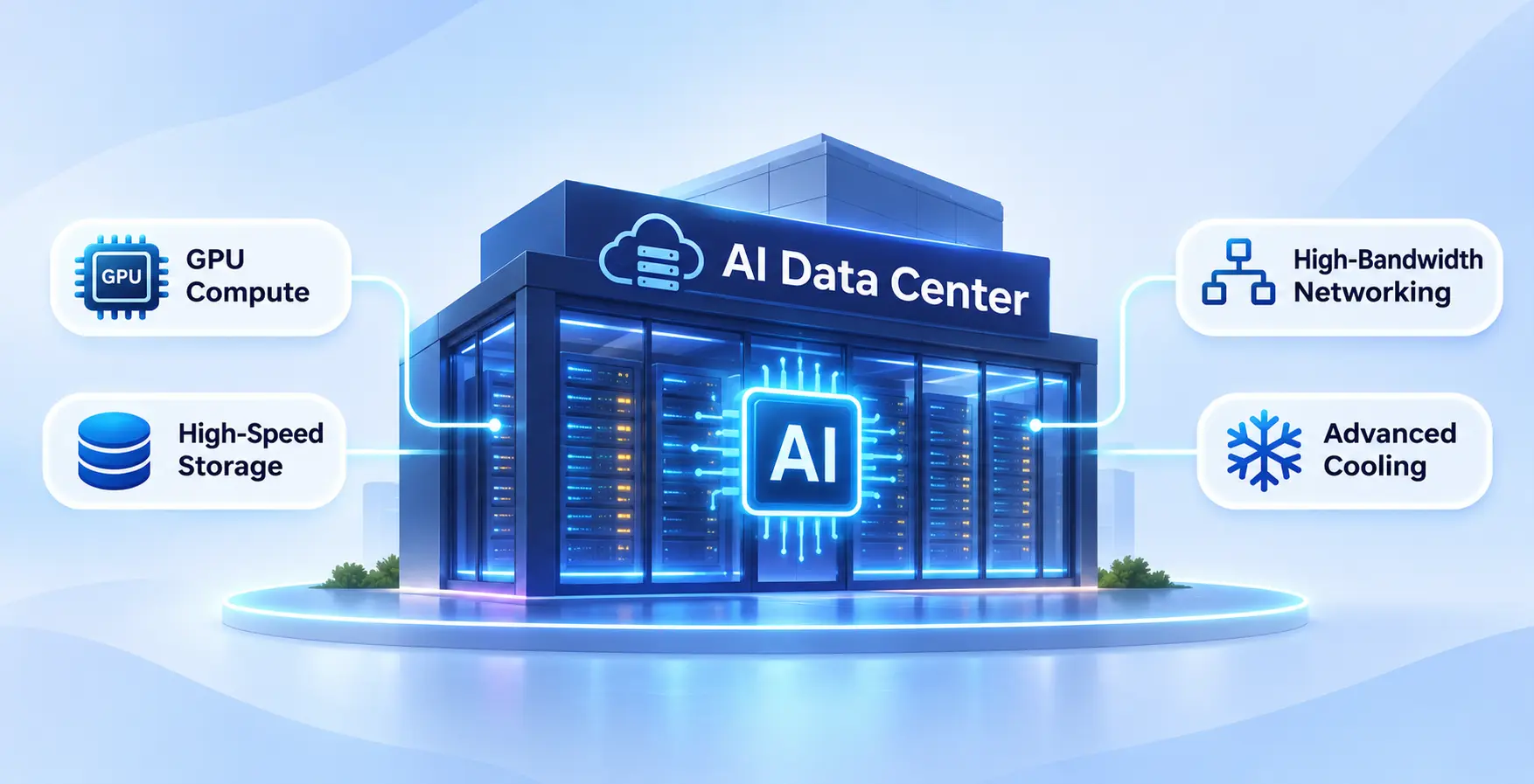
An AI data center combines multiple infrastructure components to support AI workloads:
- GPU Computing: High-performance GPUs and AI accelerators perform parallel calculations required for AI model training and inference.
- High-Speed Storage: Storage systems provide rapid access to large datasets, model files, and training checkpoints.
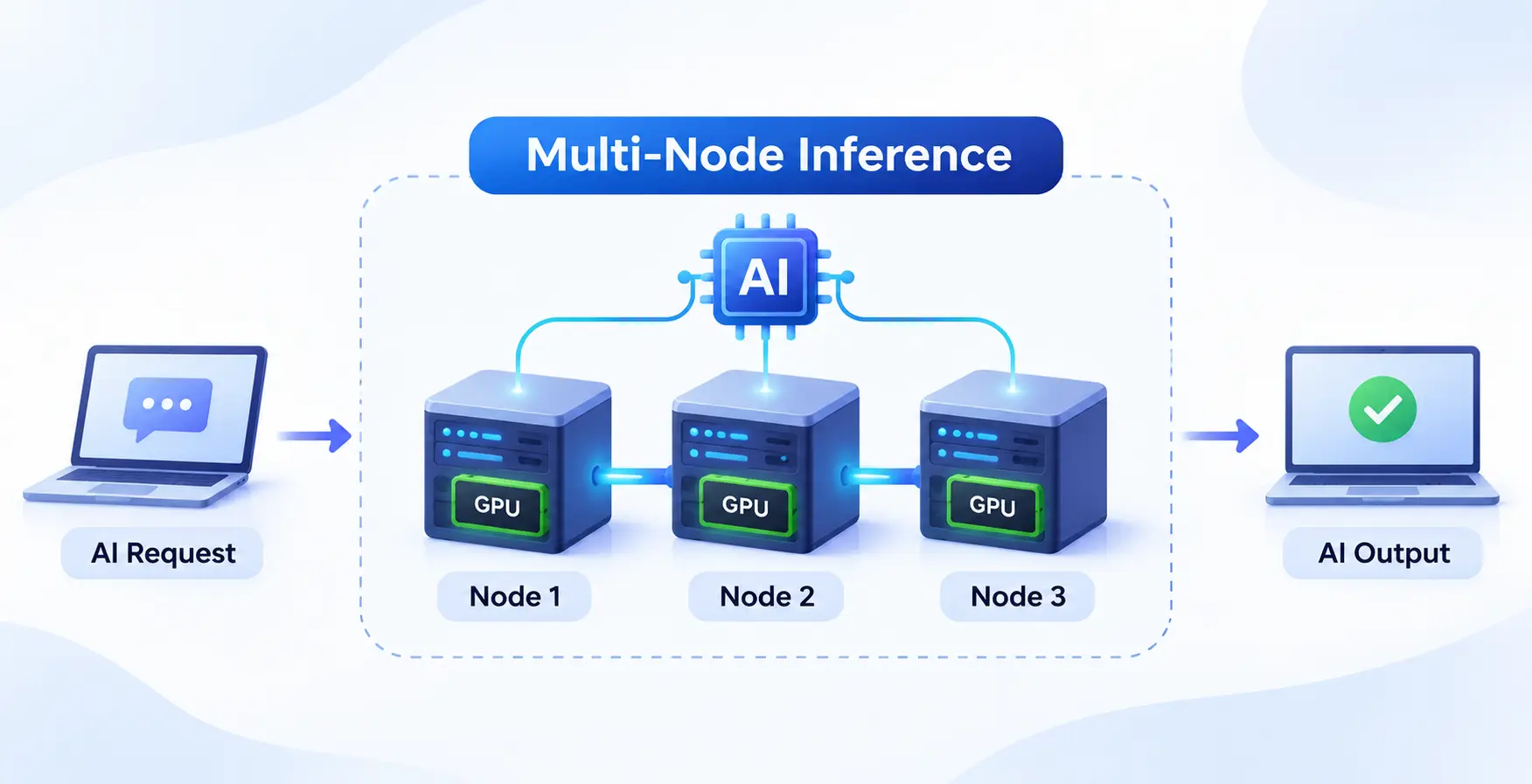
- High-Bandwidth Networking: Technologies such as InfiniBand and high-speed Ethernet enable fast communication between interconnected GPU servers.
- Advanced Cooling: Liquid cooling and high-efficiency air cooling systems manage the significant heat generated by AI hardware.
- Power Infrastructure: High-capacity power distribution systems provide reliable electricity to energy-intensive AI servers.
These components work together to support distributed AI workloads across multiple servers.
Key Features of an AI Data Center
- High-Performance Computing: Uses GPU clusters and specialized processors to accelerate AI workloads.
- Scalable Infrastructure: Supports expansion of computing, networking, and storage resources as AI demands grow.
- Low-Latency Networking: Enables efficient data transfer between GPUs and computing nodes.
- Advanced Thermal Management: Maintains optimal operating temperatures for high-density AI hardware.
- High Power Density: Accommodates server racks with substantially greater power requirements than conventional IT infrastructure.
AI Data Center vs. Traditional Data Center
| Feature | Traditional Data Center | AI Data Center |
| Primary Purpose | General IT applications | AI training and inference |
| Computing Hardware | Primarily CPUs | GPUs and AI accelerators |
| Network Requirements | Standard enterprise networking | High-bandwidth, low-latency networking |
| Cooling | Primarily air cooling | Advanced air and liquid cooling |
| Power Density | Generally lower | Typically much higher |
| Workloads | Websites, databases, applications | LLMs, machine learning, generative AI |
Applications of AI Data Centers
AI data centers support a wide range of applications, including:
- Generative AI: Training and running models that generate text, images, audio, and video.
- Large Language Models: Supporting AI assistants, chatbots, and enterprise LLM applications.
- Machine Learning: Processing large datasets for predictive analytics and model development.
- Autonomous Systems: Supporting AI development for robotics, autonomous vehicles, and intelligent systems.
- Scientific Research: Accelerating AI-driven simulations, drug discovery, and complex data analysis.
Why Are AI Data Centers Important?
As AI models grow in size and complexity, traditional computing infrastructure may struggle to meet their processing, memory, and networking requirements.
AI data centers provide the specialized infrastructure needed to train, deploy, and scale advanced AI applications. They help organizations handle demanding workloads while improving computational efficiency and resource utilization.
However, their deployment requires careful planning around power consumption, cooling capacity, infrastructure costs, and operational efficiency.
In simple terms, an AI data center is a purpose-built computing facility that combines powerful GPUs, fast networking, high-speed storage, and advanced cooling to run demanding AI applications at scale.