What is a GPU?
A GPU, or graphics processing unit, is a specialized processor built to handle many calculations at the same time. It was originally designed to render images and video quickly. But that same ability, doing thousands of simple calculations in parallel, is exactly what makes GPUs so effective for AI, machine learning, and other heavy computational workloads today.
That shift, from a graphics-only chip to the backbone of modern AI, is why GPUs have become one of the most in-demand pieces of hardware in computing.
GPU in a computer
Inside a computer, a GPU handles anything visually or computationally intensive. Rendering graphics, decodes video, or runs the parallel math behind AI models. It works alongside the CPU, which handles the computer’s general, everyday operations. A computer without a dedicated GPU still has some graphics capability, but it’s built into the CPU itself and is far less capable for demanding tasks like gaming, video editing, or AI workloads.
GPU vs CPU
This is the most common question about GPUs, and the difference comes down to how each processor is built to work:
| CPU | GPU | |
| Design | Few, powerful cores | Thousands of smaller, simpler cores |
| Best at | Sequential tasks, one complex operation at a time | Parallel tasks, many simple operations at once |
| Example | Running your operating system, general app logic | Rendering graphics, training AI models |
A useful way to think about it is that a CPU is like a few highly skilled workers who can each handle a complex task alone. A GPU is like thousands of workers who each do a simple task, but do it at the same time. For workloads that can be broken into many small, similar calculations, like matrix multiplication in AI, that parallel approach is dramatically faster.
Is a GPU RAM?
No, a GPU is a processor, the chip that does the calculations. It’s a completely different component from RAM, which is memory used for temporarily storing data. That said, GPUs do have their own dedicated memory, called VRAM (video RAM), which is separate from your computer’s main system RAM.
VRAM stores the data the GPU needs close at hand, like textures for rendering or the model weights during AI training, so the GPU isn’t constantly waiting on slower system memory.
Is a GPU a graphics card?
Not exactly, though the terms get used interchangeably. The GPU is the actual processing chip. The graphics card is the full hardware unit that contains the GPU, along with VRAM, cooling, and the connectors needed to plug it into a computer. So a graphics card has a GPU on it, the same way a motherboard has a CPU on it, but the two terms technically refer to different things.
Is NVIDIA a GPU or CPU?
NVIDIA is a company, not a processor type, but it’s best known for designing GPUs. NVIDIA doesn’t manufacture general-purpose CPUs the way Intel or AMD does; its business is built almost entirely around GPUs, from consumer graphics cards to the data center GPUs (like the H100 and H200) that power most large-scale AI training today.
Types of GPU
- Integrated GPU: Built directly into the CPU. Handles basic graphics but isn’t suited for demanding workloads.
- Discrete (dedicated) GPU: A separate chip with its own memory, used for gaming, video production, and AI. Far more powerful than integrated GPUs.
- Data center GPU: Built specifically for large-scale computing in servers, not for driving a display at all. This is the category cloud GPU instances (like NVIDIA’s H100, H200, and L4) fall into.
How a GPU runs
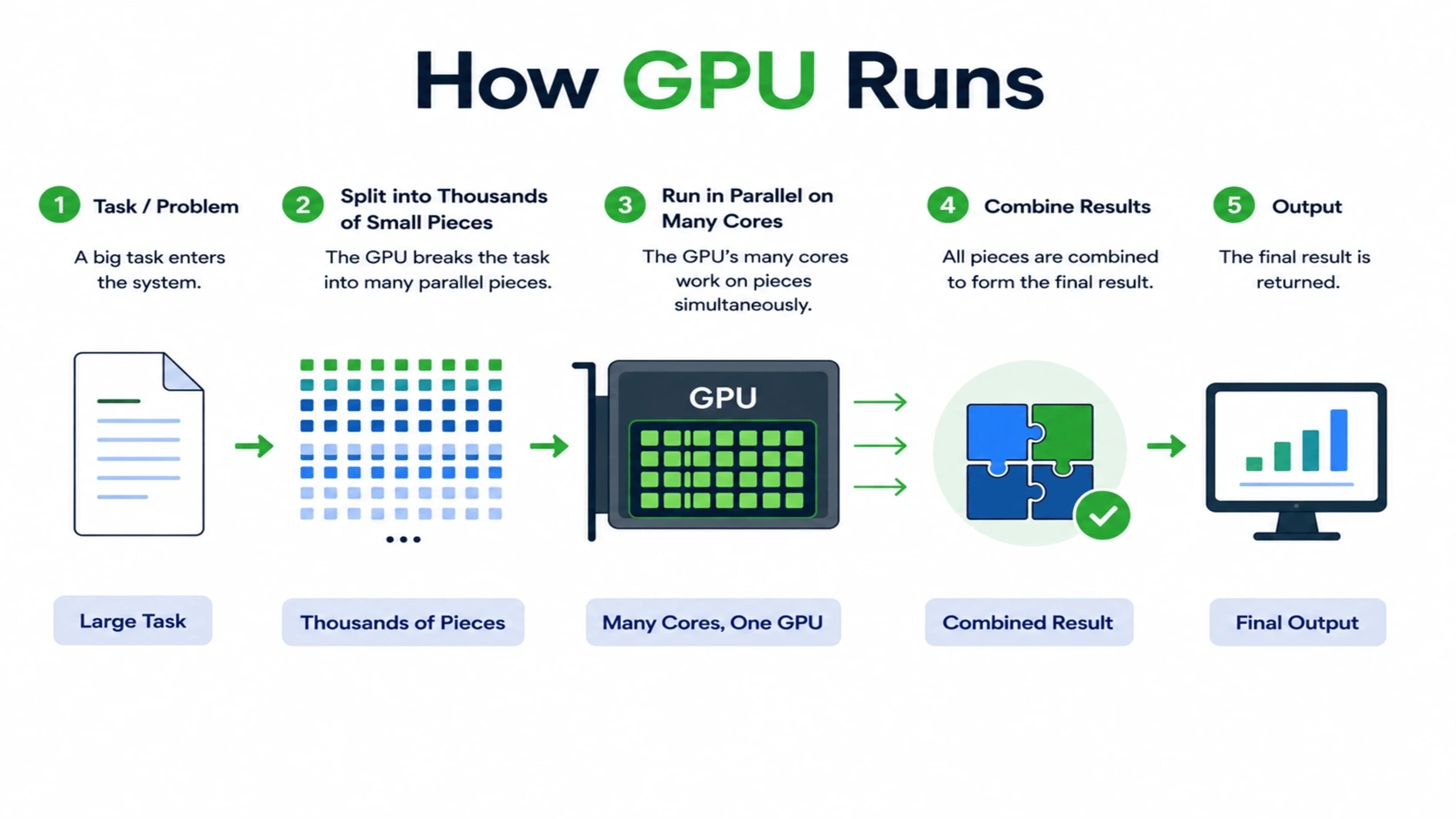
A GPU processes tasks by splitting them into thousands of smaller pieces and running them across its many cores simultaneously, rather than working through them one at a time. Software frameworks like NVIDIA’s CUDA let developers write code that takes advantage of this parallel structure directly. This is exactly how AI training frameworks like PyTorch and TensorFlow get their speed on GPU hardware.
GPU in AI
AI, especially deep learning, involves enormous numbers of repetitive mathematical operations, mainly matrix multiplication, done across huge datasets. That’s precisely the kind of workload GPUs are built for.
Training a large model on a CPU alone could take months; the same job on GPUs can often be done in days or hours, because thousands of calculations happen in parallel instead of one after another. This is why virtually every modern AI breakthrough, from image recognition to LLMs, has depended on GPU hardware.
GPU use cases
- AI training and inference: Training large models and running them in production.
- Gaming and rendering: The GPU’s original use case, still core to how it’s marketed today.
- Video editing and 3D rendering: Speeding up effects, exports, and rendering pipelines.
- Scientific computing: Simulations in fields like physics, chemistry, and genomics that rely on heavy parallel computation.
- Cryptocurrency mining: An earlier, now smaller, use case that also relied on GPU parallelism.