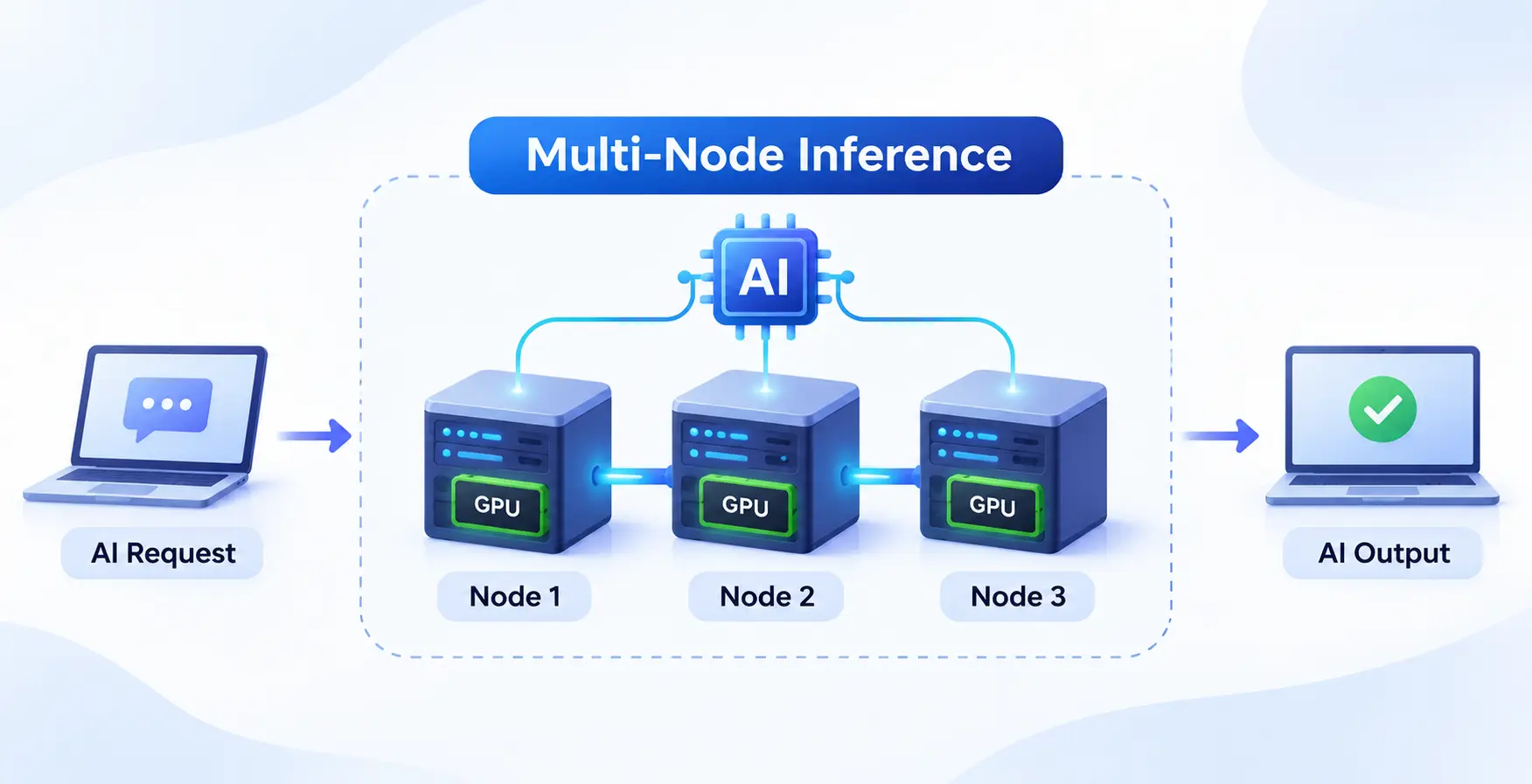
Multi-Node Inference is the process of running an artificial intelligence (AI) model across multiple interconnected computing nodes or servers to generate predictions, responses, or outputs. Instead of relying on a single machine, multi-node inference distributes AI workloads across several servers, often equipped with high-performance GPUs, to improve scalability, processing capacity, and performance.
This approach is particularly useful for large language models (LLMs), generative AI applications, and complex deep learning models that require more computing power or GPU memory than a single server can provide.
How Does Multi-Node Inference Work?
In a multi-node inference environment, multiple servers work together to process AI inference requests. These servers communicate through high-speed networks to share workloads and exchange data.
Multi-node inference generally operates using two approaches:
1. Model Parallelism: A large AI model is divided across multiple GPUs or servers. Each node processes a portion of the model, allowing models that exceed the memory capacity of a single server to run efficiently.
2. Data Parallelism: Multiple servers host copies of the same AI model and process different inference requests simultaneously. This increases overall throughput and supports more concurrent users.
Technologies such as NVIDIA GPUs, high-speed InfiniBand networking, and distributed inference frameworks help coordinate communication and workload distribution between nodes.
Benefits of Multi-Node Inference
- Improved Scalability: Organizations can add computing nodes to accommodate growing AI workloads.
- Higher Throughput: Multiple servers can process more inference requests simultaneously.
- Support for Large AI Models: Models requiring substantial GPU memory can operate across multiple machines.
- Better Resource Utilization: Workloads can be distributed across available GPU resources.
- Greater Availability: With appropriate redundancy and load balancing, inference services can continue operating if an individual node fails.
Multi-Node Inference vs. Single-Node Inference
| Feature | Single-Node Inference | Multi-Node Inference |
| Infrastructure | One server | Multiple interconnected servers |
| GPU Resources | Limited to one server | Distributed across servers |
| Scalability | Limited by server capacity | Expandable by adding nodes |
| Model Size | Limited by local memory | Supports larger distributed models |
| Complexity | Relatively simple | Requires distributed orchestration |
Use Cases of Multi-Node Inference
Multi-node inference is commonly used in:
- Large Language Models: Running large AI models for chatbots, coding assistants, and enterprise AI applications.
- Generative AI: Supporting image, video, and multimodal content generation.
- Enterprise AI Services: Processing large volumes of concurrent inference requests.
- Scientific Computing: Running complex AI models for research, simulations, and data analysis.
Why Is Multi-Node Inference Important?
As AI models become larger and inference demands increase, a single GPU server may not provide sufficient memory or processing capacity. Multi-node inference enables organizations to scale AI infrastructure beyond individual server limitations.
However, distributing inference across servers introduces network communication overhead, making high-bandwidth, low-latency interconnects essential for efficient performance.
In simple terms, multi-node inference allows multiple servers to work together to run AI models that are too large or demanding for a single machine, enabling scalable AI deployments.