What is a data center?
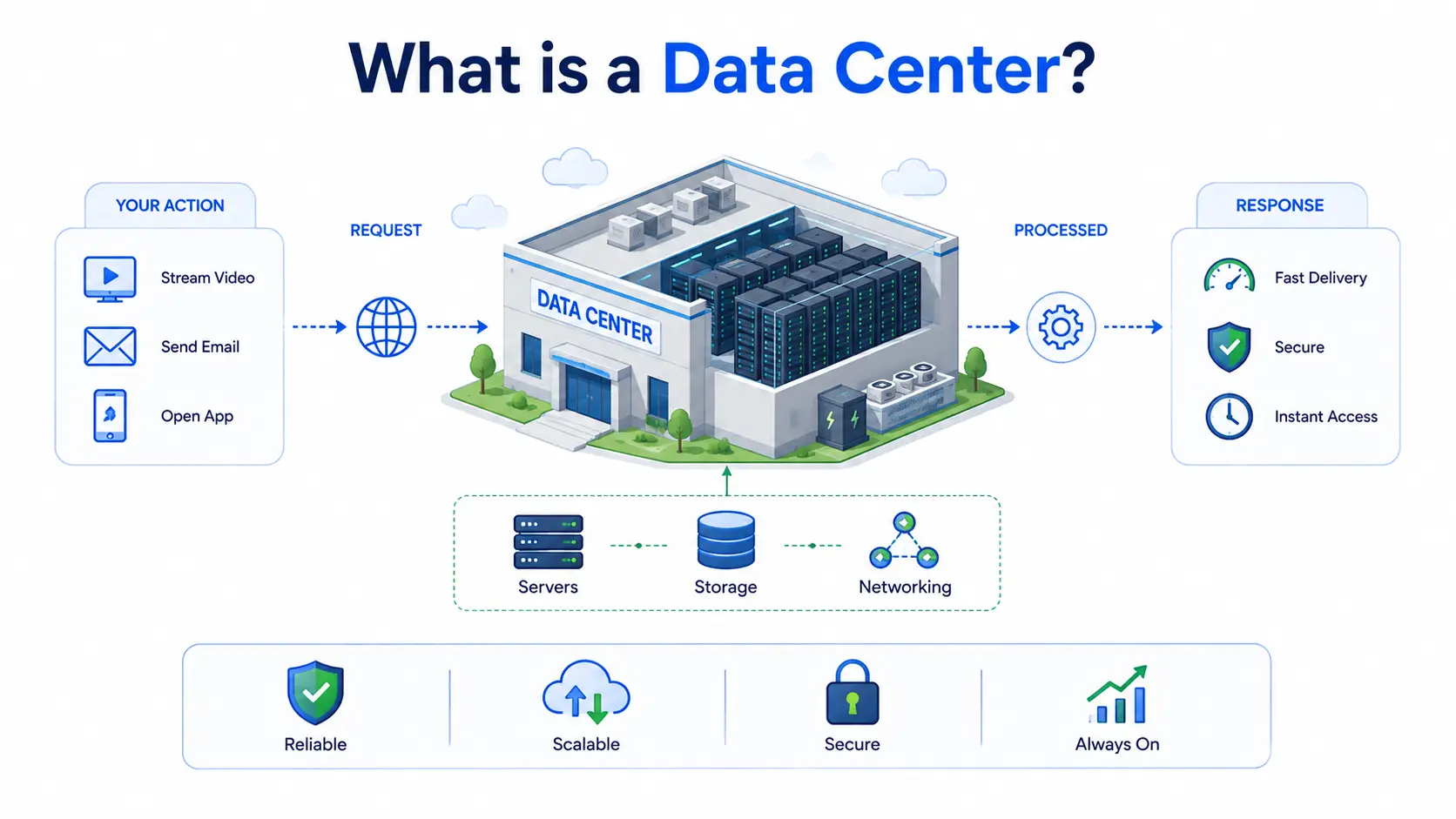
A data center is a physical facility that houses the servers, storage, and networking equipment needed to run applications, websites, and cloud services. Every time you stream a video, send an email, or open an app, a request travels to servers sitting in a data center somewhere, gets processed, and sends a response back, usually in a fraction of a second.
Think of it as the physical building behind “the cloud.” Cloud computing feels invisible, but it all runs on real hardware, sitting in real buildings, in real locations.
What exactly does a data center do
- Hosts servers: Runs the physical machines that store data and run applications.
- Provides power and cooling: Servers generate significant heat and need constant, reliable power. Data centers are built specifically to manage both at scale.
- Ensures connectivity: High-speed network connections link the data center to the internet and to other data centers.
- Maintains security: Physical security (access control, surveillance) and network security protect the hardware and the data on it.
- Provides redundancy: Backup power, duplicate network paths, and failover systems keep things running even if one component fails.
The 4 types of data centers
- Enterprise data centers: Owned and operated by a single company, exclusively for its own use. Common among large banks and enterprises that want full control.
- Colocation data centers: A facility where multiple companies rent space, power, and cooling for their own servers, without owning the building itself.
- Managed services data centers: A third party manages the infrastructure and, often, the servers themselves on a company’s behalf.
- Cloud data centers: Massive facilities run by cloud providers, where compute and storage are offered on demand, without customers owning or managing any physical hardware directly. This is what powers services like CloudPe, AWS, or Azure.
Data center cost
Building a data center is capital-intensive; land, power infrastructure, cooling systems, and networking all add up before a single server is even installed. Costs vary enormously by scale, from smaller regional facilities to hyperscale campuses. This is exactly why most businesses don’t build their own data centers anymore.
Renting infrastructure from a cloud or colocation provider turns a massive upfront cost into a predictable, ongoing operating expense.
Data center cost
Building a data center is capital-intensive; land, power infrastructure, cooling systems, and networking all add up before a single server is even installed. Costs vary enormously by scale, from smaller regional facilities to hyperscale campuses. This is exactly why most businesses don’t build their own data centers anymore.
Renting infrastructure from a cloud or colocation provider turns a massive upfront cost into a predictable, ongoing operating expense.
Data center examples
The following are data center examples:
- Hyperscale facilities: Massive campuses run by cloud giants like AWS, Google Cloud, and Microsoft Azure, often spanning hundreds of thousands of square feet.
- Colocation providers: Companies rent out space in shared facilities.
- Regional/national providers: Data centers built specifically to serve a country’s businesses with local latency and data residency, which is where India-based providers fit in.
Data centers in India
India’s data center capacity is growing fast, concentrated mainly around Mumbai, which alone accounts for over half the country’s total capacity, followed by Chennai. Several major new campuses are under construction as of 2026, including Reliance’s large-scale project in Jamnagar and Google’s data center investment in Andhra Pradesh, both aimed at supporting the growing demand for AI infrastructure.
Among facilities already operational, Yotta’s NM1 campus in Navi Mumbai is widely cited as one of the largest currently running in the country. Given how quickly new capacity is coming online, “the largest” is a title that’s likely to keep changing over the next few years.
Are data centers dangerous?
Not in the way that phrase might suggest. The real concerns are high electricity and water consumption for cooling, and local strain on power grids in areas with many facilities clustered together.
Reputable data centers follow strict safety standards for fire suppression, electrical systems, and physical security. The bigger conversations in the industry right now are around energy use and sustainability, not physical danger to nearby communities.