What is hybrid cloud?
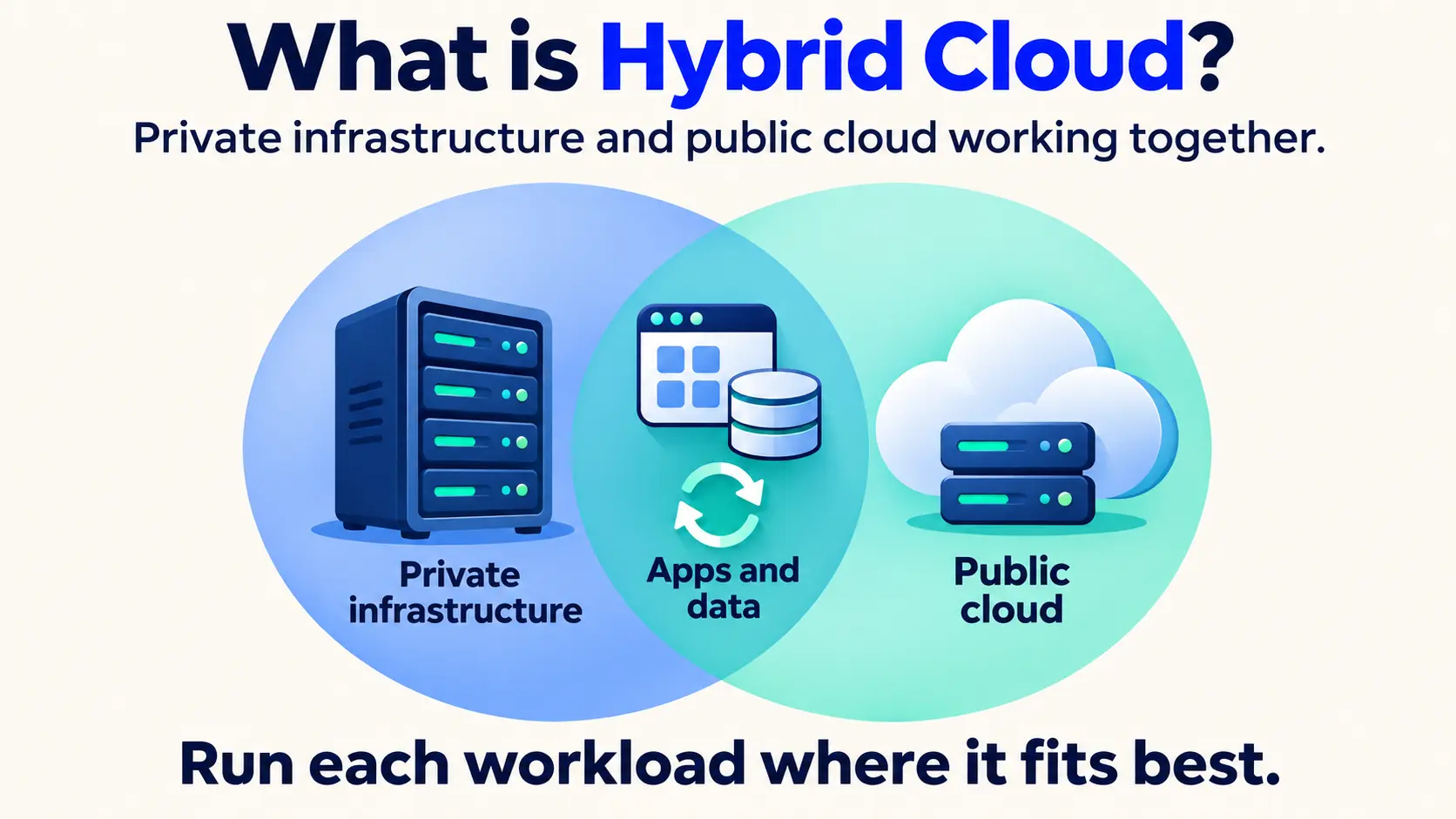
Hybrid cloud is a setup that combines private infrastructure, such as your own servers or a private cloud, with a public cloud, and lets the two work together as one environment. Data and applications can move between them, so each workload runs in the place that suits it best.
Think of owning a home and also renting a hall when you host a big event. You keep your daily life at home, and you use the hall only when you need more space.
How hybrid cloud works
In a hybrid cloud, your private environment and your public cloud are connected through a secure link. This can be a VPN, a dedicated network connection, or private peering. Management tools then let you run workloads across both sides in a consistent way.
A common pattern looks like this:
- Sensitive systems and data stay in the private environment, where you control them fully.
- Flexible or fast-growing workloads run in the public cloud, where capacity can scale on demand.
- A secure connection links the two, so applications can share data between them.
Hybrid cloud architecture
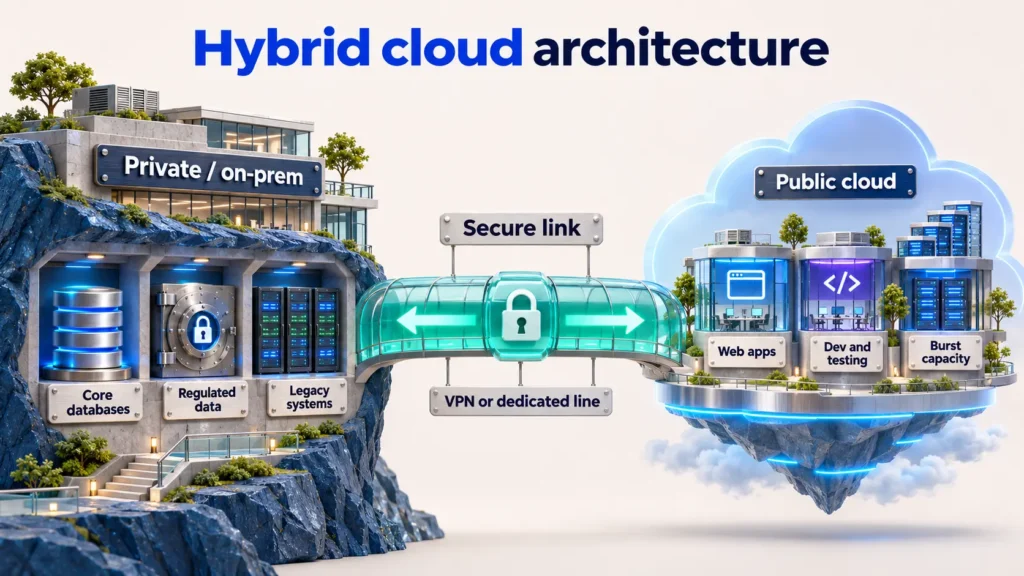
Inside the public cloud side, teams usually place resources in a private network space, such as a VPC, and control access with firewall rules.
Hybrid cloud vs public cloud vs private cloud
| Public cloud | Private cloud | Hybrid cloud | |
| Who owns the infrastructure | The provider | One organization | A mix of both |
| Upfront cost | Low | High | Medium |
| Control | Shared with the provider | Full | Full on private side, shared on public side |
| Scaling | Fast and flexible | Limited by owned hardware | Burst to public cloud when needed |
| Best for | Most workloads, variable demand | Strict control or compliance needs | Mixing sensitive and flexible workloads |
Hybrid cloud vs multi-cloud
These two terms get mixed up often:
| Term | What it means |
| Hybrid cloud | Public cloud combined with private or on-premises infrastructure |
| Multi-cloud | Using two or more public cloud providers |
A company using only AWS and Azure is multi-cloud, but not hybrid. A company using one public cloud alongside its own data center is hybrid, but not multi-cloud. A company using both can be both at once. Our multi-cloud architecture entry covers the second case.
Benefits of hybrid cloud
- Flexibility: Put each workload where it fits best, by cost, speed, or control.
- Scalability on demand: Use public cloud capacity for traffic peaks without buying extra hardware.
- Better control over sensitive data: Keep regulated or critical data in a private environment.
- Gradual cloud adoption: Move to the cloud step by step, without a risky all-at-once migration.
- Use existing investments: Keep hardware and software you already own, instead of replacing everything.
- Resilience: Run backups or failover in the other environment, so one outage does not stop everything.
Drawbacks to consider
- Complexity: Running two environments means more tools, more skills, and more to manage.
- Integration effort: Connecting private and public sides securely takes careful setup.
- Network dependence: The link between them affects latency and needs enough bandwidth.
- Security gaps: More connection points mean more places to protect.
- Cost tracking: Spending is split across two environments, which makes it harder to see the full picture.
Common hybrid cloud use cases
- Regulated industries: Banks, insurers, and healthcare firms keep sensitive records in a private environment and run customer-facing apps in the public cloud.
- Cloud bursting: Run normal load on private infrastructure and spill extra demand into the public cloud during peaks, such as a festival sale.
- Disaster recovery: Keep a backup environment in the public cloud, ready to take over if the main site fails.
- Gradual migration: Move applications to the cloud one at a time while legacy systems keep running.
- Data residency needs: Keep certain data in-country or on private systems, while using public cloud for everything else.
- AI and analytics: Keep sensitive training data private and rent GPU cloud power for heavy training runs.
What is cloud bursting
Cloud bursting is a hybrid cloud technique. Your app runs on private infrastructure by default. When demand goes past what that infrastructure can handle, extra traffic automatically moves to the public cloud. When the peak ends, the extra capacity shuts down. You pay for the added capacity only while you use it.
What you need to run a hybrid cloud
- A secure, reliable connection between private and public environments.
- Consistent management tools so you can see and control both sides together.
- Compatible technology, often through containers with Docker and a Kubernetes cluster, so workloads can run in either place.
- Unified security and access control across both environments.
- Clear rules for which workloads and data go where.
Is hybrid cloud right for you?
Hybrid cloud makes sense if you have systems that must stay private, need to keep existing hardware in use, or want to move to the cloud gradually. If you have no such limits, a single public cloud is usually simpler and cheaper to run. Hybrid works best when there is a clear reason for each side, not just a wish to have both.
Where hybrid cloud fits
Hybrid cloud is one of the main deployment models of cloud computing. It connects your own data center or private servers with public cloud resources such as virtual machines, object storage, and load-balanced applications.