What is an IPsec VPN?
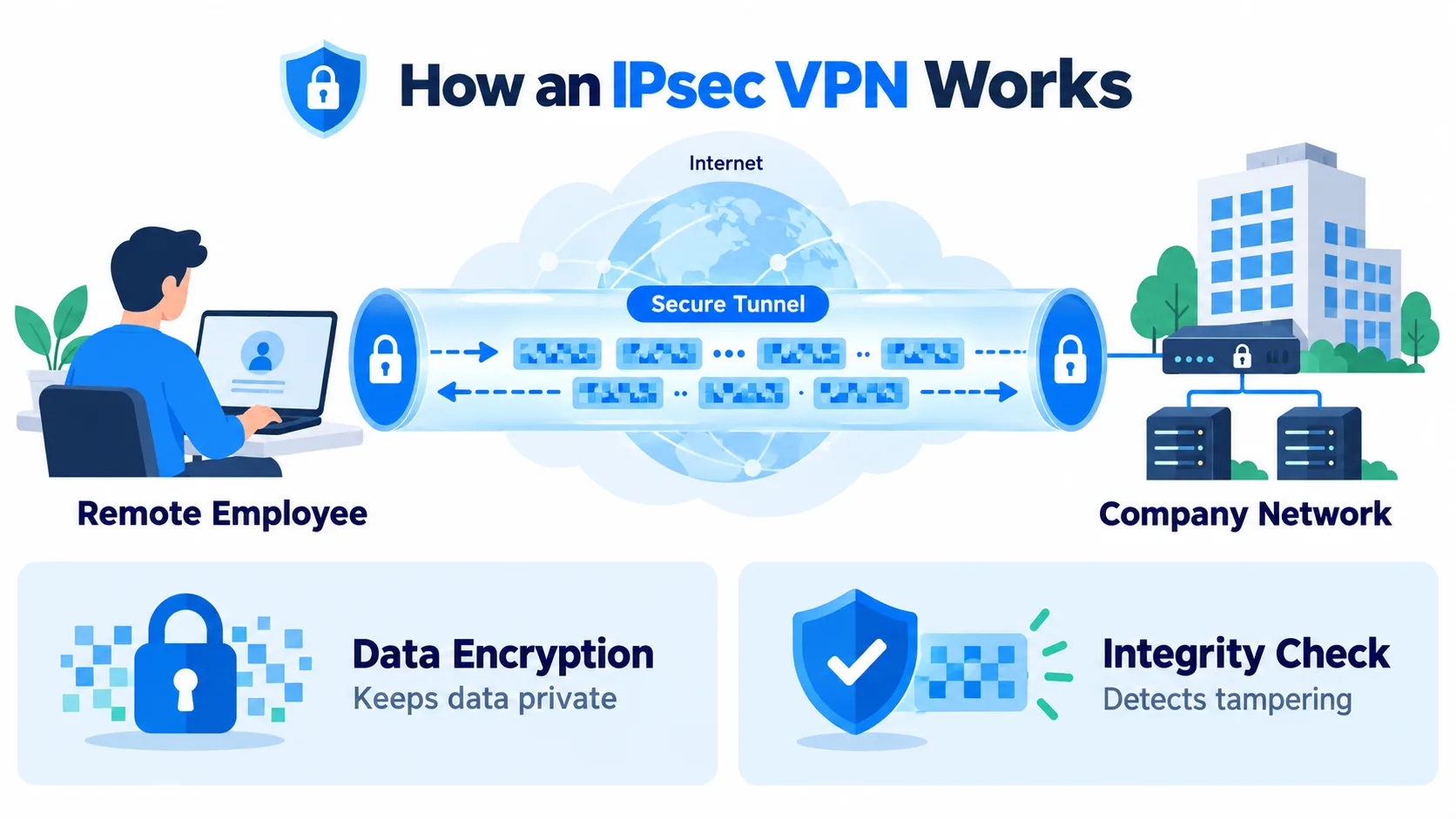
IPsec (short for Internet Protocol Security) is a group of protocols that encrypts and authenticates data as it travels over a network. An IPsec VPN uses these protocols to create a secure, private tunnel between two points, such as a remote employee’s laptop and a company network, or two office locations.
In plain terms: it scrambles your data so that anyone intercepting it along the way can’t read it, and it checks that the data hasn’t been tampered with.
History of IPsec
IPsec is older than most people realize, and it grew out of real security concerns from the early internet.
The timeline of IPsec is below:
- 1986–1991: The NSA funds early research into internet security protocols through a program called SDNS, laying some of the technical groundwork.
- 1993: A protocol called swIPe becomes one of the first serious attempts to encrypt data at the IP layer, the foundation IPsec would later build on.
- Mid-1990s: The IETF formalizes IPsec as an open standard, officially starting development in 1996.
- Late 1990s–2000s: IPsec is paired with another protocol, L2TP, to create L2TP/IPsec. This combination becomes the standard way businesses run VPNs for over a decade.
- 2000s: IPsec earns a reputation for being powerful but complicated to set up and maintain, a criticism that follows it for years.
- 2010s: A newer version, IKEv2/IPsec, improves on this. It handles mobile connections well, keeping a VPN alive when a phone switches from WiFi to cellular data.
- Mid-2010s onward: Simpler protocols like WireGuard emerge as lighter alternatives, but IPsec remains common in enterprise, government, and carrier networks.
Recent trends in IPsec VPNs
IPsec hasn’t gone away. It’s adapting to newer threats and newer competition. The following are the recent trends in IPsec VPNs:
- Post-quantum encryption is arriving: strongSwan, a widely used IPsec implementation, now supports a hybrid post-quantum key exchange, something most rival protocols can’t yet match without extra workarounds.
- It’s the protocol of choice for mobile roaming: Thanks to a feature called MOBIKE, IKEv2/IPsec can keep a connection alive as a device switches networks, which is why many governments and mobile carriers rely on it.
- Multi-factor authentication is becoming standard: Logging into an IPsec VPN with just a password is increasingly seen as insufficient on its own.
- Competition from simpler protocols is growing: WireGuard has become the default choice for many newer VPN services because it’s faster and easier to set up, pushing IPsec providers to compete on depth of security and compliance features instead.
- Zero trust is reshaping how VPNs are used: Rather than granting broad network access once connected, newer setups increasingly pair IPsec with stricter, continuous identity checks.
How IPsec works
Below is how IPsec works:
- Two devices or networks agree to set up a secure connection.
- They negotiate a shared set of encryption keys, usually through a process called IKE (Internet Key Exchange).
- Once the keys are in place, outgoing data gets encrypted and wrapped in a new IP packet.
- The encrypted packet travels across the public internet or network.
- The receiving device uses the shared keys to decrypt the data and verify it hasn’t been altered.
- The original, readable data is passed along to its destination.
The two modes of IPsec
Below are the two modes of IPsec:
- Transport mode: Encrypts only the data inside a packet, leaving the original header visible. Typically used for direct connections between two devices.
- Tunnel mode: Encrypts the entire packet, including the header, and wraps it inside a new one. This is the mode most VPNs use, since it hides more information about the original traffic.
IPsec vs other VPN protocols
Below is the comparison table of IPsec vs other VPN protocols
| IPsec / IKEv2 | WireGuard | OpenVPN | |
| Introduced | Mid-1990s | 2016 | 2001 |
| Speed | Fast, strong for mobile roaming | Fastest, lightweight | Slower than both |
| Setup complexity | More complex | Simple | Moderate |
| Post-quantum readiness | Native support in some implementations | Needs an added workaround | Varies by provider |
| Common use | Enterprise, government, mobile carriers | Modern consumer and business VPNs | Older or legacy VPN setups |
Where IPsec VPNs are used
The following are IPsec VPN use cases:
- Site-to-site connections: Linking two office networks securely over the internet, as if they were on the same local network.
- Remote access: Letting employees connect to internal company systems from home or while traveling.
- Mobile and carrier networks: Keeping connections stable and secure as devices move between networks.
- Regulated industries: Finance, healthcare, and government bodies often use IPsec because it’s a well-established, widely audited standard.