What is multi-cloud architecture?
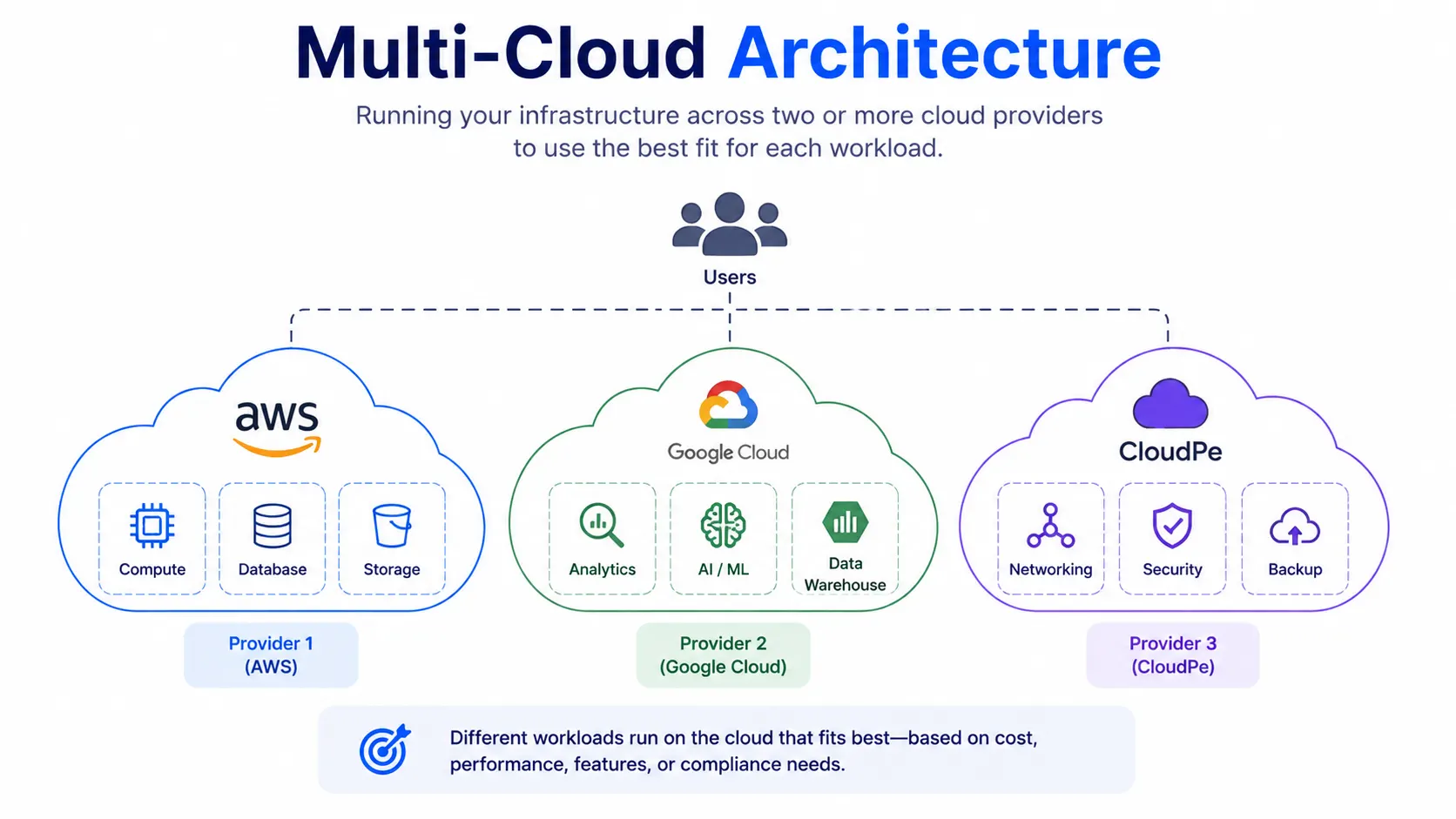
Multi-cloud architecture means running your infrastructure across two or more cloud providers instead of relying on just one, for example, using AWS for compute and Google Cloud for data analytics. Instead of putting everything in one provider’s ecosystem, workloads are split, or duplicated, across multiple clouds based on cost, performance, or risk.
The goal is usually one of three things: avoiding dependence on a single vendor, using each provider’s strengths, or meeting data residency and compliance requirements that a single cloud can’t satisfy alone.
The four types of cloud architecture
Multi-cloud is one of four broad ways companies structure their cloud infrastructure:
- Public cloud: Everything runs on one third-party provider’s infrastructure, shared with other customers (like a standard AWS or Azure setup).
- Private cloud: Infrastructure is dedicated to a single organization, either on-premises or hosted privately.
- Hybrid cloud: A mix of public cloud and private/on-premises infrastructure, working together.
- Multi-cloud: Multiple public cloud providers used together, instead of relying on just one.
These aren’t mutually exclusive. A company can run a hybrid cloud that also happens to use two different public cloud providers, making it hybrid and multi-cloud at once.
Multi-cloud vs hybrid cloud
This is the most common mix-up:
| Multi-cloud | Hybrid cloud |
| Using two or more public cloud providers (e.g., AWS + Azure + CloudPe) | Using a public cloud alongside private or on-premises infrastructure |
A company using only AWS and Azure is multi-cloud but not hybrid. A company using AWS alongside its own private data center is hybrid but not multi-cloud. Using AWS, Azure, and a private data center together is both.
Multi-cloud vs cross-cloud
These terms sound similar but describe different levels of integration:
- Multi-cloud: Different workloads run on different clouds, often independently, with little or no direct interaction between them.
- Cross-cloud: Workloads and data actively connect and operate across clouds, functioning as one integrated system rather than separate pieces.
Most companies that say they’re “multi-cloud” are really just using different providers for different, mostly separate purposes, not running one unified cross-cloud system.
Is Netflix multi-cloud?
No. Netflix runs the vast majority of its computing on AWS, and has publicly stated it, including in its own SEC filings, that switching away from AWS isn’t something it can do easily. Netflix briefly tested a multi-cloud setup in 2018 before committing fully to a single provider. It’s often used as the go-to example of a large company deliberately choosing a single-cloud strategy over multi-cloud, for the sake of simplicity.
Multi-cloud examples
- Cost optimization: Running compute-heavy workloads on the provider with cheaper compute pricing, while storing data with another for cheaper storage rates.
- Best-of-breed tools: Using AWS for core infrastructure, but Google Cloud specifically for its BigQuery analytics or AI/ML tools.
- Compliance and data residency: Keeping data in an India-based cloud provider to meet local regulations, while using a global provider for other, non-regulated workloads.
- Disaster recovery: Running a backup environment on a second cloud provider, so a full outage at one provider doesn’t take your entire application down.
Multi-tenant vs multi-cloud
Don’t confuse these two. Multi-tenant architecture means multiple customers share the same application instance and infrastructure, with their data kept logically separate, common in SaaS products. Multi-cloud is about which infrastructure providers you use, not how you separate customers. A single-tenant application can still run on multi-cloud infrastructure, and a multi-tenant SaaS app can run on just one cloud provider.
Why companies choose multi-cloud
- Avoiding vendor lock-in: Not being fully dependent on one provider’s pricing or policies.
- Resilience: If one provider has a major outage, workloads on other providers keep running.
- Regulatory requirements: Some industries or countries require data to stay within specific regions or providers.
- Negotiating leverage: Being able to credibly threaten to move workloads elsewhere.
The trade-off
Multi-cloud isn’t free. It usually means more complexity: different tools, different billing systems, and teams that need to understand more than one provider’s quirks. That’s why companies like Netflix and Spotify have chosen to stay on a single cloud rather than add that overhead, while others accept the complexity in exchange for the flexibility.