What is an AI cluster?
An AI cluster is a group of connected servers, called nodes, that work together as a single system to train or run AI models. Each node typically has one or more GPUs, along with CPUs, memory, and storage.
Technically, even two connected GPUs form a cluster, but in practice, when people say “AI cluster,” they usually mean something much larger: multi-node setups with dozens, hundreds, or even thousands of GPUs working together.
Why a single GPU isn’t enough
Modern AI models, especially large language models, are too big and too data-hungry for one machine to train in a reasonable amount of time. A single GPU has limits on memory and processing power, and training a large model on it alone could take weeks or months. Splitting the work across many GPUs, spread across many nodes, is what makes training these models practical.
Key components of an AI cluster
Below are the key components of an AI cluster:
- GPU nodes: individual servers, each equipped with one or more GPUs, plus CPUs, memory, and local storage.
- Head node: manages the cluster, schedules jobs, and coordinates how work is assigned across the other nodes.
- Worker nodes: carry out the actual compute-heavy work, like training or inference.
- High-speed interconnects: technologies like InfiniBand and NVLink that let nodes and GPUs exchange data quickly, without becoming a bottleneck.
- Storage layer: fast, tiered storage that keeps training datasets and model checkpoints readily available to every node.
How work gets distributed across a cluster
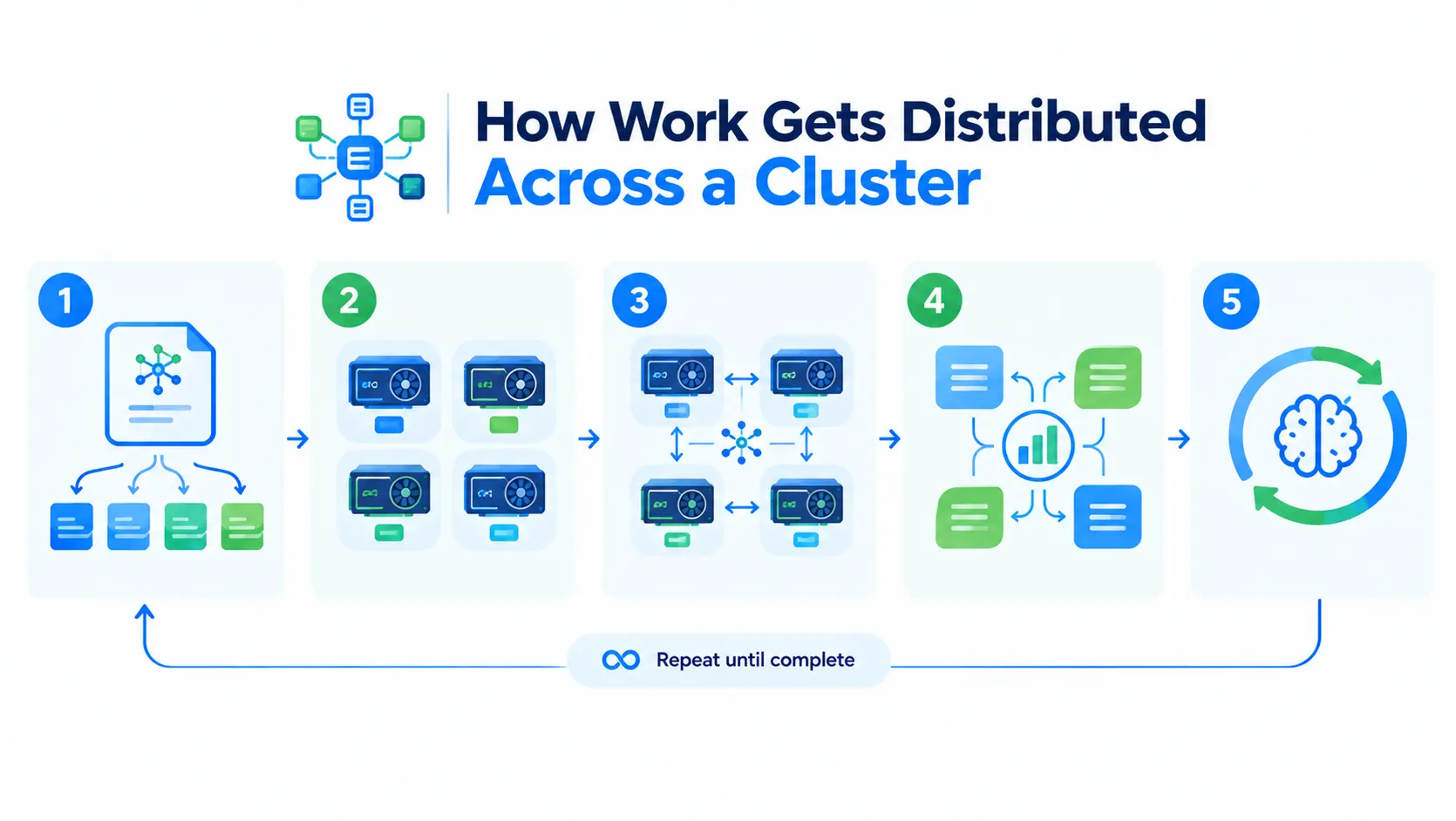
Below are the pointers that explain how work gets distributed across a cluster:
- A large task, like training a model, is split into smaller pieces.
- Each piece is assigned to a different node or GPU, and all of them run at the same time.
- Nodes constantly communicate over the interconnect to keep their work in sync.
- Results from each node are combined, or “aggregated,” to move the overall training process forward.
- This cycle repeats continuously until training is complete.
Where AI clusters came from
Here’s the year map of where AI clusters:
- 2012, the turning point: AlexNet demonstrated that GPUs could train deep neural networks dramatically faster than CPUs, a result widely credited with starting the shift toward GPU-based AI infrastructure.
- Early GPU training was still slow: training GoogleNet, a well-known image recognition model, took 21 days on a single GPU, which is part of why the push toward multi-GPU and multi-node setups began.
- 2020, the A100 era: the NVIDIA A100 made large-scale distributed training genuinely practical, and became the generation of GPU widely used to train the models behind early versions of ChatGPT.
- Today: leading AI models are commonly trained on clusters exceeding 10,000 GPUs, a scale that didn’t exist a decade earlier.
AI cluster vs traditional CPU cluster
Let’s look at AI cluster vs traditional CPU cluster below:
- Processing style: CPUs handle tasks mostly one after another; GPUs handle thousands of operations at once, which suits the repetitive math behind AI training.
- Best fit: CPU clusters are well suited to general-purpose and sequential workloads; AI clusters are built specifically for the parallel, matrix-heavy computation AI models require.
- Scale of use: AI clusters are purpose-built around interconnects and storage tuned for constant, high-volume data exchange between GPUs, something typical CPU clusters aren’t optimized for.
Common use cases
Below are the common use cases of AI clusters:
- Training AI models: building large language models and other deep learning models from scratch.
- Fine-tuning: adapting an existing model to a specific task, which needs less compute than full training but still benefits from a cluster.
- Large-scale inference: serving AI models to many users at once, at speed.
- High-performance computing (HPC): scientific simulations, rendering, and other compute-intensive workloads outside of AI.