People use “AI” and “ML” interchangeably all the time, and most of the time it genuinely doesn’t matter. Someone says “we’re building an AI product” and everyone nods along.
It starts to matter the moment you’re deciding what to build it on. The difference between AI and ML isn’t just semantics. It changes what hardware you need, what your training pipeline looks like, and what your monthly infrastructure bill ends up being. A rule-based chatbot and a fine-tuned language model both get called “AI” in a pitch deck. They cost wildly different amounts to actually run.
Here’s the actual difference, and the part most explainers skip entirely: what it means for the infrastructure underneath it.
What is AI?
AI is the broad goal, not a specific technique. It’s the umbrella term for any system built to act intelligently, reasoning, solving problems, understanding language, recognising patterns.
That umbrella covers a lot of ground. A simple if-then thermostat that adjusts itself based on room temperature counts as AI, technically. So does a chess engine running hand-coded rules. So does a voice assistant that answers your questions, and so does a large language model writing an essay. Wildly different in sophistication, all under the same umbrella, because they’re all trying to do the same thing: act smart.
The oldest form of AI didn’t need any data at all. A developer wrote the rules directly: if this happens, do that. No learning involved, just logic.
What is ML?
Machine learning is one specific way of building AI, not the only way. Instead of a developer writing the rules by hand, an ML system works the rules out itself, from data.
Feed it enough examples of spam and non-spam email, and it learns the patterns that separate the two. Feed it purchase history, and it learns what a customer is likely to buy next. Nobody wrote “if the email contains this word, mark it as spam.” The system found that pattern on its own, the same way Netflix or Spotify’s recommendation engines learn your taste without anyone hand-coding your preferences.
That’s the actual shift ML represents. Not smarter code written by a smarter developer. Code that writes its own rules by finding patterns in data, and keeps updating them as more data comes in.
AI vs ML: the key differences
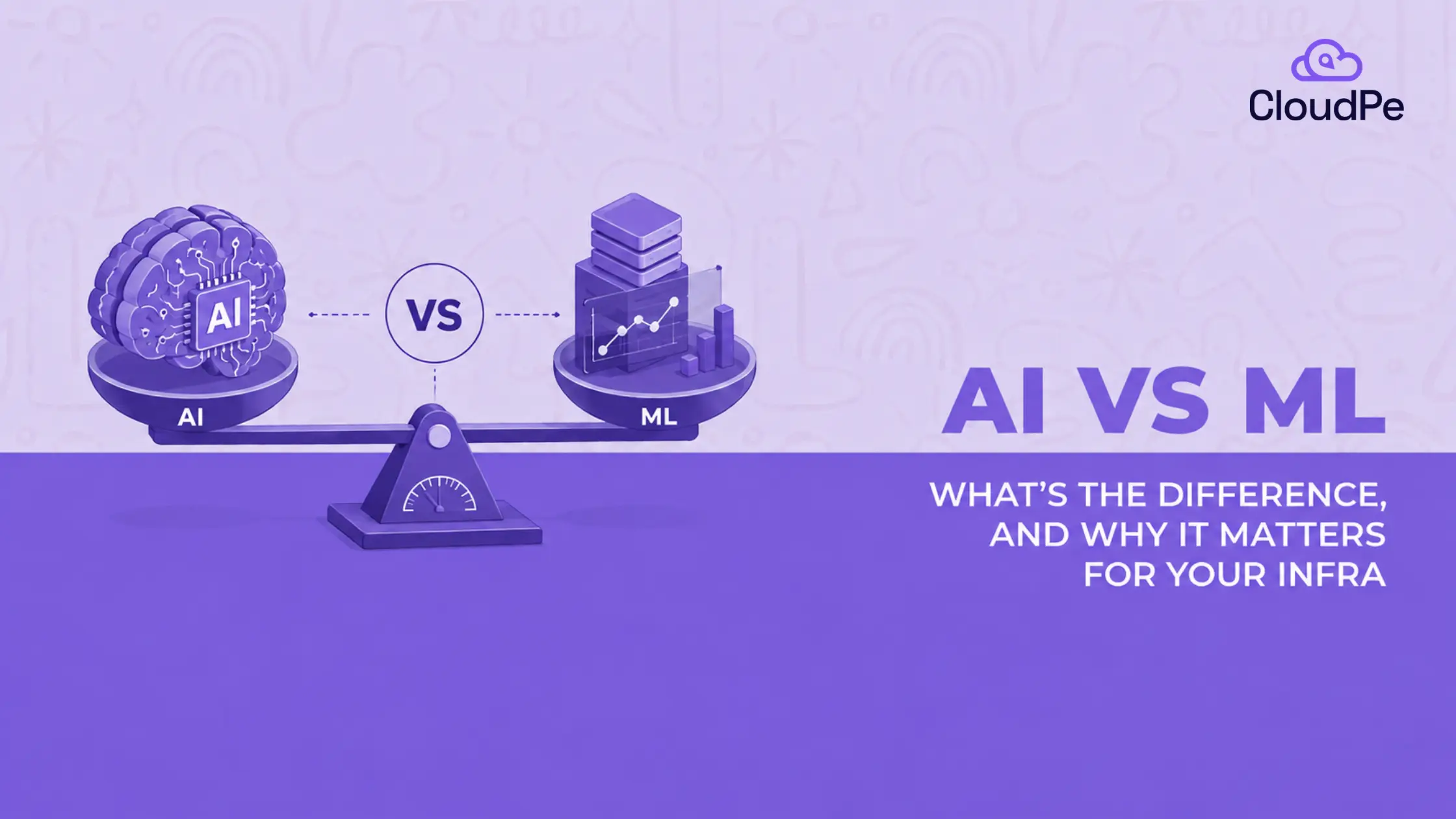
AI is the destination. ML is one route to get there, currently the most popular one. Here’s where they actually split.
| AI (in general) | ML (specifically) | |
| Scope | The full goal: any system that acts intelligently | One method within that goal |
| Approach | Can be hand-written rules, no data required | Learns patterns from data, no manual rules |
| Example | A rule-based chess engine, a thermostat | A spam filter, a recommendation engine |
| Improves with use? | Only if a developer rewrites the rules | Yes, usually, more data means better accuracy |
| Compute needs | Minimal, rules run fine on ordinary CPUs | Scales with data and model size, often needs GPUs |
That last row is the one this piece actually cares about, and it’s the one every other explainer skips. Rule-based AI runs fine on hardware you probably already have. ML, especially at any real scale, changes what you need to provision. More on that below.
The confusion between the two terms isn’t really anyone’s fault. Most AI products today are built using ML, so in casual conversation the words end up doing the same job. The distinction only bites when you move from talking about the product to actually building or provisioning for it.
If you want to see what running an actual ML workload looks like end to end, CloudPe’s AI/ML solutions page walks through it.
Where does deep learning fit in?
Deep learning is a specific kind of ML, not a separate category sitting next to it. It uses neural networks with many layers, structures loosely inspired by how neurons connect in a brain, to catch patterns too complex for simpler ML techniques to find.
A basic ML model might predict house prices from square footage and location, a handful of clear variables. A deep learning model can look at a photo and recognise what’s in it, or generate a paragraph of coherent text. Same underlying idea, learning from data, just with a lot more layers, and a lot more data required to get there.
More layers means more parameters to train, and more parameters is exactly where the infrastructure story changes. We’ll get to that.
Is ChatGPT AI or ML?
Both, technically, and this is actually a good way to see how the terms nest inside each other.
ChatGPT is an AI system. Under the hood, it’s built using deep learning, which is a type of machine learning, which is one method of building AI. So when someone asks whether it’s AI or ML, the honest answer is that it’s AI, built with ML, using deep learning specifically, at a scale of parameters most ML models never approach.
This is the pattern for almost every modern AI product you’ve heard of. AI at the product level, ML underneath, often deep learning specifically once you get past a certain scale.
AI vs ML vs data science
Data science isn’t a subset of AI or ML. It’s a separate discipline that overlaps with both.
Data science is broadly about extracting insight from data: statistics, analysis, visualisation, decision-making. ML is one of the tools a data scientist reaches for, particularly for prediction tasks. AI is the broader goal that some of that data science and ML work eventually feeds into.
Think of it this way. A data scientist might use ML to build a churn-prediction model, and that model might power a customer-retention feature that gets marketed as “AI-powered.” The three overlap constantly in practice. They’re just answering different questions.
Check current GPU options on CloudPe if you’re at the point of actually building one of these models.
Why this distinction actually matters for your infrastructure
Here’s the part that actually affects a budget or a deployment decision, and it’s the part most AI vs ML explainers never get to.
Rule-based AI, the if-then kind, runs on whatever server you already have. There’s no training involved, no GPU required, no data pipeline to build. If your “AI feature” is really a set of business rules, a standard VM handles it without breaking a sweat.
Machine learning changes that equation the moment training enters the picture. Training a model means processing large datasets repeatedly, adjusting the model’s parameters each pass, and that’s compute-intensive work. A CPU handles it slowly. A GPU handles the same job significantly faster, since GPUs are built to run thousands of these calculations in parallel instead of one after another. This is where “we’re doing ML” quietly turns into “we need GPU compute,” not just “we need a bigger server.”
Deep learning raises the stakes again. Bigger models, more layers, more parameters, and all of it needs GPU memory as much as raw speed. A model that needs 40GB of memory just to load won’t run on a card that has less than that, no matter how patient you are.
So the practical version of “what’s the difference between AI and ML” looks something like this:
- Rule-based AI → standard compute, no GPU needed
- Traditional ML, smaller models on structured data → a mid-range GPU, something like an A100, handles training comfortably
- Deep learning and large models → high-memory GPUs like the H100 or H200, where the extra memory is the actual point, not extra speed
CloudPe runs the full range, from standard VMs for rule-based systems through A100, H100, H200, and L4 GPU instances for everything from ML training to production inference. [See CloudPe’s GPU and AI/ML infrastructure →]
A quick way to place your own project:
- No learning from data, just logic → standard VM, no GPU needed
- Training on structured data, moderate model size → mid-range GPU like an A100
- Deep learning, large models, high memory needs → H100 or H200-class GPU
Knowing where your project actually sits on that spectrum, before you provision anything, saves you from two expensive mistakes: overpaying for GPU power a rules engine never needed, or underpowering a training job that needed serious memory from day one.
Get started with CloudPe GPU cloud
See GPU PricingFrequently Asked Questions
What is the difference between AI and ML with an example?
AI is the goal, ML is one method to reach it. A spam filter that learns from examples of spam is ML. A chess engine following rules a developer wrote by hand is AI, but not ML, since it never learns from data.
Are AI and ML the same or different?
Different, but related. ML is a subset of AI, not a synonym for it. All ML is AI, but not all AI is ML.
Is ChatGPT AI or ML?
Both. It’s an AI system built using deep learning, which is a specialised type of machine learning.
Can ML work without AI?
Not really, ML exists as a method for building AI systems, so it doesn’t operate as a separate goal on its own. Every ML model is, by definition, a piece of AI.
Do AI and ML engineer roles differ?
In practice, the titles overlap heavily and vary by company. An “ML engineer” title usually signals a stronger focus on model training and data pipelines specifically, while “AI engineer” is often used more broadly.
Which came first, AI or ML?
AI, by decades. The term “artificial intelligence” dates back to the 1950s, built almost entirely on hand-written rules at first. Machine learning grew out of AI research once researchers started asking whether systems could learn those rules from data instead of being told them directly.